
Amazon Dropshipping Guide 2026: The Risks, The Rules, and The Smarter Alternative
The allure of Amazon dropshipping is powerful, but strict policies and the risk of account suspension turn the dream into a nightmare for many. This guide exposes the hidden dangers of the retail arbitrage model and reveals why Print on Demand (POD) - powered by intelligent automation - is the safer, scalable alternative that smart sellers are switching to in 2026.
Bullet Points (TL;DR)
Understand the Policy: Amazon strictly forbids dropshipping from other retailers (like Walmart) where you are not the seller of record.
Evaluate the Risk: Traditional dropshipping carries high suspension risks; FBA requires high capital. POD offers a balanced, low-risk alternative.
Own Your Brand: Unlike selling generic cables, Print on Demand allows you to build a defensible brand with unique designs.
Automate Everything: Use Listybox to turn design assets into thousands of listings in minutes, not weeks.
Secure Your Future: Building a POD store on Etsy (with potential for Amazon) using white-label fulfillment is the smartest long-term play.
The promise of Amazon dropshipping is intoxicating: huge traffic, no inventory, and the dream of passive income. It sounds like the perfect business model. You list a product, a customer buys it, and a third party ships it. You keep the difference. Simple, right?
Unfortunately, in 2026, the reality is far more complex and dangerous. While the concept remains attractive, Amazon’s tightening grip on seller policies has turned the "retail arbitrage" style of dropshipping into a minefield. One wrong move - one package arriving in a Walmart box - and your business could vanish overnight.
This guide acts as your radar through that minefield. We will explore the strict rules of Amazon dropshipping, compare it to the FBA model, and introduce a superior, compliant alternative - Print on Demand (POD) - that allows you to build a sustainable brand without the fear of suspension.
What is Amazon Dropshipping?
At its core, Amazon dropshipping is a fulfillment method where you, the seller, do not keep products in stock. Instead, when a store sells a product, you purchase the item from a third party and have it shipped directly to the customer.
However, there is a massive distinction between "legitimate" dropshipping and the risky tactics often promoted on YouTube. Legitimate dropshipping involves a contract with a wholesaler who ships products with your branding on the packing slip. Risky dropshipping (often called retail arbitrage) involves buying from another retailer (like AliExpress, Walmart, or Home Depot) and shipping it to the Amazon customer. This second method is where the trouble begins.
The Minefield: Amazon Dropshipping Policy & Risks
If you take nothing else from this guide, remember this term: Seller of Record.
Amazon’s policy is crystal clear. To dropship legally on their platform:
You must be the Seller of Record of your products.
You must identify yourself as the seller of your products on all packing slips, invoices, and external packaging.
You must remove any information identifying the third-party drop shipper prior to shipping.
You must be responsible for accepting and processing customer returns.
The "Walmart Box" Trap Imagine a customer orders a cable from you on Amazon for $20. You buy it from Walmart for $10 and ship it to them. When the package arrives, it's in a blue Walmart box with a receipt showing $10. The customer feels cheated and complains to Amazon.
This is the fastest way to get suspended. Amazon views this as a poor customer experience and a violation of their policy. Once suspended for this reason, reinstatement is notoriously difficult.
The Profit Margin Squeeze Beyond the risk of a ban, the economics of standard dropshipping are brutal. Because you are selling generic items that hundreds of other sellers have access to, you enter a "race to the bottom" on price. Our internal data suggests that the average net profit margin for a new Amazon dropshipper in the electronics niche is often less than 5% after ad spend.
Amazon FBA vs. Dropshipping: Choosing Your Battle
Many sellers debate between Fulfillment by Amazon (FBA) and dropshipping. Both have distinct profiles.
Capital Requirement
Amazon FBA: High. You must buy inventory upfront (often thousands of dollars worth) and ship it to Amazon's warehouses.
Dropshipping: Low. You only pay for the product after you make a sale.
Risk Factor
Amazon FBA: Inventory Risk. If your product doesn't sell, you are stuck with dead stock and long-term storage fees.
Dropshipping: Policy Risk. You carry zero inventory risk, but high operational risk regarding shipping times and policy compliance.
Sustainability
Amazon FBA: High. Amazon handles shipping, so your metrics stay healthy.
Dropshipping: Low to Medium. You are at the mercy of your supplier's shipping speed. Late shipments can tank your "Order Defect Rate" (ODR).
The Smarter Alternative: Print on Demand (POD)
If the risks of Amazon dropshipping sound stressful, there is a better way. The Print on Demand (POD) model combines the "no inventory" benefit of dropshipping with the legitimacy of a real brand.
In POD, you sell custom-designed products (t-shirts, mugs, decor). When a sale happens, a manufacturing partner prints your design and ships it. Crucially, professional POD partners ship white label. This means the package looks like it came from you, complying perfectly with the "Seller of Record" policy.
Why POD Wins
Brand Ownership: You aren't selling generic cables; you are selling your designs.
High Margins: Custom products command higher prices.
Safety: You comply with marketplace policies by default.
Unleashing the Power of Automation
Whether you choose to sell on Amazon, Etsy, or both, the manual work of listing products is the bottleneck. This is where the right tools change the game.
Meet Sarah: A Cautionary Tale Turned Success
Meet Sarah, an aspiring entrepreneur who wanted to leave her 9-to-5.
Her goal was simple: launch an e-commerce store to generate passive income.
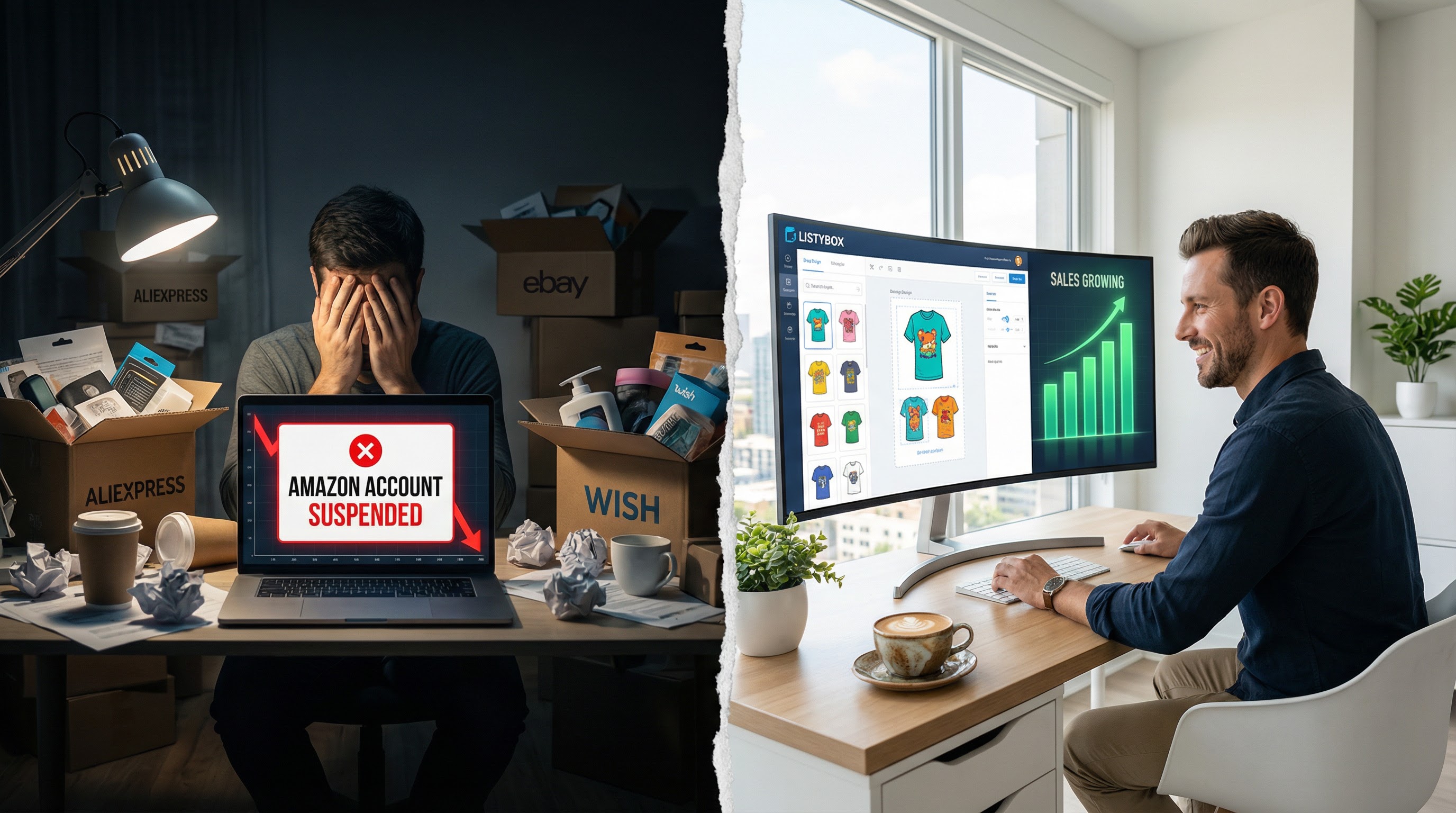
Sarah started with the "retail arbitrage" dropshipping method on Amazon. She spent her evenings manually copying customer addresses from Amazon to a spreadsheet and buying items from a big-box retailer. It was grueling. Then, the inevitable happened. A customer reported receiving a package with a competitor's invoice. Amazon suspended Sarah’s account, freezing $2,000 of her funds for 90 days. The dream seemed over.
Then, Sarah discovered the Print on Demand model and Listybox.
She realized she could use the Creation Wizard to take her graphic designs and instantly generate hundreds of unique products. Instead of risking her account with shady dropshipping, she was building a legitimate brand. When an order came in, Zero-Touch Order Management automatically routed it to the printer.
Before Listybox, Sarah was an anxious clear-out shopper living in fear of suspension. After Listybox, she became the owner of a self-running design brand, with her weekends finally free.
How Listybox Powers Your POD Empire
While Listybox is currently the ultimate weapon for Etsy sellers, its architecture is built for the multi-channel future, including Amazon integration potential. By centralizing your operations on Listybox, you create a "source of truth" for your products.
1. Scale with the Creation Wizard Manual listing creation is a recipe for burnout. With the Creation Wizard, you can apply your artwork to t-shirts, hoodies, and mugs simultaneously. Our data shows that sellers who use bulk creation tools launch 5x more products in their first month than those who list manually.
2. Dominate Search with Magic Wand Getting found is half the battle. Instead of guessing keywords, use the Magic Wand SEO tool. It analyzes market data to write high-converting titles and descriptions for you, ensuring your products appear in front of eager buyers.
3. Professionalism with ListyStyle In dropshipping, trust is everything. Generic mockups kill conversion rates. ListyStyle generates hyper-realistic lifestyle photos of your products, making your brand look like a Fortune 500 company without the photoshoot budget.
Ready to Launch? If the technical side of setting up a store feels overwhelming, you don't have to do it alone. With Listybox Store Setup, our expert team sets up your Etsy store, lists your first 10 products, and optimizes everything for SEO. This service is included FREE with annual Starter and Professional plans!
Amazon dropshipping is fraught with peril, but the underlying desire - passive income through e-commerce - is valid and achievable. By pivoting to the Print on Demand model and leveraging the automation power of Listybox, you build a business on rock-solid foundations, not on a policy loophole.
Start your free trial - no credit card required and transform your e-commerce journey today.
Never Miss an Update
Get actionable Etsy tips delivered to your inbox every week. No spam, unsubscribe anytime.