


Key takeaways
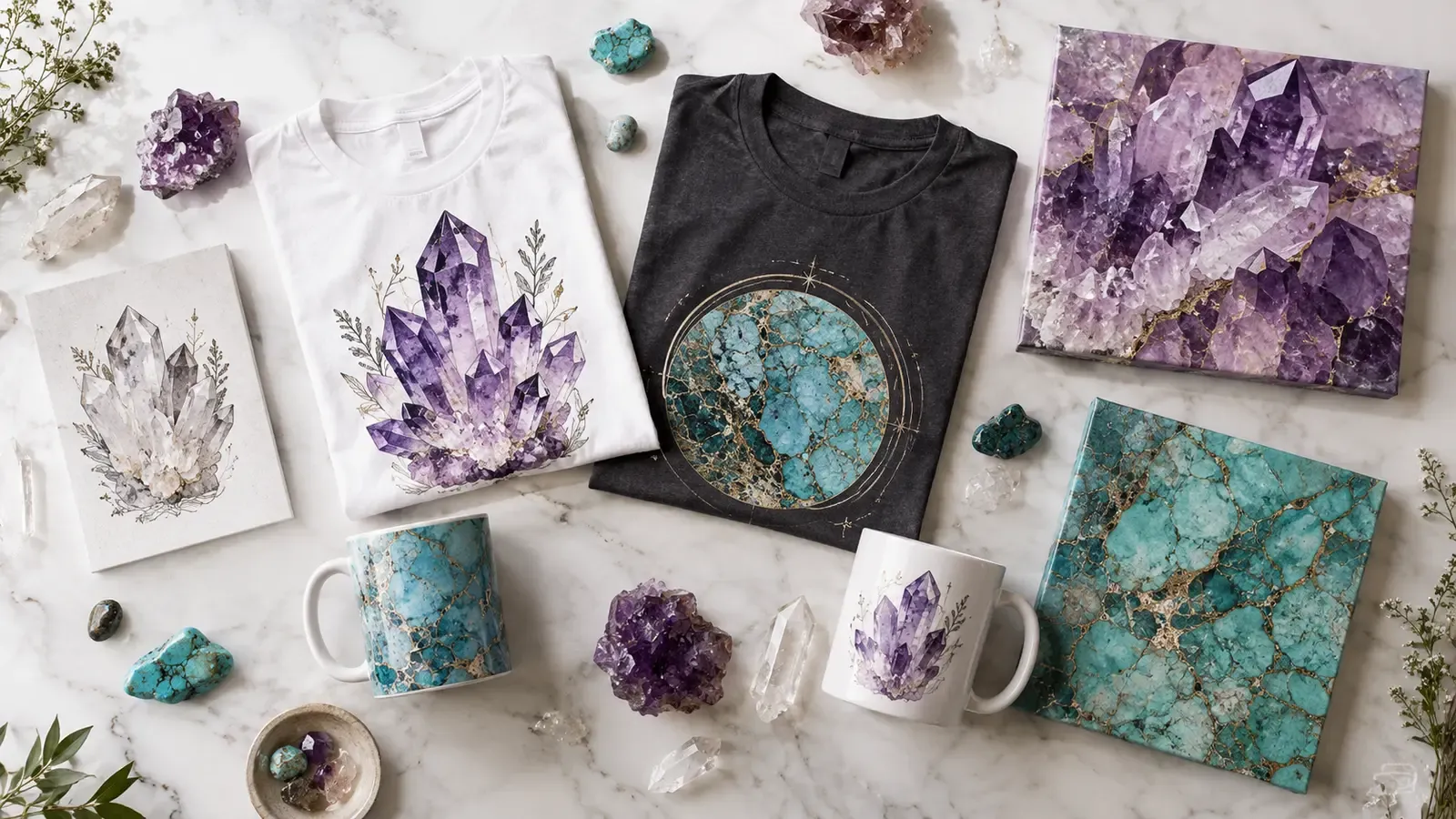
Niche cohesion matters: A successful gemstone line relies on visual consistency across different product types, not just a single great design.
The mockup bottleneck is real: Manually placing one design on 20 different products creates a visual mismatch that can make your shop look unprofessional.
SEO scales with structure: Writing unique, keyword-rich titles and tags for dozens of crystal-themed listings manually is the fastest path to burnout.
Visual consistency is automated: Tools like Listystyle analyze your gemstone design and generate realistic lifestyle scenes that match your niche.
You keep creative control: Editing placement, background, and descriptions is always in your hands, ensuring the final output matches your brand vision.
Lucas had a clear vision. He wanted to build a calming, spiritual brand on Etsy centered entirely around gemstones and crystals. His notebook was filled with ideas: “Amethyst Healing Energy” on a unisex hoodie, “Turquoise Protection” on a canvas tote bag, and a “Rose Quartz Love” framed print. He had the design files ready, exported from his favorite graphic software. He was excited to build a cohesive product line that felt like a real brand.
But when Lucas sat down to actually build the store, the excitement faded fast. He opened his production partner’s website and started uploading his first amethyst design. He selected a t-shirt. Then he had to manually select the t-shirt color, adjust the placement, and wait for the preview to render. He repeated this for a hoodie. Then a mug. Then a canvas print. By the time he finished his third design, he had spent his entire Saturday clicking the same buttons, and he hadn’t even started writing a single product title or description. The “cohesive brand” he dreamed of suddenly felt like a data-entry prison.
This is the reality of building a gemstone product line for Etsy. The niche is profitable and visually stunning, but the operational side can crush a seller’s creativity before they even make their first sale. This guide walks you through the practical steps to structure, design, and list a gemstone collection without letting the manual grind win.
How do I structure a gemstone product line for Etsy print on demand?
A common mistake new sellers make is treating a product line as a random assortment of items. A structured gemstone line is built on a “hub and spoke” model. The hub is your core design concept, and the spokes are the different product types. Lucas’s mistake was starting with the product first. The smarter approach is to start with the design collection.
Building a design-first collection
Before you even look at a product catalog, group your digital assets into themed collections. A gemstone niche naturally lends itself to this. You might have a “Chakra Collection” featuring seven specific stones, a “Zodiac Birthstone Collection,” or a “Raw Crystal Cluster” aesthetic. Each collection is a hub.
Once you have your collection theme, you define the spokes: the products. A robust gemstone line typically includes wearable items (t-shirts, hoodies), home decor (canvas prints, throw pillows), and accessories (tote bags, phone cases). The goal is to allow a buyer who loves “Labradorite” to outfit a large part of their life with that specific stone’s aesthetic. This strategy increases the average order value because the products feel curated, not random.
However, the technical hurdle appears immediately when you try to map one design to 15 different products. If you use a standard mockup generator, your “Blue Lace Agate” design might look perfect on a white t-shirt but completely distorted on a tall ceramic mug. The placement won’t match. You end up with a product line that looks disjointed. To see how a structured product catalog can simplify this, you can explore the Creation Wizard: Your Creativity Assembly Line. This feature lets you select multiple designs from your gemstone collection and multiple products simultaneously, combining them in bulk while you retain the ability to adjust individual placements.
💡 Practical tip: Start with a tight collection of 3 gemstone designs and 5 core products (t-shirt, hoodie, mug, canvas, tote). Master the workflow for this 15-product batch before expanding to 100 listings. This keeps your quality control high.
Selecting the right production partners
Your product line’s quality depends on the print providers you choose. For gemstone designs, which often feature subtle color gradients and fine crystal details, print quality is critical. You need a partner that handles vibrant color reproduction well. Direct-to-garment (DTG) printing is usually preferred for fabric, while sublimation works best for mugs and phone cases.
You don’t need to sign separate contracts with multiple factories. A print-on-demand integration handles this. Listybox’s Custom Product Hub lets you clone existing catalog products or create your own from scratch. If you have a specific, high-quality mug supplier you trust, you can set up that product with your own mockups and SKU, and it will work with the rest of the Listybox ecosystem. This means your gemstone line can include unique items that generic POD platforms don’t offer, giving you a competitive edge.
What are the hidden traps when creating matching product images for gemstone designs?
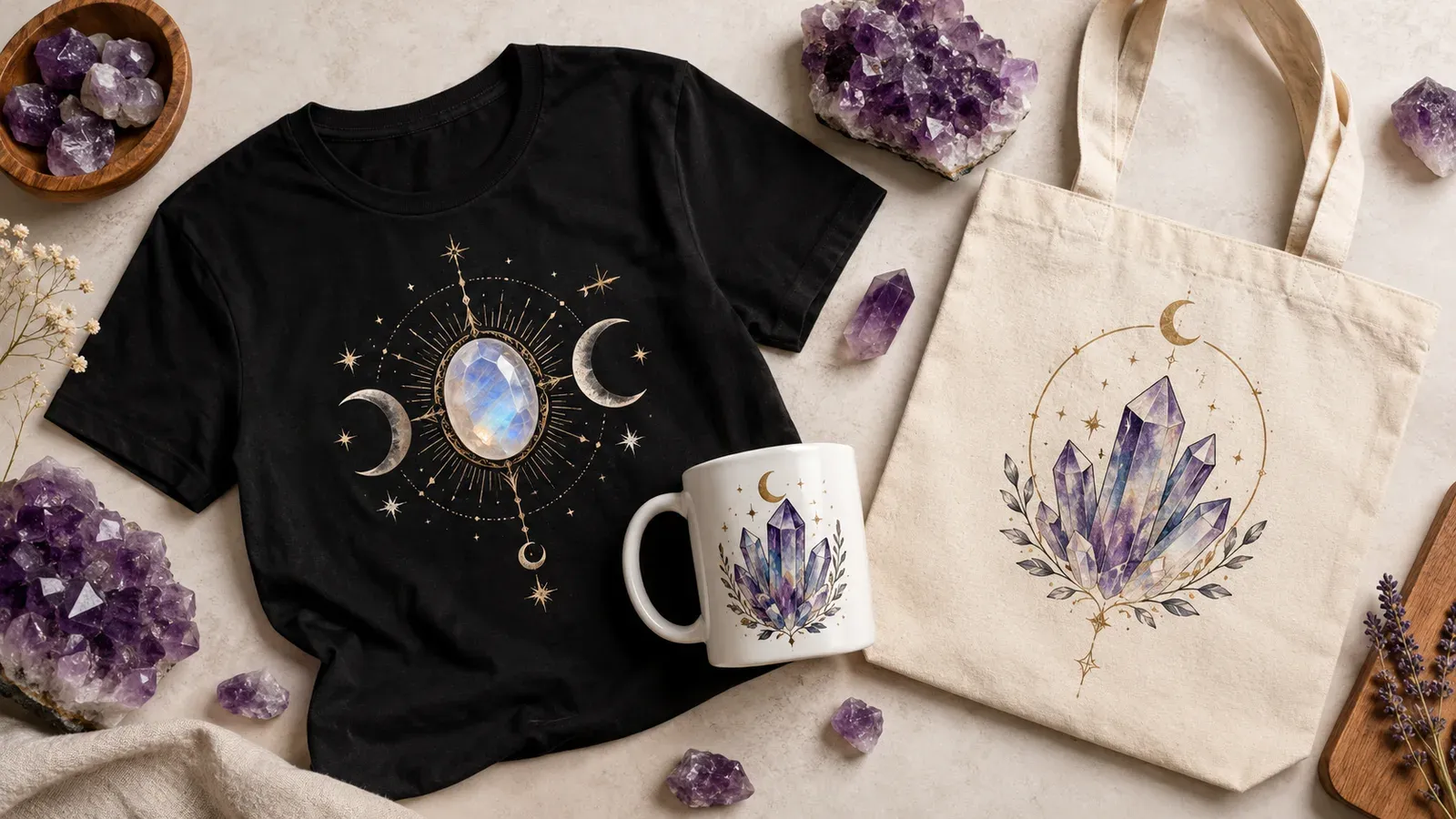
Lucas thought the design work was the hard part. He was wrong. The real trap is the “mockup mismatch.” When you sell a gemstone product line, the buyer expects visual magic. They want to see the labradorite flashing with blue and green fire. A flat, generic mockup with a low-resolution design slapped onto a white t-shirt kills that magic in minutes.
The agony of generic mockups
The manual process is brutal. You find a free mockup online. You place your “Malachite” design. It looks okay on the t-shirt. But that same mockup style doesn’t exist for the hoodie, the mug, or the canvas. You end up with a product line where each item looks like it was photographed by a different person in a different studio. This inconsistency is a trust killer. Etsy buyers are visually driven; if your shop looks like a chaotic garage sale, they will bounce to a competitor with a polished, cohesive look.
Another hidden trap is the background. A mockup with a busy background distracts from the intricate details of your gemstone design. For crystal and stone niches, the context matters. A “Black Tourmaline Protection” t-shirt looks powerful in a moody, grounded scene. That same t-shirt on a plain white background loses its emotional impact. Creating these contextual scenes usually requires expensive photography or advanced Photoshop skills. For a deeper look at how visuals impact buyer behavior, read our guide on The Visual Edge: How Product Mockups Boost Etsy Sales Conversion.
Creating contextual lifestyle scenes without a studio
This is where the visual strategy needs a smarter tool. Listystyle is built for this exact problem. Instead of hunting for matching mockups, you select your gemstone creation and tell the system to generate lifestyle images. The technology analyzes your design and places it into realistic, relevant scenes. A “Citrine Abundance” design might appear on a hoodie worn by someone in a sunlit, cozy reading nook. A “Selenite” canvas print might render on a minimalist bedroom wall.
You don’t need to write complex prompts or learn photo editing. You select the number of images you want and click a button. The system generates hundreds of unique, hyper-realistic photos that match the vibe of your niche. You still have full control; you review the generated images and choose the ones that best represent your brand. This moves your product line from looking like a DIY project to a professional boutique, without the hours of manual editing.
⚠️ Important: Never use generic white-background mockups for an entire gemstone line. The spiritual and crystal niche relies heavily on aesthetic and mood. A disconnected visual experience can cause a potential buyer to question the quality of the physical product itself.
How can I write SEO-optimized listings for an entire gemstone collection?
With the visuals sorted, Lucas faced his next mountain: words. He had 15 products ready to go. Each needed a title, 13 tags, and a detailed description that included the metaphysical properties of the stone, care instructions, and size details. He opened a generic AI tool and asked it to write a product description for an “Amethyst T-Shirt.” The output was generic. It read: “This beautiful amethyst t-shirt is great for crystal lovers. Makes a perfect gift.”
That generic text is a death sentence for Etsy SEO. Etsy’s search algorithm, much like Google’s Helpful Content update, penalizes thin, generic content. Your gemstone listings are competing against thousands of other spiritual and crystal shops. To rank, your listing content needs to be specific, rich with long-tail keywords, and formatted to answer the buyer’s intent.
Why generic AI tools fail the gemstone niche
Standard AI writers don’t understand Etsy’s search context. They don’t know that “Spiritual Healing Gift” is a high-volume search term, or that you need to include attributes like “Crystal Grid Shirt” or “Witchy Aesthetic” in your tags. They also don’t understand the product context. A description for a mug needs different keywords than a description for a hoodie, even if they share the same design. Writing this manually for a 50-product line is a full-time job. You can see the specific problems with generic tools in our breakdown of ChatGPT for Etsy Listings: The Hidden Problem with Generic AI (And What Actually Works).
Writing listing content that matches buyer intent
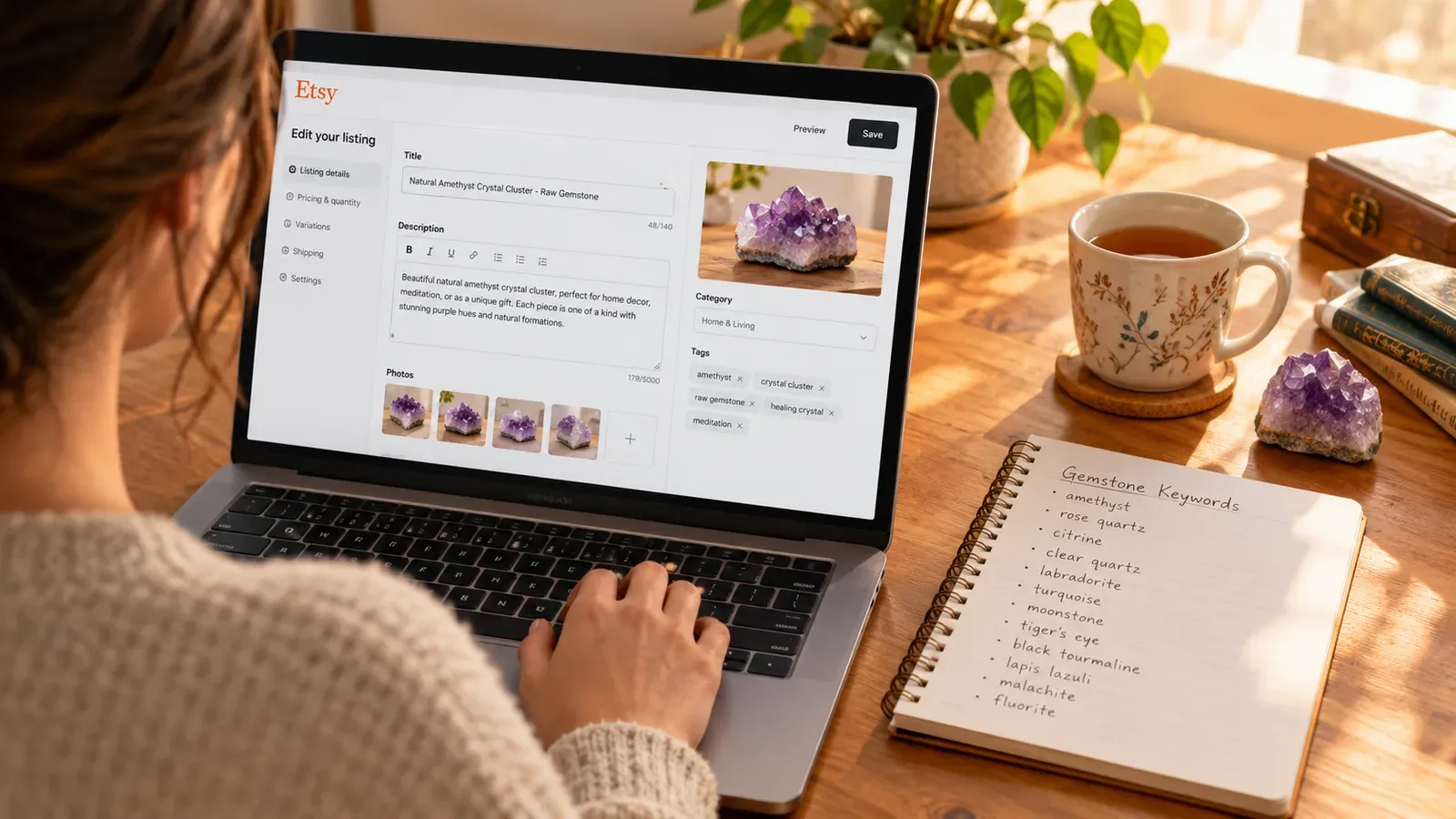
The solution is a tool that understands the specific product and design combination. The Magic Wand feature is trained to analyze a “creation” (your design plus the product type). When you apply it to your “Rose Quartz Canvas Print,” it generates a title that includes “Rose Quartz Wall Art,” “Crystal Home Decor,” and “Love Energy Painting.” It writes 13 relevant tags and a description that flows naturally, incorporating the emotional and aesthetic appeal of the stone.
You don’t publish blindly. You review the generated text, tweak the tone to match your brand voice, and ensure the metaphysical descriptions are accurate to your standards. The key is that you start with a highly relevant, optimized draft in minutes, rather than staring at a blank screen. This allows you to scale a gemstone product line from 10 items to 100 items while maintaining a high standard of SEO for every single listing.
💡 Practical tip: When optimizing gemstone listings, always include the stone’s name, its color, its metaphysical property, and the product type in your title. Example: “Green Aventurine Luck T-Shirt | Crystal Healing Gift | Spiritual Graphic Tee.” This captures broad and specific search traffic.
What is the most efficient way to apply one gemstone design to multiple products?
Lucas had his designs and his SEO plan. Now came the actual assembly. The traditional method in print-on-demand is a repetitive loop: upload design, select product, adjust placement, download mockup, repeat. For a single design going onto five products, that’s five loops. For a collection of ten designs going onto ten products, that’s one hundred loops. This is where most sellers burn out before their shop is even fully stocked.
The bulk creation bottleneck
The inefficiency isn’t just the clicking. It’s the visual checking. You place a “Tiger’s Eye” design on a black hoodie. It looks centered. You place it on a tote bag. The aspect ratio is different, so the design is now cut off at the edges. You have to manually open a placement editor for each individual product to fix it. This process isn’t creative; it’s mechanical quality control. It steals hours from the work that actually grows your business, like market research or social media marketing.
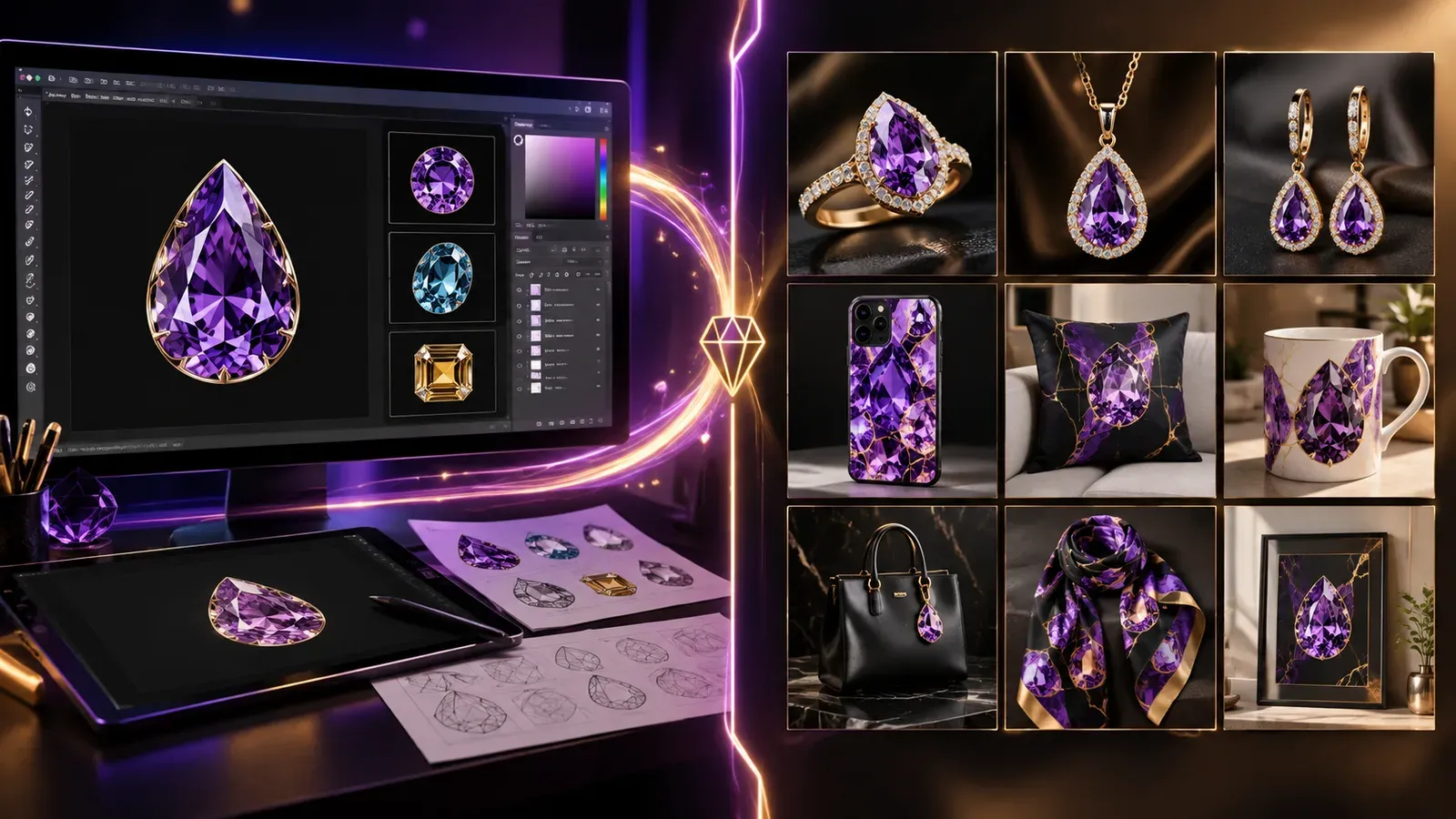
This is where the Creation Wizard changes the workflow. You upload your gemstone designs to My Artworks, your cloud-based design vault. Then, in the Creation Wizard, you select your “Zodiac Collection” designs on one side and your chosen products (t-shirt, hoodie, mug, canvas, tote bag) on the other. With one click, the system pairs every design with every product. It generates all the mockup variants in minutes.
Fine-tuning placement in bulk
But what about that cut-off tote bag? This is where the Placement Editor saves the day. Instead of editing each product one by one, you can open the editor for one creation, adjust the design’s position or size on the tote bag, and then apply that custom placement to all other creations using a tote bag. This ensures visual consistency across your entire line. Your “Lapis Lazuli” design will sit in the exact same perfect spot on every tote bag, regardless of which collection it belongs to.
You can also use the Background Remover on any uploaded artwork that has a solid background, making the gemstone design transparent and ready to place on any colored product without a white box around it. This entire assembly process turns what used to be a weekend of tedious clicking into a focused, manageable task where you make the creative decisions and the system handles the repetition.
How do I keep my gemstone Etsy shop active without manual daily uploads?
Lucas finally had 50 beautiful, optimized listings ready. His instinct was to publish them all at once. He hit “publish” on everything on a Tuesday night. Then he waited. The views were flat. Etsy’s algorithm favors consistent activity. A shop that dumps 50 items and then goes silent for a week doesn’t signal “active, reliable seller” to the platform. The algorithm rewards fresh content dripped out steadily.
The algorithm’s preference for consistency
Manually logging in every day at 10 AM to publish one new listing is a recipe for inconsistency. Life gets in the way. You miss a day. Then two. Your shop’s activity graph looks like a flatline with a single, massive spike. The smarter strategy is to publish one or two new gemstone items every single day. This keeps your shop in a constant state of refresh, which Etsy’s algorithm notices. But doing this manually requires you to be chained to your computer at the same time every day.
This is why a scheduling tool is non-negotiable for scaling. After you use the Creation Wizard and the Magic Wand to prepare your 50 listings, you don’t publish them. You use the Scheduled Publish feature. You set a rule: “Publish 1 listing every 12 hours” or “Publish 2 listings every day at 9 AM.” Listybox then drips your gemstone products onto Etsy automatically, according to your schedule. You set the strategy once, and the system executes it consistently.
💡 Practical tip: Time your scheduled publishes to align with your target audience’s browsing habits. If you sell “Sleep Crystal” themed products, publishing in the late evening might catch users who are winding down and shopping for relaxation aids.
Automating the post-sale process
Once you start making sales, the operational work shifts to fulfillment. A manual process means watching your email for the “Etsy Sale” notification, logging into your POD provider, manually typing the customer’s address, selecting the product, and placing the order. If you make a typo in the address, you eat the cost of a replacement.
Zero-Touch Fulfillment automates this entirely. When an Etsy order comes in for your “Fluorite Focus Mug,” Listybox detects it, routes it to the correct print provider, and sends the shipping details. When the provider ships it, the tracking number is automatically pushed back to Etsy, and the order is marked as complete. The customer gets notified without you lifting a finger. This turns your gemstone shop into a business that can run without you being the bottleneck, freeing you up to design the next collection or work on your marketing strategy. For a complete overview of scaling your operations, see our guide on How to Scale Your Etsy Shop: The Complete Automation Blueprint for 2026.
Building a gemstone brand that lasts
The difference between a hobbyist and a professional Etsy seller in the gemstone niche isn’t the quality of the designs. It’s the workflow behind them. A hobbyist manually uploads 10 items, gets burned out, and their shop sits stagnant. A professional structures a design collection, uses contextual lifestyle imagery to build trust, writes targeted SEO content for every product, and automates the tedious publishing and fulfillment tasks.
The gemstone and crystal market is driven by aesthetics and emotion. Your operational process should support that creativity, not fight against it. By moving the repetitive work to a system that handles bulk creation, visual generation, and scheduled publishing, you reclaim the time to do what you actually signed up for: connecting with customers who love the energy and beauty of the stones as much as you do.
If you’re ready to build your gemstone product line without the manual grind, you can see how all these pieces connect in one place. Start free - no credit card required and begin turning your crystal collection into a cohesive, thriving Etsy shop.
Listybox
Create listings 10x faster with Listybox.
Frequently asked questions
Put this into practice in your shop.
Every step from design to live listing, on one platform. Start on the free plan.
Related posts

Want to go deeper? Read our in-depth Etsy guides · Browse 100 Etsy niche guides