
Jan 7, 2026
Dropshipping vs POD: Why Print on Demand Wins in 2025 (The Hidden Traps Revealed)
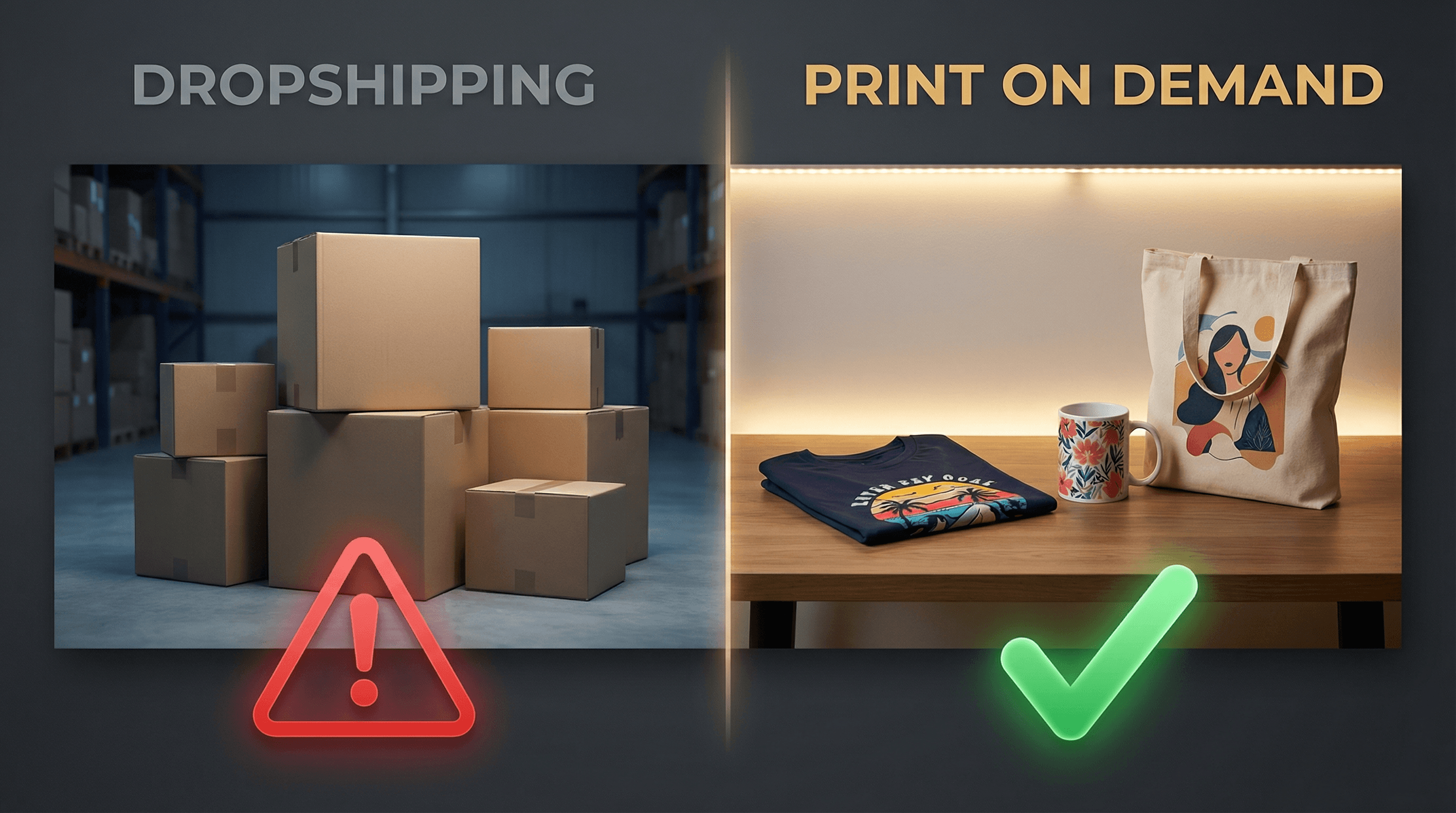
Dropshipping looks easy, but the hidden traps—zero brand value, no quality control, and sudden platform bans—destroy most sellers within months. This guide reveals why Print on Demand offers a safer, more profitable path to building a real Etsy business that you actually own.
Bullet Points (TL;DR)
Dropshipping Has No Brand Value: You're selling someone else's generic products that thousands of competitors also sell, leading to endless price wars.
Zero Quality Control: With dropshipping, you never touch the product—when suppliers ship defective items, your reputation suffers.
Platform Risk Is Real: About 90% of dropshippers fail because of supplier issues, late shipments, and marketplace bans.
POD Builds Real Equity: Every print-on-demand product carries your unique design, creating a brand that customers return to.
Automation Changes Everything: With Listybox's intelligent automation system, you can launch hundreds of POD products while the platform handles fulfillment automatically.
You've heard the pitch a thousand times: "Start a dropshipping business with zero inventory!" It sounds perfect. No warehouse, no upfront costs, no risk. But here's what those YouTube gurus conveniently forget to mention—dropshipping is a house of cards built on someone else's foundation.
The dream of passive income quickly turns into a nightmare of refund requests, supplier disappearances, and razor-thin margins. Meanwhile, Print on Demand (POD) sellers are quietly building real brands with loyal customers and sustainable profit margins. In this guide, we'll pull back the curtain on dropshipping's hidden traps and show you why POD is the smarter path forward.
What Is the Difference Between Dropshipping and Print on Demand?
Before diving into the risks, let's clarify what separates these two business models—because understanding this difference could save you months of frustration and thousands of dollars.
The Dropshipping Model
Dropshipping is a fulfillment method where you sell products without holding inventory. You list items from a supplier (often from China via AliExpress or Alibaba), and when a customer orders, the supplier ships directly to them. You never touch the product.
The problem? You're essentially a middleman selling generic products that hundreds—sometimes thousands—of other sellers are offering at the exact same price. There's no differentiation, no brand identity, and no customer loyalty.
The Print on Demand Model
Print on Demand is a specialized form of fulfillment where products are created only after a customer places an order—but here's the crucial difference: these products feature your unique designs. You're not reselling someone else's generic merchandise. You're creating original products that customers can only buy from you.
Our internal data shows that POD sellers on Etsy achieve profit margins 2-3x higher than traditional dropshippers because they compete on creativity and brand value, not just price.
Why Is Dropshipping So Risky in 2025?
If you're considering dropshipping in 2025, you need to understand that the game has fundamentally changed. The "golden era" of dropshipping from 2015-2020 is over, and what remains is a minefield of hidden traps.
The Brand Value Trap
Meet Alex, a hopeful entrepreneur who decided to start a dropshipping store selling phone accessories last year.
His plan seemed bulletproof: find trending products on AliExpress, list them on his Shopify store, and run Facebook ads. Simple, right?
Within two weeks, Alex noticed something disturbing. He searched for the exact products he was selling and found 47 other stores offering the identical items—many at lower prices. His "unique" store was just one face in a crowd of thousands.
The price war began. To stay competitive, he slashed his margins from 30% to 15%, then to 8%. But competitors kept undercutting him. After three months, Alex's store was hemorrhaging money on ads while generating almost no profit.
Here's the brutal truth: when you dropship generic products, you have zero brand equity. Customers don't remember your store name—they only remember the price. And there's always someone willing to sell cheaper.
The Quality Control Nightmare
Dropshipping's dirtiest secret is that you never see the product before it reaches your customer. You're essentially gambling your reputation on a supplier you've never met.
Consider these statistics: about 90% of dropshippers fail because they choose poor suppliers, receive terrible product quality, and face constant customer complaints. When a supplier ships a defective item or the wrong size, you're the one dealing with angry refund requests and negative reviews—even though the mistake wasn't yours.
And it gets worse. Some suppliers have been known to insert their own promotional materials into packages, revealing to customers that they massively overpaid for a product they could have bought directly from the source.
The Platform Risk Nobody Mentions
Here's where dropshipping in 2025 becomes truly dangerous. Recent trade tensions between the US and China have created a perfect storm of problems:
Customs Duties: The US has imposed 25-100% additional customs duties on many product categories from China
De Minimis Removal: Previously, shipments under $800 were tax-exempt—this threshold has been lowered or removed
Strict Controls: Packages from China can wait months at customs
Platform Bans: Amazon and other marketplaces are actively banning certain China-sourced products
If your entire business model depends on cheap Chinese suppliers, you're building on quicksand. One policy change can destroy your profit margins overnight.
How Does Print on Demand Help You Build a Real Brand?
Now let's talk about what makes Print on Demand fundamentally different—and why it's the better choice for anyone serious about building a sustainable e-commerce business.
Your Designs, Your Brand
With POD, every product that leaves the warehouse carries your unique creative vision. When a customer buys a t-shirt with your design, they're not just buying fabric—they're buying into your brand story.
This creates a powerful competitive moat. Unlike dropshipping, where customers can find the exact same product elsewhere, your POD designs are exclusive. If someone loves your artwork, they have to buy from you. There's no price war because there's no direct competition.
Our research indicates that POD sellers who consistently publish original designs see customer return rates up to 40% higher than dropshippers selling generic products.
Quality You Can Control
With Print on Demand, you partner with established print providers who have built their reputation on quality. These aren't random AliExpress suppliers who might disappear tomorrow—they're professional fulfillment companies with quality control processes in place.
You can order samples, verify print quality, and ensure your brand is represented exactly as you envision. This level of control is impossible with traditional dropshipping.
Platform Safety and Compliance
Print on Demand products are manufactured domestically or through vetted international partners who comply with all import regulations. You're not gambling on customs delays or worrying about policy changes that could shut down your business overnight.
Platforms like Etsy actively encourage POD sellers because the products are original and handmade-adjacent. Meanwhile, they're increasingly cracking down on resellers of generic dropshipped goods.
Which Business Model Is More Profitable Long-Term?
Let's break down the real numbers that most "gurus" never show you.
Dropshipping: The Math Doesn't Work
Let's say you find a product on AliExpress for $8 and sell it for $25. Your gross margin is $17. Sounds great, right?
Now subtract reality:
Shipping cost: $5-10 (or customers abandon cart)
Facebook ad cost per conversion: $8-15 (and rising)
Refund rate: 10-15% on average
Payment processing fees: 2.9% + $0.30
After all expenses, most dropshippers are lucky to net $2-3 per sale. And that's before accounting for the hours spent dealing with supplier issues and customer complaints.
Print on Demand: Building Equity
With POD, your per-product margin might be similar initially. But here's what changes everything:
Customer lifetime value: People who love your designs come back
Premium pricing: Unique designs command higher prices
Lower ad costs: Original content performs better on social media
Brand equity: Your store becomes an asset you can sell
Sellers using platforms with built-in Lowest Price Guarantee features can lock in optimal production costs, ensuring every sale maximizes profit without the constant price-hunting that plagues dropshippers.
How Can I Start a POD Business Without the Manual Grind?
Here's where most POD beginners get stuck. They understand the benefits of Print on Demand, but the execution feels overwhelming. Creating listings, writing SEO-optimized descriptions, managing orders—it's a lot.
Let's revisit Alex from our earlier scenario. After his dropshipping disaster, he decided to try POD on Etsy with 15 original t-shirt designs.
He started by listing his first design manually. Four hours later, he had created just 20 product variations. At that rate, getting his full collection live would take weeks. And that's before dealing with SEO optimization, order management, or customer service.
Then his first order came in. Excited, he manually copied the customer's address, forwarded the order to his print provider, and waited. Two days later, he realized he'd made a typo in the shipping address. The package was returned, the customer was furious, and Alex was out of pocket for shipping costs.
The Power of Intelligent Automation
This is exactly where Listybox's fine-tuned automation system built specifically for Etsy transforms the POD experience.
Instead of spending 40 hours creating 500 product listings, the Creation Wizard lets you combine multiple designs with multiple products and generate all variations in under 5 minutes. What would take Alex weeks now takes a single coffee break.
For SEO, the Magic Wand SEO tool analyzes real competitor data to generate optimized titles, 13 tags, and compelling descriptions—all with a single click. No more guessing at keywords or spending hours on eRank research.
And when orders come in? The Zero-Touch Order Management system automatically detects orders, routes them to the best print provider, and updates customers with tracking information. Alex's shipping typo nightmare becomes impossible because human error is removed from the equation.
From Struggle to Scale
Let's complete Alex's story. After discovering Listybox, his 15 designs became 300 live listings in a single afternoon. His first sales came within 48 hours. Within a month, he was generating more profit than his entire failed dropshipping venture.
But here's the real transformation: Alex stopped working in his business and started working on it. Instead of copy-pasting addresses and writing repetitive product descriptions, he focused on creating new designs and building his brand.
Before Listybox, Alex was trapped in manual labor, fighting price wars with generic products he couldn't control. After Listybox, he was building a real brand with loyal customers who came back for his unique creative vision.
The Verdict: Why POD Wins in 2025
Dropshipping had its moment. In the early 2010s, before everyone knew about AliExpress and before platforms started cracking down, it was genuinely possible to build a profitable dropshipping store. That window has closed.
Today's e-commerce landscape rewards:
Brand differentiation over price competition
Quality and consistency over volume and variety
Customer relationships over one-time transactions
Platform compliance over gray-area tactics
Print on Demand checks every box. With POD, you're not at the mercy of random suppliers or policy changes. You're building something real—a brand that customers recognize and return to.
For those serious about creating a sustainable Etsy business, the choice is clear. And with modern tools handling the operational complexity, there's never been a better time to make the switch.
Ready to Build Your POD Empire?
Does all of this feel overwhelming? You don't have to start from scratch. With Listybox Store Setup, our expert team sets up your Etsy store, lists your first 10 products, and optimizes everything for SEO. This service is included FREE with annual Starter and Professional plans!
Whether you're escaping a failed dropshipping venture or launching your first e-commerce business, you can explore all features to see how Listybox transforms POD from a manual grind into a streamlined, profitable operation.
Stop building on someone else's foundation. Start creating a brand that's truly yours.
Never Miss an Update
Get actionable Etsy tips delivered to your inbox every week. No spam, unsubscribe anytime.