
Dropshipping vs Print on Demand: The 2026 E-commerce Showdown
Stuck between dropshipping and print on demand? One hides a nightmare of quality control, while the other offers true brand building. Find out which model actually creates lasting passive income.
Bullet Points (TL;DR)
Print on demand vs dropshipping: POD gives you brand control; dropshipping offers speed.
In 2026, POD profit margins range 20-40% vs dropshipping's 10-20%.
POD is lower risk and safer for beginners due to no upfront inventory.
For passive income, POD often wins with automation and less daily management.
Choose POD if you love design; choose dropshipping if you excel at spotting trends.
The dream of e-commerce is highly seductive. You imagine waking up, checking your phone while your coffee brews, and seeing a dashboard flooded with overnight sales notifications. In 2026, the barrier to entry for online selling has never been lower, but the barrier to sustainable, long-term success is higher than ever. If you are researching how to start an online business, you have inevitably crashed into the two heavyweight contenders of the digital economy: dropshipping and print on demand. Both models promise freedom from inventory, packing tape, and post office lines. They both allow you to run a global enterprise from a laptop in your kitchen or a beach cafe. However, beneath the surface, these two paths lead to vastly different destinations.
One path often traps you in a cycle of customer service nightmares, long shipping delays, and razor-thin margins. The other gives you the foundation to build a defensible, highly profitable brand with loyal repeat customers. If you are comparing dropshipping vs print on demand, you are not just choosing a fulfillment method. You are choosing your daily lifestyle, your risk tolerance, and your long-term wealth strategy.
Let's break down exactly how these models work, where the hidden traps lie, and how modern technology is changing the game entirely for digital entrepreneurs.
Understanding the Core Mechanics
Before we can declare a winner, we need to clearly define the battlefield. Both dropshipping and print on demand are order fulfillment methods where a third party handles the physical product, but the similarities end there. The way you source products, market them, and build value differs completely.
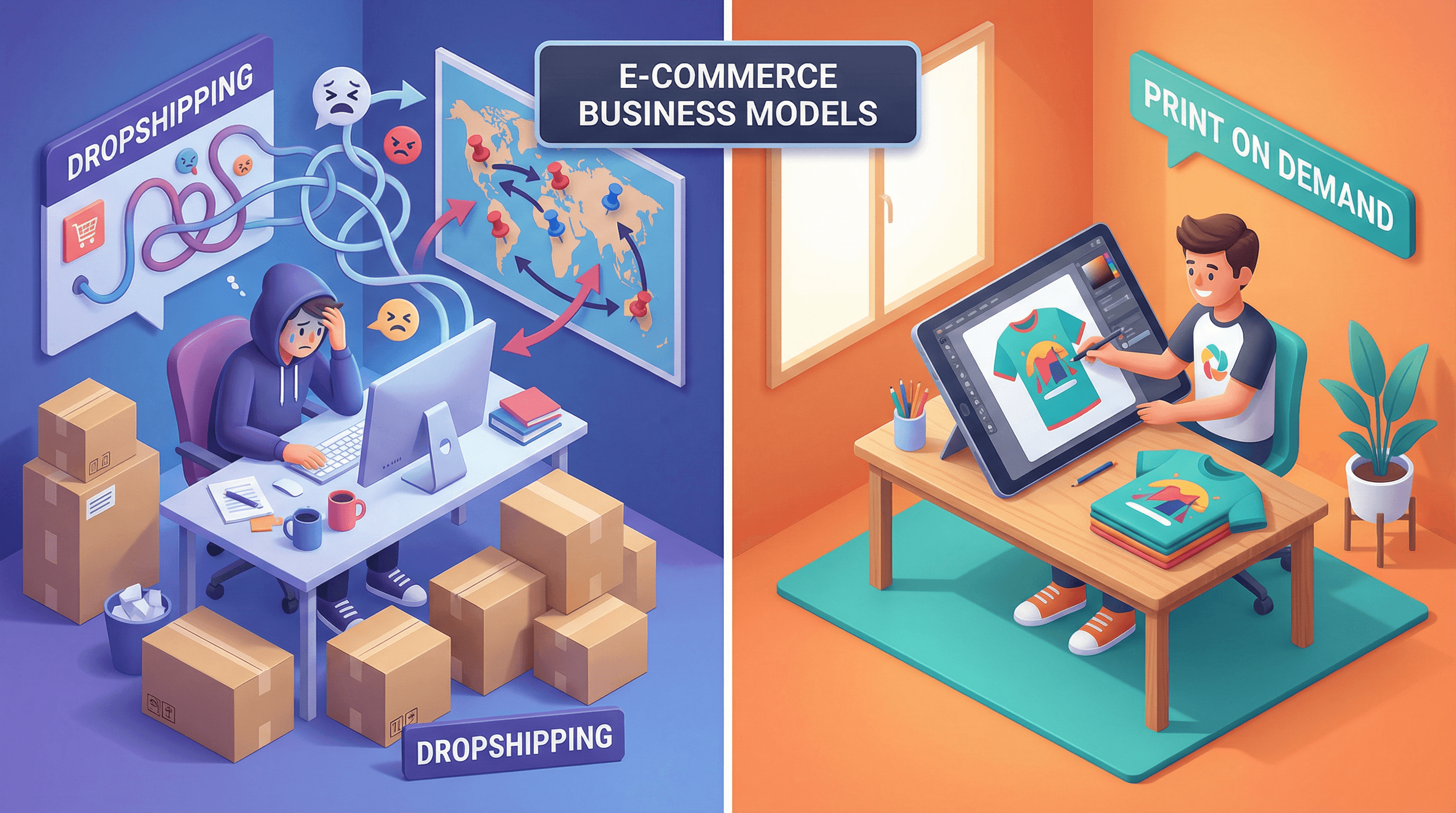
Dropshipping is essentially retail arbitrage on a global scale. You set up an online storefront and populate it with existing products manufactured by a third-party supplier, usually located overseas in places like China. When a customer buys a dog collar from your store for $30, you forward that order to your supplier, paying them $10. The supplier then ships the generic dog collar directly to your customer. You keep the $20 difference as gross profit. You never touch the product, but you also have zero input into its creation.
Print on demand (POD), on the other hand, is a specialized form of dropshipping focused entirely on custom, white-label products. Instead of selling a generic item that already exists, you create original digital designs and apply them to blank products like t-shirts, mugs, posters, or tote bags. When a customer buys your custom "Plant Mom" t-shirt, the order goes to a specialized print facility. The facility prints your specific design onto a blank shirt, packages it, and ships it. You are selling a unique piece of intellectual property, not just a physical commodity.
The Hidden Traps of Traditional Dropshipping
At first glance, dropshipping looks like the perfect business. You can sell anything from electronics to gardening tools without spending a dime on inventory. However, the reality of running a dropshipping business is often a stressful, high-risk grind. According to industry reports from Forbes and other e-commerce analysts, the failure rate for new dropshipping stores is notoriously high, and for very logical reasons.
First, you have absolutely zero brand equity. Because you are selling the exact same generic products as thousands of other dropshippers, you have no unique selling proposition other than price. This inevitably leads to a race to the bottom. If you find a winning product, it only takes a few days for competitors to clone your store, steal your ad copy, and undercut your price by a dollar.
Second, the shipping times are often a customer service nightmare. Traditional dropshipping relies on inexpensive overseas shipping methods like ePacket. Customers accustomed to two-day delivery are suddenly forced to wait three to four weeks for their order to arrive. This leads to a flood of angry emails, negative reviews, and devastating credit card chargebacks that can get your payment processor shut down overnight.
Finally, the marketing costs are astronomical. Because you are selling generic items on a standalone website, you have no organic traffic. You are entirely dependent on paid advertising through Facebook, TikTok, or Google Ads. You might see a gross profit margin of 50% on paper, but once you factor in the high cost of acquiring a customer through paid ads, your actual net profit often shrinks to a stressful 10% or less. You are essentially gambling your own money every day on ad campaigns just to stay afloat.
Why Print on Demand is the Superior Choice for Brand Builders
Print on demand completely flips the script on the e-commerce model. Instead of competing on price with generic goods, you are competing on creativity and connection. This single shift changes the entire trajectory of your business.
With POD, you own the design. When you create a funny, niche-specific graphic for a coffee mug, nobody else can legally sell that exact product. You are creating a unique asset. This allows you to build a genuine brand with a loyal community. Customers buy from you because they resonate with your specific art style or the message on your apparel, not because you were the cheapest option on the internet.
Quality control and shipping speeds are also drastically better. Top-tier POD suppliers have networks of printing facilities located locally in the US, Europe, and Australia. When a US customer orders your shirt, it is printed and shipped from a US facility, often arriving within a few days. The blank products used are high-quality, retail-ready brands like Bella+Canvas or Gildan. This results in happy customers, five-star reviews, and highly profitable repeat purchases.
Most importantly, POD pairs perfectly with organic marketplaces. Instead of burning thousands of dollars on Facebook ads, you can list your custom products on a massive marketplace like Etsy. Etsy already has millions of active buyers searching for unique, personalized items every single day. By mastering your Etsy SEO guide practices, you can capture this free organic traffic, keeping your profit margins healthy and your stress levels low.
Dropshipping vs Print on Demand: The Ultimate Comparison
To make the best decision for your future, we need to compare these two models across the four most critical pillars of business: profit margins, risk, quality, and workload.
Profit Margins and Pricing Control
Dropshipping: Gross margins look high (often 50-60%), but net margins are incredibly low (10-15%) due to the massive cost of paid advertising required to drive traffic to a standalone store. You have very little pricing power because competitors sell the exact same item.
Print on Demand: Gross margins typically sit around 30-40%. However, because you can use free organic traffic on platforms like Etsy, your net margin stays very close to your gross margin. Furthermore, with tools like Listybox's Lowest Price Guarantee, you automatically secure the best production prices in the industry without paying extra subscription fees, pushing your profit margins even higher.
Risk Levels and Initial Investment
Dropshipping: High risk. You need a significant budget (often $1,000 to $3,000) just to test paid ads and find a winning product. If the ads fail, that money is gone forever. You also face high risks of chargebacks due to long shipping times.
Print on Demand: Extremely low risk. Listing a product on Etsy costs just $0.20. You can test hundreds of different designs for a fraction of the cost of one Facebook ad campaign. If a design does not sell, you simply move on to the next one with virtually zero financial loss.
Quality Assurance and Customer Satisfaction
Dropshipping: You are entirely at the mercy of overseas factories. Product quality can change from batch to batch without your knowledge. Returns are nearly impossible to process profitably, leaving you to simply refund angry customers out of pocket.
Print on Demand: You choose the exact blank garment or product you want your design printed on. The printing technology is highly standardized. If a misprint happens, reputable POD partners will automatically send a free replacement to your customer, protecting your brand reputation.
Workload and Automation Potential
Dropshipping: High daily workload. You must constantly hunt for new trending products, remake video ads, monitor ad spend hourly, and deal with complex customer service tickets regarding missing packages.
Print on Demand: Front-loaded workload. You spend time creating designs initially. Once listed, the product can sell for years with zero extra effort. The entire fulfillment process can be completely automated.
The Print on Demand Bottleneck
If print on demand is clearly the superior model for building a sustainable, low-risk business, why isn't everyone a millionaire? Because traditional POD has a massive, hidden bottleneck: the soul-crushing manual labor of product creation.
Creating a great design is only step one. To actually make money, you need volume. You need hundreds, if not thousands, of active listings in your shop to capture different search terms and trends. Doing this manually is an agonizing process.
You have to upload your design to a platform like Printify. You have to manually position the artwork on the shirt. You have to select the colors. You have to download mockups. You have to write a title, description, and tags from scratch. You have to upload everything to Etsy. Doing this for just one product takes 10 to 15 minutes. If you want to build a professional store with 500 products, you are looking at over 100 hours of mindless, repetitive clicking.
This manual grind is where 90% of new sellers give up. They want passive income, but they find themselves trapped in a low-paying data entry job of their own making. They spend all their time adjusting image placements instead of researching new trends or creating art. This is the exact problem that intelligent automation systems customized for Etsy sellers were built to solve.
How Listybox Turns Print on Demand into True Passive Income
To truly win at print on demand, you need to break the bottleneck of manual labor. You need to operate like a media company, launching products rapidly and flawlessly without spending your entire weekend clicking buttons. This is where Listybox changes the entire landscape of Etsy POD.
Imagine taking that 100-hour task of creating 500 listings and finishing it before your coffee gets cold. With the Listybox Creation Wizard, you can upload a single design and instantly apply it to dozens of different products at once. The system handles the tedious work of generating professional lifestyle mockups, writing SEO-optimized titles based on real market data, and preparing the listings for your store.
But speed means nothing without precision. One of the biggest complaints with bulk automation is losing creative control over how your art looks on the final product. Listybox solves this elegantly with the Placement Editor. This feature allows you to perfectly adjust the scale and position of your design on one master template, and then instantly apply that exact artistic direction to hundreds of different product variations. You get the speed of a machine with the eye of an art director.
Once your products are live and the sales start rolling in, the real magic happens. A sale should be a moment of celebration, not the start of a new chore. With Listybox's Zero-Touch Order Management, your entire post-sale process is handled automatically. The system routes the order to the best printing facility, pays for the production, and updates your Etsy customer with their tracking number. You never have to copy-paste an address or worry about missing a fulfillment deadline. It acts as your personal Chief Operating Officer, working quietly in the background 24/7.
Does all of this feel overwhelming? You don't have to start from scratch. With Listybox Store Setup, our expert team sets up your Etsy store, lists your first 10 products, and optimizes everything for SEO. This service is included FREE with annual Starter and Professional plans!
Real-World Scenario: Surviving vs Scaling
To make this concrete, let's look at a realistic scenario comparing a traditional dropshipper to a Listybox-powered POD seller.
Meet Alex. Alex decides to dropship generic posture correctors. He spends $1,500 on Facebook video ads to test the product. After two weeks of intense stress and tweaking ad budgets daily, he makes $2,000 in revenue. His gross profit is $1,000. However, after subtracting his $1,500 ad spend, he is actually down $500. Worse, the products take 25 days to reach his customers from overseas. He spends two hours a day answering angry emails and dealing with PayPal disputes. Alex is exhausted, unprofitable, and building an asset that has zero long-term value.
Now meet Sarah. Sarah decides to start a POD store targeting the niche of funny software engineering jokes. She creates 50 clever text-based designs. Instead of spending weeks uploading them manually, she uses Listybox to turn those 50 designs into 500 distinct product listings (t-shirts, hoodies, mugs, and mousepads) in a single afternoon. She publishes them to Etsy, optimizing her tags for organic search.
Because her listings look professional and target specific keywords, Etsy's algorithm starts sending her free traffic. In her first month, she makes $2,000 in revenue. Her production costs are $1,200. She spent $0 on advertising. Her net profit is a clean $800. Best of all, when orders come in while she is sleeping, Listybox automatically routes them to local US printers. The items arrive in four days, resulting in glowing five-star reviews. Sarah has built a defensible brand, secured a healthy profit margin, and her daily operational workload is practically zero.
Final Verdict: Which Business Model Should You Choose?
If you want to gamble on paid ads, deal with complex overseas logistics, and compete solely on price in a race to the bottom, dropshipping might offer a thrilling, albeit risky, ride. It is a model built on short-term cash grabs rather than long-term asset creation.
However, if your goal is to build a sustainable business, protect your peace of mind, and create a genuine brand with loyal customers, print on demand is the clear winner. It removes the financial risk of inventory, solves the nightmare of long shipping times, and allows you to compete on creativity.
The only downside to POD has historically been the immense manual labor required to scale your catalog. But in 2026, that barrier no longer exists. By using a fine-tuned automation engine, you can bypass the tedious data entry and focus entirely on finding new trends and scaling your profits. You can turn a side hustle into an empire without hiring a massive team or working 80-hour weeks.
The tools for total e-commerce freedom are already built and waiting for you. The only thing left to do is decide what you want to create today. Start your free trial - no credit card required and see how effortless building a POD empire can actually be.
Never Miss an Update
Get actionable Etsy tips delivered to your inbox every week. No spam, unsubscribe anytime.