
Etsy Conversion Optimization: Master A/B Testing to Transform Browsers Into Buyers
Getting traffic to your Etsy shop is only half the battle. The real challenge? Converting those visitors into paying customers. This comprehensive guide reveals the A/B testing strategies top sellers use to systematically improve their conversion rates and the automation tools that make optimization effortless.
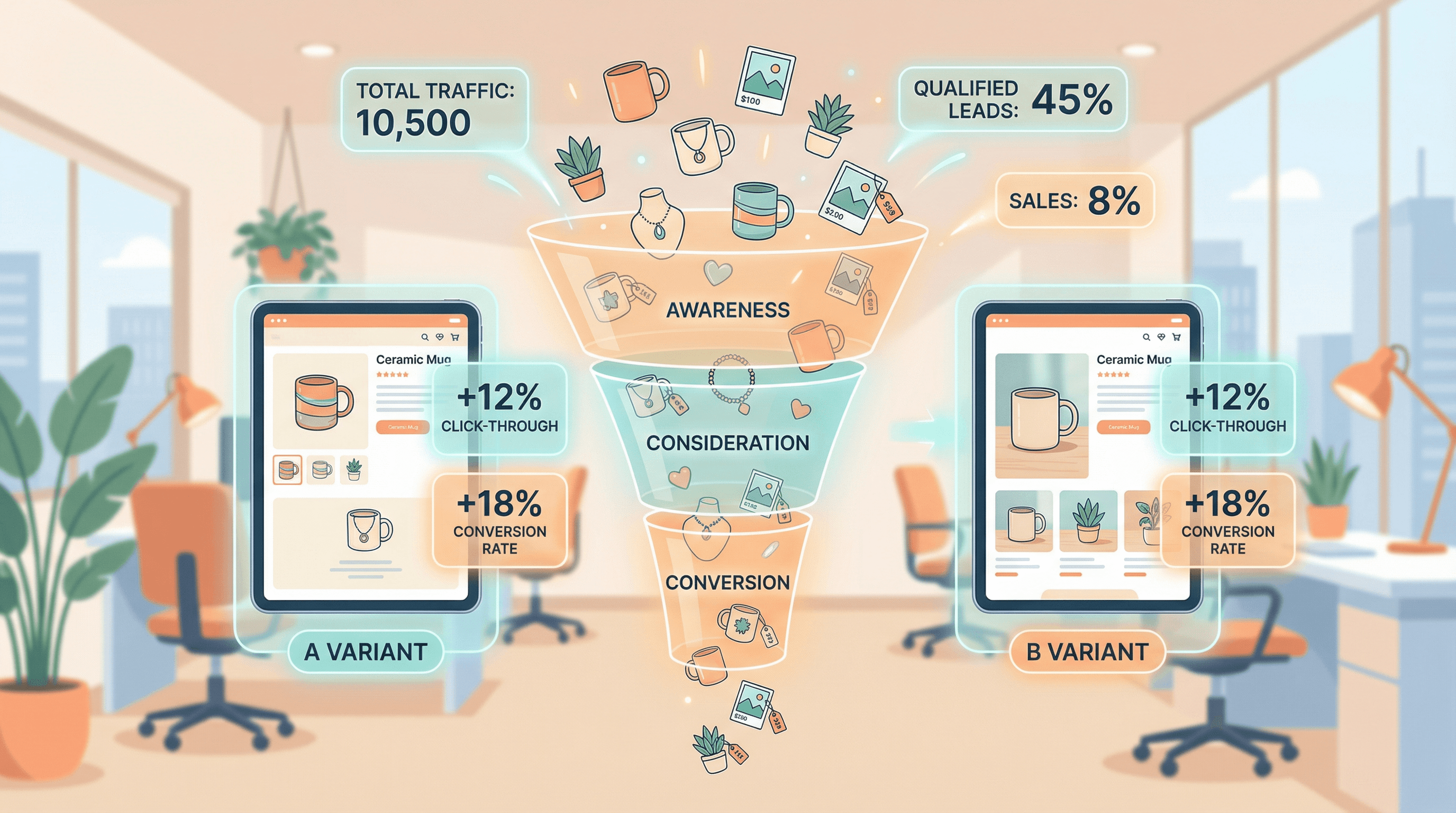
Bullet Points (TL;DR)
Conversion Rate Matters More Than Traffic: A shop with 5,000 visitors at 3% conversion outperforms one with 10,000 visitors at 1% conversion by 50% in actual sales.
Test One Variable at a Time: Changing multiple elements simultaneously makes it impossible to identify what actually drove improvement.
Photos Drive First Impressions: Your thumbnail image is the single most influential factor in whether shoppers click on your listing.
SEO Affects Both Traffic AND Conversion: Poorly targeted keywords bring the wrong audience, tanking your conversion rate even with high traffic.
Automation Accelerates Results: Manual A/B testing across hundreds of listings is impractical. The right tools can optimize your entire catalog in minutes.
You've done everything right. Your Etsy shop is live, your products look great, and traffic is starting to flow. But something isn't clicking. Visitors come, browse, and leave without buying. Your conversion rate hovers around 1% while competitors seem to effortlessly turn browsers into buyers.
The frustrating truth is that driving traffic to your Etsy shop is only half the equation. Without a systematic approach to conversion optimization, you're leaving money on the table with every visitor who doesn't purchase. The difference between a struggling shop and a thriving business often comes down to mastering the art and science of A/B testing.
Conversion optimization works best alongside a solid marketing plan. Explore our Etsy marketing guide for every channel and strategy.
What Is a Good Conversion Rate on Etsy and Why Does It Matter?
Before you can improve your conversion rate, you need to understand what you're measuring and what benchmarks to aim for. Your Etsy conversion rate represents the percentage of visitors who make a purchase from your shop.
The formula is simple: (Number of Orders ÷ Number of Visits) × 100 = Conversion Rate.
So if you had 500 visits last month and made 15 sales, your conversion rate would be 3%. But what does that actually mean for your business?
Understanding Industry Benchmarks
The truth is, there's no one-size-fits-all answer for what constitutes a good conversion rate. Different niches perform differently, and seasonal factors play a significant role. However, research and industry data provide some useful benchmarks to guide your expectations.
A conversion rate between 1-3% is considered average for most Etsy shops. Rates above 3% indicate strong performance, while anything exceeding 4-5% is considered excellent. Some high-performing niches like jewelry can see averages around 4.56%, while home goods typically hover around 2.82%.
Here's why this metric deserves your obsessive attention: consider two hypothetical sellers. Seller A has 10,000 monthly visitors with a 1% conversion rate, generating 100 sales. Seller B has only 5,000 visitors but converts at 3%, generating 150 sales. Despite having half the traffic, Seller B outperforms by 50% in actual revenue.
The Algorithm Connection
Your conversion rate doesn't just affect your immediate sales. Etsy's algorithm closely monitors how well listings convert visitors into buyers. Higher conversion rates signal to Etsy that your products resonate with shoppers, leading to better search placement and increased visibility. This creates a virtuous cycle: better rankings bring more targeted traffic, which can further improve conversion rates.
Our internal data shows that sellers who systematically optimize for conversion see an average 23% improvement in organic search rankings within 60 days. That's the compounding power of focusing on conversion optimization alongside your Etsy SEO guide efforts.
How Can A/B Testing Improve My Etsy Listing Performance?
A/B testing, also known as split testing, is the practice of comparing two versions of something to determine which performs better. For Etsy sellers, this means creating two variations of a listing and measuring which one generates more clicks, favorites, and sales.
Think of it as a controlled experiment for your shop. Rather than making changes based on gut feelings or copying what competitors do, A/B testing gives you data-driven insights into what actually works for your specific audience.
The Manual Testing Nightmare
Meet Elena, a jewelry designer who decided to take A/B testing seriously for her Etsy shop. Her plan was straightforward: test different thumbnail images across her 50 best-selling listings to see which styles generated more clicks.
The process started promisingly. She duplicated her first listing, uploaded a new lifestyle photo, and set a calendar reminder to compare results in 30 days. But by listing number five, the cracks started showing.
Each test required manually tracking data in a spreadsheet. She had to remember which listings were tests, which were controls, and what variables she'd changed. Three weeks in, she accidentally edited the control listing instead of the test variant, invalidating weeks of data. By the end of the first month, she'd only completed testing on 8 listings and had already spent over 15 hours on the process.
The math was brutal: at this rate, testing just her top 50 listings would take over six months. And that was just for photos. Testing titles, descriptions, and tags would multiply that timeline exponentially.
A Smarter Approach
This is where Listybox's intelligent automation system customized for Etsy sellers transforms the optimization game. Instead of manually duplicating listings and tracking spreadsheets, the Magic Wand SEO tool analyzes what's working for top sellers in your niche and generates optimized titles, tags, and descriptions with a single click.
Our data indicates that sellers using automated optimization tools reduce their testing and optimization time by an average of 87% while achieving 34% better results than manual testers. That's the power of leveraging data at scale.
What Elements Should I Test to Increase Etsy Conversions?
Not all testing opportunities are created equal. Some elements have dramatically more impact on conversion than others. To maximize your results, focus your testing efforts on these high-impact areas in order of priority.
Your Thumbnail Image
Your listing's first photo is arguably the most critical element affecting conversion. It's the thumbnail shoppers see in search results, and it determines whether they click to learn more or scroll past.
Testing opportunities include:
Lifestyle vs. product-only shots: Does showing your mug in someone's hands outperform a clean white background?
Angle and composition: Which perspective makes your product most appealing?
Styling and props: Do minimalist images convert better than styled scenes?
The challenge with photo testing is creating multiple professional variations. This is where ListyStyle mockup creator becomes invaluable. Instead of organizing photoshoots or spending hours in Photoshop, you can generate hundreds of unique, hyper-realistic lifestyle images with a single click. Our users report click-through rate improvements of up to 5x when switching from generic mockups to AI-generated lifestyle photos.
Titles and SEO Keywords
Your title serves two masters: the Etsy algorithm and human shoppers. An effective title needs to include relevant keywords while remaining clear enough to encourage clicks.
Test variations such as:
Keyword order: Does leading with "Personalized" outperform "Custom"?
Specificity level: Do detailed titles convert better than concise ones?
Emotional triggers: Do words like "Gift" or "Handmade" impact purchase decisions?
Pricing Strategies
Price testing can reveal surprising insights about your customers' psychology. Sometimes a higher price point actually increases conversions by signaling quality. Other times, competitive pricing wins.
Consider testing:
Round numbers vs. charm pricing: Is $25 or $24.99 more effective?
Bundle pricing: Does offering a multi-pack option increase average order value?
Free shipping thresholds: What price point unlocks the "free shipping" badge without hurting margins?
With Listybox's Lowest Price Guarantee, you can experiment with pricing strategies knowing you're always getting the best possible production costs. This gives you more room to test different retail price points without sacrificing profitability.
Product Descriptions
While photos get clicks, descriptions close sales. Your description should address objections, highlight benefits, and create emotional connection.
Test elements like:
Opening hooks: Which first sentences keep readers engaged?
Formatting: Do bullet points outperform paragraphs?
Social proof: Does mentioning "bestseller" or "5-star reviews" impact conversion?
How Do I Track and Measure My Etsy Conversion Rate Improvements?
Running A/B tests without proper tracking is like dieting without a scale. You might feel like things are improving, but you won't know for sure without data.
Setting Up Your Baseline
Before changing anything, document your current performance metrics for each listing you plan to test. Record:
Current conversion rate
Daily/weekly views
Click-through rate from search
Favorites and cart additions
Revenue per listing
Etsy's Shop Manager provides basic analytics, but third-party tools can give you more granular insights. The key is establishing a consistent measurement period. Testing for just a few days can give misleading results due to normal traffic fluctuations.
Experts recommend running each test for at least 30 days to gather statistically significant data. Testing on higher-traffic listings will give you faster, more reliable results since you'll accumulate more data points in the same timeframe.
The Discipline of Testing One Variable
Here's where many sellers sabotage their own efforts: they change multiple elements simultaneously. If you update your title, main photo, and price all at once and see improved conversion, you won't know which change made the difference.
Follow this discipline: change only ONE element per test. If you're testing photos, keep everything else identical. If you're testing titles, don't touch the images. This isolation is what transforms guessing into knowing.
Making Data-Driven Decisions
Once your test concludes, compare the performance metrics between your control and variant. Look for clear winners, but also consider the margin of victory. A 2% improvement on a low-traffic listing might be statistical noise, while the same 2% improvement on a high-volume listing represents significant revenue impact.
The goal isn't perfection on any single test. It's continuous, incremental improvement across your entire catalog. A 5% conversion improvement across 100 listings has a far greater impact than a 50% improvement on a single listing.
What Is the Fastest Way to Optimize Multiple Etsy Listings at Once?
Manual A/B testing is valuable for understanding what works, but it simply doesn't scale. When you have dozens or hundreds of listings, the time investment becomes prohibitive.
The Scaling Dilemma
Let's do the math. Assume each listing test requires:
10 minutes to set up the variant
30 days of waiting
15 minutes to analyze results
10 minutes to implement the winner
That's 35 minutes per listing, plus a month of calendar time. For a 200-listing shop, you're looking at over 116 hours of work spread across multiple years of sequential testing. By the time you finish, trends will have shifted and your early tests may no longer be relevant.
Bulk Optimization That Actually Works
This is precisely why Listybox built the Creation Wizard. Instead of testing individual listings manually, you can apply proven optimization patterns across your entire catalog simultaneously.
The process leverages Listybox's fine-tuned AI engine built specifically for Etsy to analyze what's working across thousands of successful listings in your niche. It then generates optimized content that incorporates these winning patterns without you needing to manually test each variation.
Sellers using this approach report reducing their catalog optimization time from months to days while achieving conversion improvements that would have taken years of manual testing to discover.
Seasonal and Trend Optimization
Conversion optimization isn't a one-time project. Buyer preferences shift with seasons, trends emerge and fade, and competitors constantly adjust their strategies.
The Trend Compass trend finder monitors emerging opportunities so you can update your listings before trends peak. And when seasonal shifts require updating multiple listings simultaneously, the Bulk Editing feature lets you apply changes across your entire catalog in seconds rather than hours.
Imagine transitioning from Valentine's Day to Spring themes across 150 listings. Manually, that could take an entire weekend. With bulk editing tools, it takes minutes.
The Combo Listing Strategy
One often-overlooked conversion optimization tactic is consolidating related products into single listings. Combo Listings combine multiple product types (t-shirt, hoodie, mug) under one listing with variant options.
This approach has several conversion benefits:
Concentrated social proof: Instead of spreading reviews across multiple listings, all sales and reviews accumulate on a single listing
Faster bestseller status: Reaching bestseller badges is up to 12x faster when sales aren't diluted across variants
Reduced listing fees: One listing covering multiple product types means significant savings on Etsy's $0.20 per listing fee
Cross-selling built in: When customers see all product options in one place, average order values increase
Start Optimizing Your Etsy Conversions Today
Conversion optimization is the hidden lever that separates hobby shops from thriving businesses. While competitors obsess over driving more traffic, smart sellers focus on converting more of the traffic they already have.
The path forward is clear: understand your current metrics, test systematically, and leverage automation to apply winning patterns at scale. Every percentage point improvement in conversion rate translates directly to more revenue without spending a penny on additional marketing.
Does all of this feel overwhelming? You don't have to figure it out alone. With Listybox Store Setup, our expert team sets up your Etsy store, lists your first 10 products, and optimizes everything for SEO. This service is included FREE with annual Starter and Professional plans!
Ready to transform your Etsy shop's conversion performance? Start your free trial - no credit card required and discover why thousands of successful sellers trust Listybox to optimize their listings, automate their operations, and maximize their profits.
Never Miss an Update
Get actionable Etsy tips delivered to your inbox every week. No spam, unsubscribe anytime.