


Key takeaways
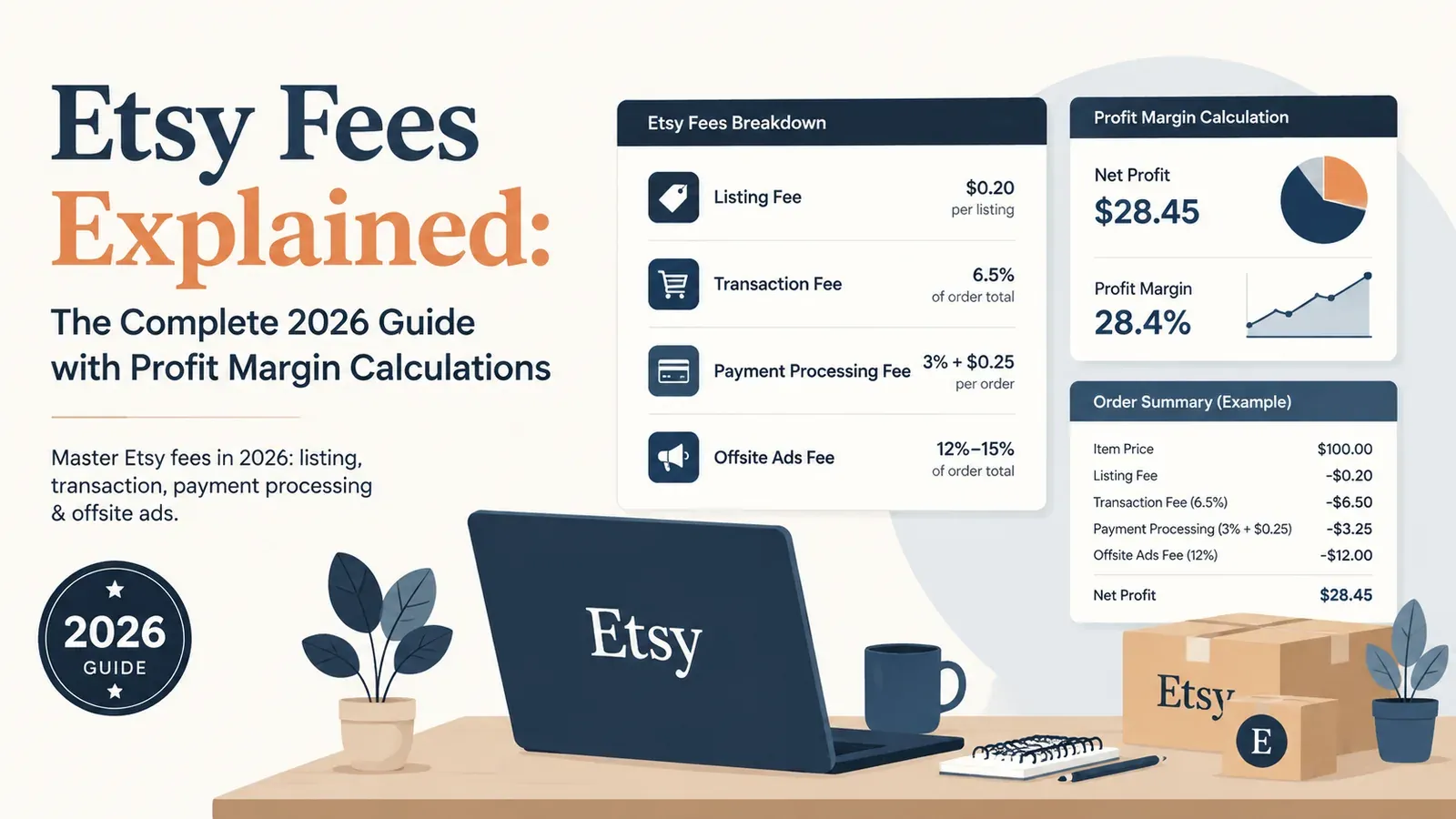
Etsy charges a $0.20 listing fee, 6.5% transaction fee, and a payment processing fee of 3% + $0.25 in the US per order in 2026.
Aim for a 35-50% profit margin after all fees to sustain a profitable Etsy shop.
Digital products skip shipping fees but still incur listing, transaction, and payment processing costs.
Sellers crossing $10,000 in annual sales are automatically enrolled in mandatory Offsite Ads, paying 12-15% per sale from external links.
You just made your first Etsy sale. That satisfying “cha-ching” notification hits, and you feel like a real entrepreneur. Then you check your actual payout and wonder: where did all my profit go?
You’re not alone. Understanding Etsy fees is one of the most confusing yet critical aspects of running a profitable shop. Many sellers price their products based on gut feeling, only to discover months later that they’ve been losing money on every sale. This guide will give you complete clarity on every fee Etsy charges in 2026, show you exactly how to calculate your profit margins, and reveal strategies to protect your bottom line.
To understand fees in context, explore our Etsy seller guide for a full breakdown of costs, pricing strategies, and profit optimization.
What Are All the Etsy Fees I Need to Know About?
Before you can price your products profitably, you need to understand every fee that will eat into your revenue. Etsy’s fee structure has multiple layers, and missing even one can throw off your entire pricing strategy.
Listing Fee: $0.20 Per Item
Every time you publish a new listing or renew an existing one, Etsy charges a flat $0.20 fee. This applies to both physical and digital products. Listings remain active for four months or until the item sells. Here’s what catches many sellers off guard: if you sell multiple quantities of the same listing, Etsy charges the listing fee per item sold, not per listing.
For example, if you list a coffee mug and sell five of them, you pay five listing fees totaling $1.00. This might seem small, but for high-volume sellers with hundreds of listings, these fees add up quickly.
Transaction Fee: 6.5% of Total Sale
This is the big one. Etsy charges 6.5% on the complete order total, which includes your product price, shipping charges, and any gift wrapping fees. Many new sellers assume this fee only applies to the item price, which leads to underpricing.
If you sell a t-shirt for $25 and charge $5 for shipping, Etsy takes 6.5% of the entire $30, which equals $1.95. This fee structure means that offering “free shipping” by baking it into your product price doesn’t save you any money on transaction fees.
Payment Processing Fee: 3% + $0.25 in the US
When customers pay through Etsy Payments (which is mandatory in most countries), you’re charged an additional 3% of the total sale plus a flat $0.25 per transaction if your bank account is in the US. This covers credit card processing, Apple Pay, and other payment methods.
Combined with the transaction fee, you’re already looking at approximately 9.5% plus $0.25 on every sale before you’ve even considered your product costs.
Where your shop’s bank account is registered changes this number, and the spread is wide. Etsy publishes the rate per country in its payment policy, which is a separate page from the fee schedule. On a $29.99 sale:
- United States: 3% + $0.25, so $1.15 comes out.
- United Kingdom: 4% + £0.20, so $1.47 comes out.
- Eurozone: 4% + €0.30, so $1.55 comes out.
- Turkey: 6.5% + ₺14.00, so $2.24 comes out.
A shop banking in Turkey pays almost double what a US shop pays on the same order, which is enough to wipe out a thin margin. Fixed fees were converted at the Wise mid-market rate on 26 August 2026, and the rates come from Etsy’s payment policy, read on the same date. The full country list is on that page.
Regulatory Operating Fee
Depending on your country, Etsy may charge additional regulatory fees to comply with local laws. These vary by region and are calculated as a percentage of the order total. Sellers in certain countries should factor this into their pricing strategy.
Try it in your shop.
Every step from design to live listing, on one platform. Start on the free plan.
How Much Does Etsy Really Take From Each Sale?
Let’s get specific with real numbers. When you add up all mandatory fees, the total cost can be surprising.
For US-based sellers, the mandatory fees break down like this:
Listing fee: $0.20 flat
Transaction fee: 6.5%
Payment processing: 3% + $0.25 in the US
This means on a $30 sale (including shipping), you’d pay approximately:
$0.20 (listing)
$1.95 (6.5% transaction fee)
$0.90 + $0.25 (payment processing)
Total fees: $3.30, or about 11% of the sale
But wait - that’s just for a regular sale. If the customer found you through Etsy’s external advertising, you could be paying significantly more.
The average Etsy seller loses track of approximately 15-20% of potential profit due to fee miscalculations. This happens because they forget to include shipping in their fee calculations or don’t account for payment processing on every sale.
What Is the Etsy Offsite Ads Fee and Can I Avoid It?
Offsite Ads is Etsy’s program where they advertise your listings on platforms like Google, Facebook, Instagram, and Pinterest. When someone clicks one of these ads and makes a purchase within 30 days, you pay an advertising fee on that sale.
The Offsite Ads Fee Structure
Shops under $10,000 in annual sales: 15% fee on attributed orders (optional - you can opt out)
Shops over $10,000 in annual sales: 12% fee on attributed orders (mandatory - you cannot opt out)
The fee is capped at $100 per order, which provides some relief on high-ticket items. However, for most print-on-demand sellers working with $25-50 products, this fee can devastate profit margins.
Here’s what makes this particularly painful: let’s say you’re selling a $30 t-shirt with $10 in production costs. On a regular sale, after standard Etsy fees (roughly $3.30), you’d make about $16.70 gross profit. But on an Offsite Ads sale, you’d pay an additional $3.60 (12%), dropping your gross profit to $13.10 - a 21% reduction in profit from a single fee.
Can You Avoid Offsite Ads?
If your shop has made less than $10,000 in the last 12 months, you can opt out through your Shop Manager settings. However, once you cross that threshold, enrollment becomes mandatory. Many sellers find themselves automatically enrolled and are surprised by the sudden fee increases.
The strategic approach is to factor offsite ads into your pricing from the beginning, even if you’re currently below the threshold. This way, your margins stay healthy as you scale.
How Do I Calculate My Profit Margin on Etsy?
Understanding your profit margin is the difference between running a hobby that loses money and building a real business. The formula is straightforward, but gathering accurate numbers requires discipline.
The Profit Margin Formula
Profit Margin = [(Revenue - Total Expenses) ÷ Revenue] × 100
Let’s walk through a real example for a print-on-demand t-shirt sale:
Sale Details:
Selling price: $29.99
Shipping charged to customer: $4.99
Total revenue: $34.98
Expenses:
POD production cost: $12.50
POD shipping cost: $4.00
Etsy listing fee: $0.20
Etsy transaction fee (6.5% of $34.98): $2.27
Payment processing (3% of $34.98 + $0.25 in the US): $1.30
Total expenses: $20.27
Profit Calculation:
Net profit: $34.98 - $20.27 = $14.71
Profit margin: ($14.71 ÷ $34.98) × 100 = 42%
This is a healthy margin. Successful print-on-demand stores typically operate with profit margins between 30-50%. Below 20%, you’re leaving yourself vulnerable to any cost increases or additional fees.
The Hidden Costs Most Sellers Forget
Your actual profit margin might be lower than calculated if you’re forgetting:
Design costs (if you pay for designs or use paid design tools)
Marketing expenses outside of Etsy
Time spent on customer service and order management
Returns and refunds
Packaging materials for non-POD items
How Can I Maximize My Profit Margins on Etsy POD Products?
Knowing your fees is only half the battle. The real question is: how do you protect and grow your margins while still staying competitive?
Strategy 1: Price for Your Worst-Case Scenario
The biggest mistake sellers make is pricing for the best case - a regular sale with no additional fees. Instead, price assuming every sale will trigger offsite ads. If it doesn’t, you make extra profit. If it does, you’re still profitable.
For a $30 product with $12 in production costs, adding the maximum 15% offsite ads fee means you need at least $4.50 in margin buffer. Price accordingly.
Strategy 2: Bundle Products with Combo Listings
Instead of paying $0.20 listing fees for each individual product, use Combo Listings to offer multiple product types (t-shirt, hoodie, mug) within a single listing. This consolidates your sales momentum, reduces listing fees, and can help you reach Bestseller status far faster.
Strategy 3: Automate Pricing Calculations
Manually calculating profit margins for hundreds of products is a recipe for errors - and errors cost real money. Sellers who manually track their pricing make calculation mistakes on approximately 23% of their listings.
Strategy 4: Scale Without Losing Track
As your shop grows, maintaining accurate pricing across hundreds or thousands of listings becomes nearly impossible manually. One price change from a supplier can throw off your margins on dozens of products.
A Real-World Scenario: The Difference Automation Makes
Meet David, a teacher who started selling print-on-demand products as a side hustle. His goal was simple: create an extra $1,000 per month in passive income selling motivational quote designs on t-shirts and mugs.
David started by manually listing products and tracking his profits in a spreadsheet. Every evening after work, he’d spend 2-3 hours updating listings, calculating margins, and adjusting prices. After three months, he had 50 listings generating about $400/month in revenue.
Then he checked his actual profit: just $47. He had made calculation errors on his production costs, forgotten to account for payment processing fees on most listings, and priced several products below break-even without realizing it.
David discovered Listybox and rebuilt his shop. Using the Magic Wand SEO tool for optimized listings, he expanded to 200 listings in two weeks.
Six months later, David’s shop generates $3,200 monthly in revenue with $1,280 in actual profit. Most of the time he puts into the shop goes to creating new designs. His orders run through Zero-Touch Fulfillment: each order lands in My Orders in Listybox, and once David pays for it there, it goes to production and the tracking number is written back to his Etsy order.
Taking Control of Your Etsy Profit Margins
Etsy fees aren’t going away. In fact, history suggests they may continue to increase over time. The sellers who thrive are those who understand every fee, price strategically, and use systems that eliminate calculation errors.
Here’s your action plan:
1. Audit your current listings - are you accounting for ALL fees?
2. Calculate your true profit margin on your top 10 products
3. Identify any products priced below your target margin
4. Consider how automation could protect your profits as you scale
Does setting up your Etsy shop and managing all these calculations feel overwhelming? You don’t have to figure it all out alone. With Listybox Store Setup, our team helps you set up your Etsy store. It is available inside a custom Enterprise+ offer, so plan a demo or write to [email protected].
To check one of your own listings against the fee structure above, the free Etsy profit calculator has all of it built in, including Offsite Ads at both rates.
Ready to stop guessing and start profiting? Start for free - no credit card required.
Frequently asked questions
Put this into practice in your shop.
Every step from design to live listing, on one platform. Start on the free plan.
Related posts



Want to go deeper? Read our in-depth Etsy guides · Browse 100 Etsy niche guides