
The Etsy Free Shipping Strategy for 2026: Beat the Algorithm Update
Are your Etsy views suddenly dropping? The February 2026 algorithm update now heavily penalizes high shipping costs. Learn how to bake print-on-demand shipping into your product prices to recover your rankings and increase your profit margins.
Bullet Points (TL;DR)
The 2026 Etsy algorithm update heavily prioritizes listings with free shipping, especially those meeting the $35 threshold.
Bake average shipping costs into your product prices to maintain profit margins while offering free shipping.
Configure your shop to meet the free shipping guarantee requirements to earn the ranking boost and badge.
For international orders, adjust pricing or use calculated shipping profiles to avoid losses while staying competitive.
Higher prices with free shipping can outperform lower prices plus shipping fees because buyers value transparency and the perception of a deal.
The e-commerce landscape shifted dramatically in February 2026. If you have noticed a sudden, unexplained drop in your Etsy store traffic, you are not alone. Many sellers woke up to find their best-selling items pushed to the second or third page of search results.
The culprit is not a bad design or a sudden change in consumer taste. It is the new Etsy algorithm update. Etsy has officially made shipping prices a primary ranking factor. The platform now actively rewards listings that offer free shipping or keep their shipping costs strictly under $6. Listings with high, unexpected shipping fees added at checkout are being pushed down in visibility.
This creates a massive hurdle for print-on-demand sellers. When you work with production partners, you do not control the base shipping rates. If a heavy hoodie costs $8 to ship, how can you possibly offer free shipping without eating the cost and destroying your profit margin? The answer lies in a strategic pricing model known as "baking in" your costs. Let us look at exactly how to adjust your pricing and shipping profiles to beat the 2026 algorithm update and get your products back on the first page.
What Is the February 2026 Etsy Algorithm Update?
To succeed on any marketplace, you must understand what the platform wants. Etsy wants buyers to complete their purchases. They want high conversion rates.
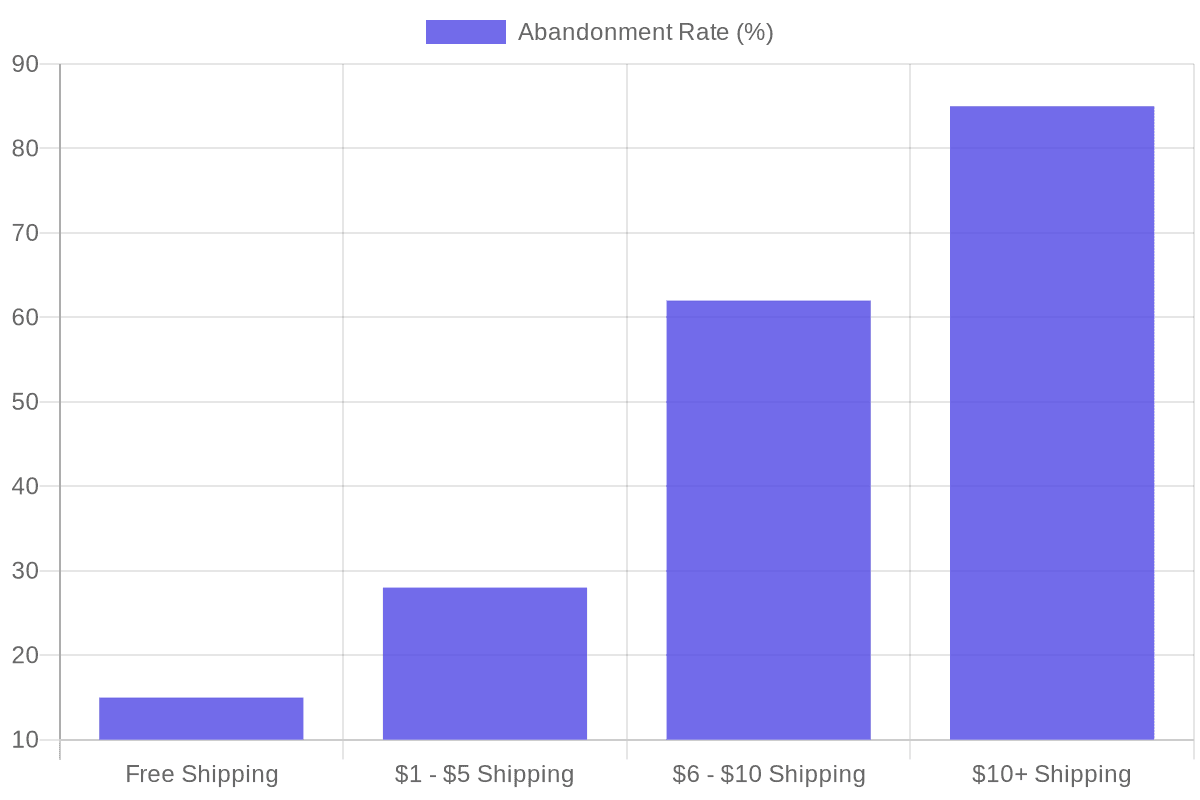
Over the past few years, cart abandonment has been a growing problem for the platform. A buyer finds a $20 t-shirt, adds it to their cart, and heads to checkout. Suddenly, an $8.50 shipping fee appears. The total jumps to nearly $30. The buyer feels tricked, closes the tab, and buys something on Amazon instead. Etsy loses the sale, and you lose the customer.
Recent consumer behavior data shows that 62% of online shoppers will abandon their cart if shipping costs are too high or revealed too late in the checkout process.
To combat this, the February 2026 algorithm update changed how the search engine ranks products. The algorithm now scans your shipping profile before deciding where to place your item in search results.
If you offer free shipping, you get a significant visibility boost. If your shipping is under $6, you remain competitive. If your shipping is over $6, the algorithm assumes your listing will cause cart abandonment, and your ranking drops. This is a permanent shift. You can have the best SEO tags in the world, but if your shipping is $9, you will struggle to get views. If you want to dive deeper into how keywords work alongside these new rules, read our Etsy SEO guide.

The Psychology of Free Shipping
Before we look at the math, we need to understand the psychology of the buyer. Why does this update exist, and why does free shipping work so well?
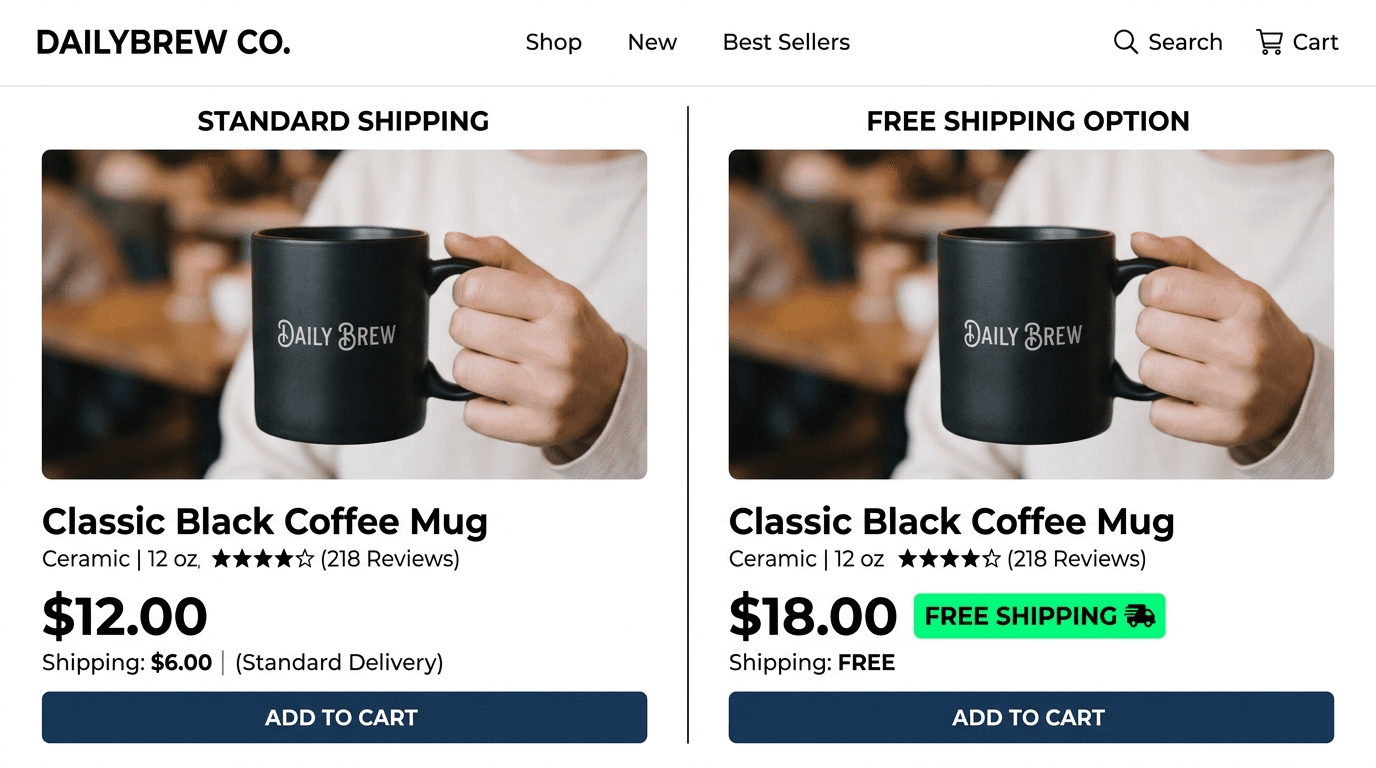
Human brains are wired to perceive "free" as a massive benefit, even if the total cost is identical. Consider two pricing models for the exact same mug:
Option A: Mug costs $12 + $6 Shipping. Total = $18.
Option B: Mug costs $18 + Free Shipping. Total = $18.
Logically, the buyer pays $18 out of their bank account either way. However, Option B converts at a much higher rate. When a buyer sees Option A, they feel like they are paying $6 for a service (shipping) that has no physical value to them. They feel penalized. When they see Option B, they feel like they are buying a premium $18 product and getting a bonus reward (free shipping).
Etsy knows this psychology works. By forcing sellers to adopt the Option B model, Etsy improves the overall buying experience on their platform. Your job is not to fight this psychology, but to use it to your advantage.
How Do Print-on-Demand Shipping Costs Actually Work?
A major point of confusion for new sellers is understanding who actually pays for shipping in a print-on-demand model. Let us clarify the flow of money so you can price your items correctly.
When you use a platform like Listybox, you are dealing with two separate financial transactions for every sale.
Transaction 1: The Customer Pays You The customer goes to your Etsy shop, buys a t-shirt, and pays Etsy. Etsy takes their transaction and processing fees, then puts the remaining money into your Etsy payment account. This money belongs to you.
Transaction 2: You Pay the Production Partner Once the order comes in, it needs to be printed and shipped. This is where Listybox's intelligent automation system customized for Etsy sellers takes over. Through our Zero-Touch Order Management, the order is caught automatically. Listybox then charges your connected credit card for the base cost of the blank t-shirt plus the actual shipping cost charged by the printing facility.
The customer does not pay Listybox. You pay Listybox. Therefore, if the printing facility charges $5 for shipping, that $5 comes out of your pocket. If you did not charge the customer for shipping, or if you did not hide that $5 inside the retail price of the shirt, you will lose money.
How to Price Products for Free Shipping or Under $6
The solution to the algorithm update is the "Bake-In" strategy. You must take the base shipping cost and bake it into your retail item price. This allows you to offer free shipping to the customer while still covering your expenses.
Let us look at the exact mathematical formula you should use in 2026.

The Profit Formula
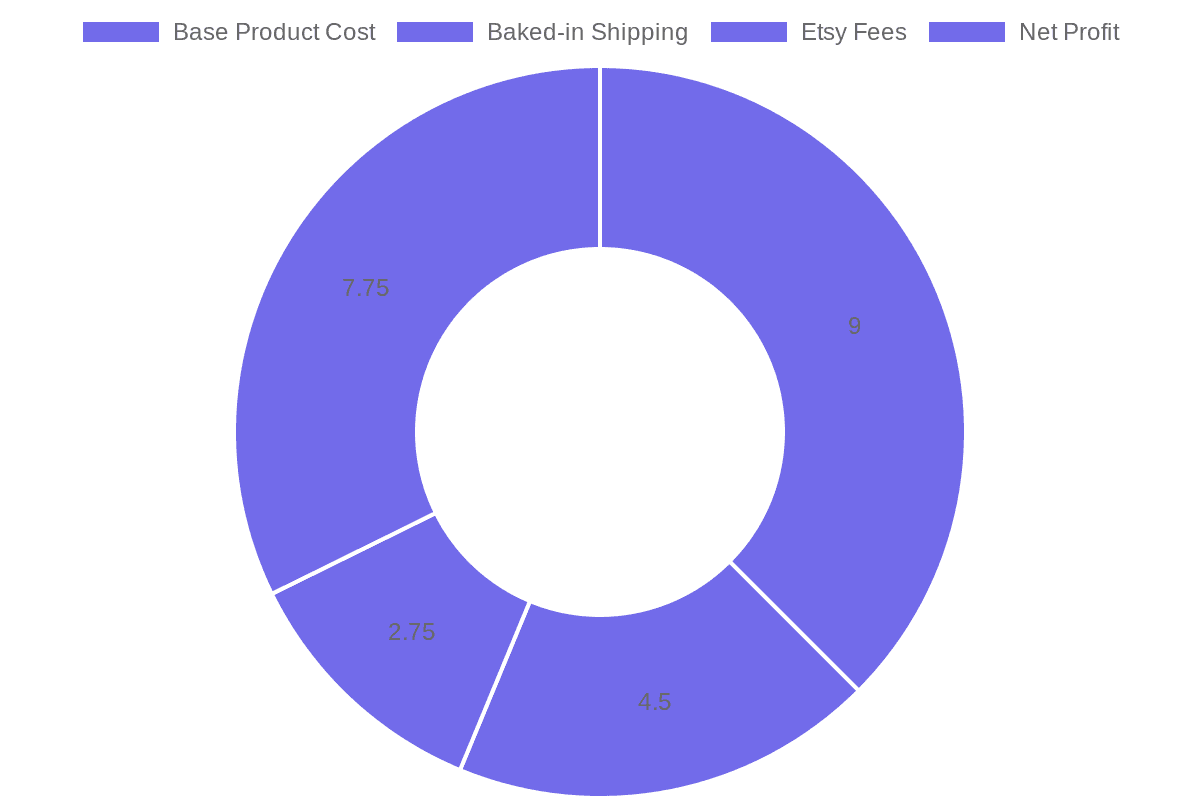
To find your ideal retail price, you need to account for four things: the base product cost, the shipping cost, Etsy fees (roughly 9.5% + $0.45 depending on your region), and your desired profit.
Here is a real-world example using a standard unisex t-shirt.
Base Product Cost: $9.00
Actual Shipping Cost: $4.50
Total Cost to You: $13.50
If you want to make a clear $7.00 profit on this shirt, you cannot just price it at $20.50. You must account for Etsy taking their cut of the total sale price.
Target Retail Price: $24.00 (with Free Shipping)
Etsy Fees on $24: ~$2.75
Total Expenses (Product + Shipping + Fees): $16.25
Your Final Net Profit: $7.75
By pricing the shirt at $24 with free shipping, you hit the algorithm's requirement, you satisfy the buyer's psychology, and you walk away with a healthy profit.
If a $24 t-shirt feels too expensive for your niche, you can use a hybrid model. Price the shirt at $20 and charge $4 for shipping. You still stay under the algorithm's $6 penalty threshold, and your total revenue remains $24.
Keeping Your Base Costs Low
The bake-in strategy only works if your base costs are low enough to allow for a competitive retail price. If your production partner charges $14 for a blank shirt and $6 for shipping, your total cost is $20. To make a profit, you would have to sell the shirt for $30, which is too high for most basic apparel.
This is where securing excellent production rates becomes vital. You need access to the best pricing in the industry. By using our Lowest Price Guarantee, you automatically get the best negotiated rates from top printing facilities without paying for a premium monthly subscription. Lower base costs mean you can comfortably bake in your shipping and still keep your retail prices attractive to buyers.
Step-by-Step: Setting Up Your 2026 Etsy Shipping Profiles
Now that you understand the math, you need to apply it to your Etsy shop. Etsy shipping profiles tell the system exactly what to charge customers based on their location. Setting these up incorrectly can lead to massive financial losses, especially with international orders.
Here is how to set up your profiles to satisfy the 2026 algorithm.
Step 1: Create a Domestic Free Shipping Profile
If you are selling primarily to the US market, your goal is to offer free domestic shipping.
Go to your Etsy Shop Manager.
Click on Settings, then Shipping settings.
Click Add a shipping profile.
Name the profile something clear, like "T-Shirts - US Free Shipping".
Under Origin zip code, enter the zip code of your primary print provider (you can find this in your Listybox product details).
Under Processing time, select the average production time (e.g., 2-5 business days).
Under Standard shipping for your domestic country, select Free shipping from the drop-down menu.
Step 2: Handle International Shipping Carefully
You cannot offer free shipping worldwide. International shipping for a t-shirt can cost $10 to $15. If you bake $15 into your retail price, your item will be far too expensive for domestic buyers.
Instead, you must charge a calculated fee for international buyers.
In the same shipping profile, scroll down to Everywhere Else.
Select Fixed cost.
How much should you charge? Take the actual international shipping cost from your provider and subtract the domestic shipping cost you already baked into the item price.
For example: If international shipping costs $12, and you already baked $4.50 into the retail price of the shirt, you should charge the international customer $7.50 ($12.00 - $4.50 = $7.50).
Enter $7.50 in the shipping fee box for Everywhere Else.
This exact formula ensures you do not overcharge international buyers, but you also do not lose money on overseas shipping.
Step 3: Utilize Localized Routing
One of the best ways to keep international shipping costs low is through localized routing. When you use a smart fulfillment system, an order from the UK does not need to be printed in the US and shipped across the ocean.
The system will automatically route the UK order to a printing facility located in the UK. This drops the shipping cost from $12 down to local rates, usually around $4 or $5. Because this local rate is similar to your US domestic rate, you can often afford to offer free shipping to multiple regions, massively boosting your global conversion rates.
Always check the specific shipping costs for different product categories. A shipping profile for a lightweight t-shirt will not work for a heavy ceramic mug or a large framed canvas. Create separate profiles for each product type.
Does all of this feel overwhelming? You do not have to start from scratch. With Listybox Store Setup, our expert team sets up your Etsy store, lists your first 10 products, and optimizes everything for SEO. This service is included FREE with annual Starter and Professional plans!
Handling Returns and Refunds with Baked-In Shipping
A common question from sellers is how to handle refunds when the shipping cost is hidden inside the item price. If a customer buys a $25 shirt (which includes $5 of baked-in shipping) and asks for a refund, do you refund the full $25?
In most cases, yes. When you offer free shipping, the customer expects a full refund of the purchase price if the item arrives damaged or defective. Because print-on-demand products are custom-made, you generally do not accept returns for buyer's remorse (like ordering the wrong size). You only refund for production errors.
When a production error occurs, your printing partner will usually provide a free replacement or a refund for the base cost and shipping. This means you are not left out of pocket. Be sure to state your return policies clearly in your shop. If you need help crafting these rules, read our guide on Etsy shop policies.
How to Protect Your Profit Margins While Offering Free Shipping
The biggest fear sellers have with the bake-in strategy is that their prices will look too high compared to the competition. If everyone else is selling shirts for $15 (plus hidden shipping), your $24 free shipping shirt might seem expensive at first glance.
To make the bake-in strategy work, you must increase the perceived value of your product. A buyer will happily pay $25 for a t-shirt if it looks like a premium, high-end brand.
Elevate Your Visual Branding
The fastest way to increase perceived value is through your product photography. If you use the same flat, boring, white-background mockups that thousands of other sellers use, you cannot command a premium price. You will look like a cheap commodity.
Instead, you need to show your designs in real-world, aspirational settings. When a buyer sees your design worn by a stylish model in a cozy coffee shop, the perceived value of the item skyrockets. They are no longer buying a piece of cotton; they are buying an aesthetic.
Creating these images manually takes hours and expensive software. Instead, use the ListyStyle mockup creator. This tool analyzes your design and generates hundreds of hyper-realistic lifestyle photos in seconds. Data shows that upgrading from standard mockups to lifestyle photography can increase your click-through rate by up to 5 times, allowing you to easily justify a 20% to 30% higher retail price. This extra margin easily covers your baked-in shipping costs.
Create Product Bundles
Another excellent way to offset shipping costs is to encourage buyers to purchase multiple items. Shipping two t-shirts in the same package costs significantly less than shipping two t-shirts separately.
You can create listings that naturally encourage bundling. Selling matching couples shirts, group vacation tees, or a set of three complementary wall art prints increases your average order value. The profit margin on the second and third items in the package will be much higher because the base shipping cost is already covered by the first item.
Conclusion: Adapt and Thrive
The February 2026 Etsy algorithm update is not a punishment; it is an opportunity. While other sellers panic about dropping views and refuse to change their pricing models, you now have the exact blueprint to adapt.
By understanding the psychology of free shipping, calculating your bake-in costs accurately, and setting up smart shipping profiles, you align your shop perfectly with what the algorithm wants to promote. Combine this pricing strategy with premium lifestyle mockups, and you will turn a potential traffic drop into a massive competitive advantage.
Stop letting shipping costs eat into your profits or ruin your search rankings. Take control of your pricing strategy today, and watch your store climb back to the top of the first page.
Never Miss an Update
Get actionable Etsy tips delivered to your inbox every week. No spam, unsubscribe anytime.