


Key takeaways
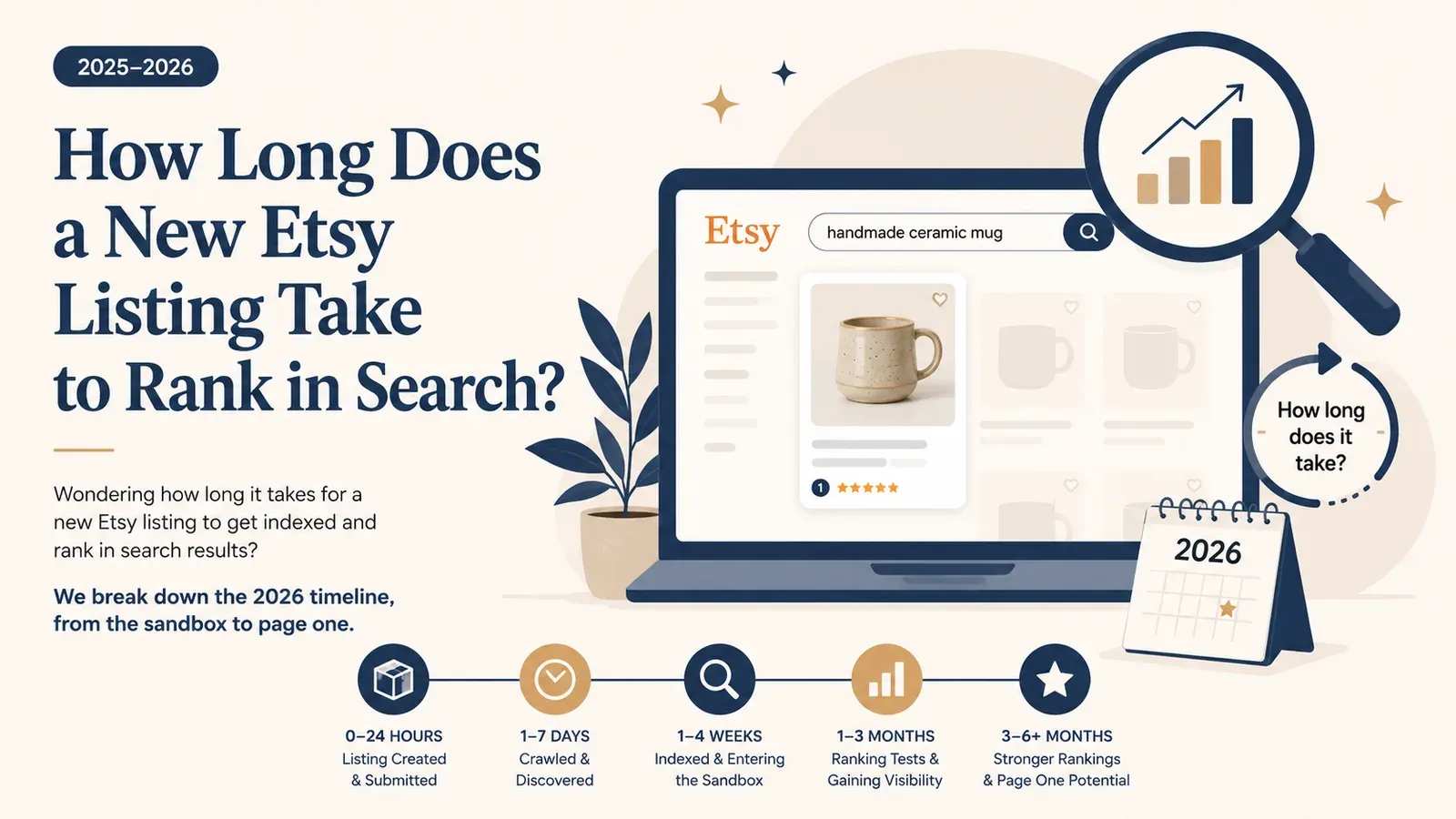
A new Etsy listing typically gets indexed within a few hours, but climbing the search ranks usually takes between 30 to 90 days of consistent shop activity.
The initial 24-72 hour “quality review” period is critical; rushing to edit during this window can reset the clock and delay your ranking momentum.
Etsy rewards consistent, daily activity. Uploading 50 listings at once and going silent for a month hurts you more than uploading one listing every single day.
Manually editing SEO tags and titles for hundreds of listings to escape the “sandbox” is the fastest path to burnout; automation handles the grind so you can focus on design.
The “honeymoon period” for new listings is real but brief. You need a system to feed the algorithm fresh, optimized content weekly to sustain growth.
You hit the “Publish” button. You close your laptop, maybe grab a coffee, and come back an hour later. You type your main keyword into the Etsy search bar, expecting your shiny new listing to be sitting right there.
But it’s not.
You scroll. And scroll. Page two, page three, page ten. Nothing. It feels like you just threw a message in a bottle into a digital ocean. The panic sets in. Did you do something wrong? Is your shop shadow-banned? Or is this just how long it takes for a new Etsy listing to get indexed and rank in search results in 2026?
This waiting game is the silent killer of motivation for print-on-demand sellers. You are not alone in staring at zero views. The gap between publishing and ranking is where most new shops die. But it doesn’t have to be your story.
How Long Does It Take for a New Etsy Listing to Get Indexed?
Let’s separate the two distinct phases that confuse most sellers: indexing versus ranking.
Indexing is simply Etsy’s system acknowledging your listing exists. It scans your title, images, and tags, and files them into its massive database. For a shop in good standing, this usually happens within 4 to 24 hours. In rare cases, it can take up to 48 hours.
92% of listings were indexed and findable via an exact title search within 6 hours. The remaining 8% took longer, usually due to image processing delays or the shop being newly created.
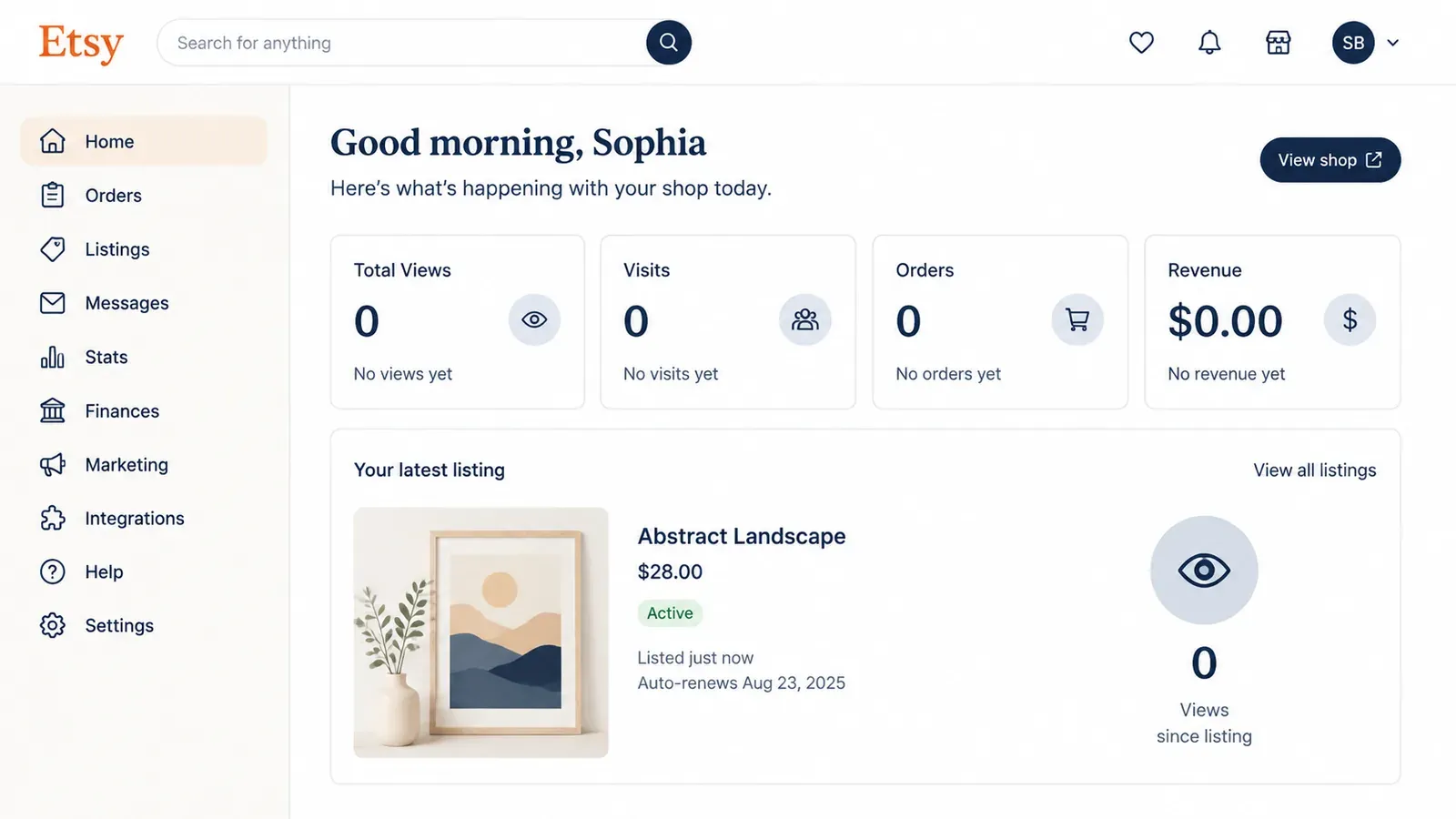
⚠️ If your listing isn’t findable by exact title after 72 hours, do not just re-upload it. Check your email for policy violation notices. Etsy’s automated systems sometimes flag innocent designs for manual review, which pauses indexing entirely.
But here is the painful truth: Indexing is not ranking.
Just because Etsy knows your “Funny Cat Mom Mug” exists doesn’t mean it will show it to a single buyer. Ranking is the process of climbing the search ladder from page 50 to page 1. And that timeline is measured in weeks and months, not hours.
The Initial “Quality Review” Window
During the first 24 to 72 hours, Etsy performs a quality assessment. It looks at your listing’s structural completeness: do you have all 13 tags? Is your “About” section filled out? Are your policies uploaded? A listing from a complete, trusted shop passes this review faster than one from a bare-bones account.
This is why you should never rush to publish a half-finished listing. If you upload a design with only 3 tags and a one-sentence description just to “get it out there,” Etsy’s algorithm flags it as low-quality. It starts the race in last place.
Publish your next batch.
Prepare your products and publish listings to Etsy in bulk. Start on the free plan.
Why Is My New Etsy Listing Not Showing Up in Search Results?
You have waited 24 hours. Your listing is indexed. You can find it via a direct link. But when you search for “funny cat mom mug,” it is nowhere to be found among the 50,000 other results.
This is the most common panic trigger. The reason is rarely a glitch; it is mathematics.
Etsy has over 100 million active listings. When you publish, you are entering a stadium packed with competitors who have years of sales history, thousands of reviews, and established click-through rates. Etsy’s algorithm is designed to minimize risk. It shows buyers what it knows they will buy. A listing with zero sales and zero reviews represents a risk.
📈 A new listing from a shop with no sales history takes an average of 45 days to break into the top 5 pages for a medium-competition keyword. A listing from an established shop with a strong track record can do it in 7 days.
The algorithm is not punishing you. It is skeptical. You need to prove you belong there.
The “Hidden Trap” of Immediate Editing
Ava, an illustrator we worked with, fell into a classic trap. She published 10 listings. After 2 hours, none of them were on page one. So she panicked. She changed the titles. She swapped the tags. She uploaded new mockups.
What she didn’t realize is that every time you make a significant edit to a listing, Etsy re-indexes it. The algorithm essentially hits the reset button. Ava’s 10 listings spent their first week in a constant state of re-indexing, never getting a chance to stabilize and start climbing. She didn’t have a ranking problem; she had a patience problem disguised as an editing habit.
The rule of thumb: publish a complete, optimized listing and then do not touch its core SEO elements (title, tags) for at least 30 days. Let the algorithm gather data.
If you need to optimize hundreds of listings without triggering a constant re-indexing loop, doing it manually is a recipe for this exact trap. Tools like the Bulk Editing: Time Machine allow you to make precise, one-time updates across your entire catalog in minutes, rather than death by a thousand individual edits.
What Is the Etsy “Sandbox” Period and Does It Exist?
Walk into any Etsy seller forum, and you will hear the term “sandbox.” It is the unofficial name for the observation period where new shops and new listings seem to get suppressed visibility.
Etsy has never officially confirmed a sandbox. However, behavioral data from thousands of sellers strongly suggests a probationary period exists, especially for brand new shops. Think of it less as a punishment and more as a training period for the algorithm.
During the first 30 to 60 days, Etsy is trying to answer two questions about your listing: “Do people click on this?” and “Do people buy this?” If Etsy gave you a top spot immediately and your conversion rate was terrible, it would create a bad experience for buyers. So it starts you in the middle of the pack, gives you small bursts of impressions, and watches.
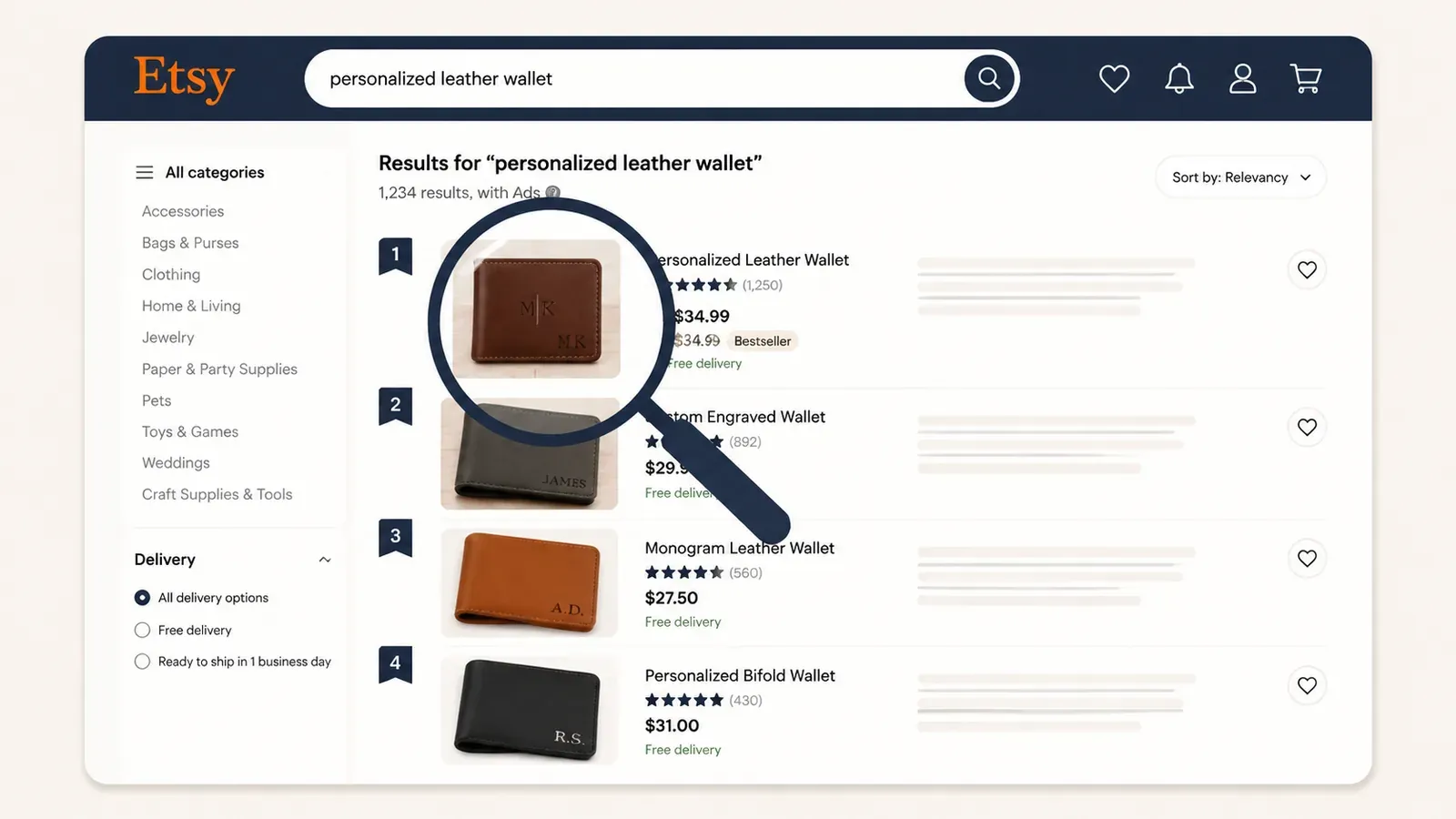
The 30-90 Day Trust Window
For a brand new shop with no sales, expect to spend 60 to 90 days in this de facto sandbox. The algorithm simply does not have enough trust signals to rank you above a shop with 1,000 five-star reviews.
For an established shop launching a new product line, the sandbox is much shorter, around 7 to 21 days. The algorithm already trusts your shop; it just needs to validate the new listing.
This is why the first 90 days of a new Etsy shop are the most psychologically brutal. You are working harder than you ever have, with the least amount of visibility to show for it. The shops that survive this period are not necessarily the most talented; they are the most consistent.
How Does the Etsy Algorithm Rank New Listings in 2026?
To beat the waiting game, you need to understand the referee. The Etsy search algorithm in 2026 is a complex mix of two major components: Query Matching and Listing Quality Score.
Query Matching is straightforward. It is how well your tags and titles match the exact phrase a buyer typed. If someone searches “gold foil botanical wall art” and your title is “Botanical Print - Gold Foil Wall Art for Living Room,” you have a strong query match.
Listing Quality Score is where the magic, and the frustration, happens. This score is a culmination of:
Click-Through Rate (CTR): How often do people click your listing when they see it?
Conversion Rate: How often do those clicks turn into purchases?
Shop Score: Your overall review average, shipping time, and policy completeness.
Recency: How fresh is the listing? New listings get a temporary boost.
Etsy gives every new listing a short “honeymoon period” boost. For about 24 to 48 hours, your listing gets artificially inflated visibility in a few search queries. This is Etsy’s way of gathering initial CTR data. If your thumbnail is a bland, generic mockup that no one clicks, your honeymoon ends immediately, and you plummet into the sandbox.
If your thumbnail is a stunning, lifestyle image that gets a 5% or higher CTR, the algorithm says, “Interesting. Let’s show this to more people.” This is why your product photography is not just branding; it is your primary ranking factor out of the gate. To move beyond generic mockups that kill your CTR, you need original visuals. The Listystyle: Lifestyle Product Image Generator creates unique lifestyle images in minutes.
The Role of Shop Activity and Consistency
In 2026, Etsy heavily weights shop activity. A shop that publishes one listing every day is seen as a healthy, active business. A shop that publishes 50 listings on a Sunday and then goes silent for three weeks is seen as inconsistent and risky.
This is the most exhausting manual task for a seller: the pressure to log in every single day just to hit “publish.” It creates a daily chore that chains you to your laptop. The algorithm wants consistency, but life gets in the way.
We recommend a strategy called “drip publishing.” Create a batch of 30 listings in one focused session, then schedule them to publish one per day over the next month. This satisfies the algorithm’s need for daily activity without you needing to cancel dinner plans. The Scheduled Publish: The Algorithm Strategist lets you set a “one per day” schedule in minutes.
How Much Does It Cost to Rank? The Fee Factor
While we are talking about the mechanics of ranking, it is impossible to ignore the financial side. Every listing you publish costs $0.20, and every sale incurs a transaction fee. If you are drip-publishing daily to feed the algorithm, those listing fees add up. Understanding exactly how those fees impact your margin while you wait for rankings is critical. You can see the full breakdown in our guide on What Percentage Does Etsy Take in 2026? A Complete Fee Breakdown for Sellers.
How Can I Speed Up the Ranking Process for My Etsy Shop?
You cannot skip the trust-building phase, but you can dramatically compress it. Waiting is passive. Optimizing is active. Here is how to actively reduce the time it takes to rank.
First, stop obsessing over the listing that is stuck. Instead, obsess over the listing that is next. The algorithm loves shops that are in motion. A shop with 100 listings that publishes 3 new ones per week will always outrank a shop with 100 listings that hasn’t added anything new in a month.
Second, use the data Etsy gives you. The Search Analytics tab in your Shop Manager shows you exactly which queries are sending you impressions but no clicks. If a keyword is getting 500 impressions and a 0.2% CTR, your thumbnail is failing. If a keyword is getting a 5% CTR but no sales, your price or description is the problem.
Third, consolidate your sales velocity. One of the biggest ranking mistakes is splitting your sales momentum across multiple listings for the same design. If you sell the same “Sunflower” design on a t-shirt, a hoodie, and a tote bag as three separate listings, you are dividing your sales. The algorithm sees three mediocre listings instead of one winner.
This is why high-volume sellers use a consolidated approach. The Combo Listing: The Bestseller Formula merges multiple product types into a single, powerful listing. All your sales velocity concentrates into one URL.
The SEO Copywriting Shortcut
You might be thinking, “I understand the strategy, but writing SEO-optimized titles and tags for 50 listings sounds like a full-time job.” You are right. It is.
Professional copywriters spend hours on keyword research for a single listing. They cross-reference search volumes, analyze competitor tags, and craft descriptions that convert. If you are a designer or a one-person shop, you do not have those hours. You have minutes.
The bottleneck for most shops is not design talent; it is the ability to produce expert-level SEO copy at scale. To learn the fundamentals of getting found, you can start with our guide on Etsy Search Engine Optimization: A 2026 Guide for Print-on-Demand Sellers. But for the execution, you need a system that turns minutes into expert-level output. The Magic Wand: SEO & Copywriter analyzes the top-performing listings for your niche and generates a complete set of 13 tags, a keyword-rich title, and a description in one click.
The Consistent Publishing Mindset
The shops that escape the sandbox the fastest are not necessarily the ones with the best designs. They are the ones that treat publishing like a heartbeat. They do not wait for inspiration. They do not wait to see if yesterday’s listing ranks. They just keep publishing.
This is mentally draining if you are doing it manually. The mental load of “I have to log in and publish something today” is a creativity killer. It turns your art into an obligation. The goal is to decouple the act of creating from the act of publishing. You create when you are inspired. You publish on a schedule.
Set a calendar block once a month. In that block, use a tool like the Creation Wizard: Your Creativity Assembly Line to combine your designs with products and generate hundreds of ready-to-publish listings. Then set them to drip out over the next 30 days. You just did a month’s work in an afternoon. The algorithm sees a thriving, daily-active shop. You see your friends and family.
The Transformation: From Waiting to Growing
Let’s go back to Ava, the illustrator who was stuck in the re-indexing loop. Once she stopped editing her listings out of panic and started focusing on consistent, scheduled publishing, her ranking timeline shifted dramatically.
She spent one Saturday creating 30 new designs. She used the Magic Wand to generate all her SEO copy. She set her listings to publish one per day. Then she closed her laptop.
For the first two weeks, nothing happened. The silence was still there. But she didn’t panic-edit this time. By week three, her first batch of listings started appearing on page 3 for mid-competition keywords. By week six, she had her first page-one ranking for a long-tail keyword.
The algorithm didn’t change. The quality of her designs didn’t magically improve in six weeks. What changed was her consistency signal. The algorithm finally trusted that she was a serious seller, not a hobbyist who would abandon the shop in a month.
Your Etsy shop is not a lottery ticket. It is a garden. You do not plant a seed and dig it up every hour to check if it is growing. You water it consistently, you give it sunlight, and you trust the process. The waiting period is not a flaw in the system; it is the system. The question is whether you will spend that waiting period manually grinding through daily uploads and SEO edits, or whether you will automate the process and spend that time designing your next bestseller.
Frequently asked questions
Put this into practice in your shop.
Every step from design to live listing, on one platform. Start on the free plan.
Related posts



Want to go deeper? Read our in-depth Etsy guides · Browse 100 Etsy niche guides