Etsy Product Photography: The Complete Guide to Images That Sell (Without the Studio)
Great product photos can make or break your Etsy shop, but setting up professional photoshoots is expensive and time-consuming. This guide reveals the photography techniques top sellers use and introduces an intelligent automation alternative that eliminates the need for traditional product photography entirely.
Bullet Points (TL;DR)
Master the Basics: Natural lighting, clean backgrounds, and smartphone cameras are enough to capture quality Etsy photos.
Understand Photo Types: Use a mix of hero shots, lifestyle images, scale photos, and detail close-ups to tell your product's complete story.
Lifestyle Images Drive Sales: Products shown in real-world contexts can increase conversion rates by up to 50% compared to flat designs.
POD Sellers Face Unique Challenges: Without physical products, traditional photography becomes nearly impossible.
AI Changes Everything: Listybox's fine-tuned AI engine generates hundreds of unique, hyper-realistic lifestyle photos from a single design, eliminating expensive photoshoots.
You've poured hours into creating the perfect design. Your Etsy listing is optimized, your pricing is competitive, and you're ready to launch. Then you hit a wall: product photography.
For print-on-demand sellers, this is where dreams collide with reality. How do you photograph products you've never touched? How do you compete with sellers who have professional studios when you're working from a kitchen table? The truth is, photography has always been the hidden bottleneck that separates struggling shops from thriving businesses.
But the rules are changing. In this guide, you'll learn the fundamentals of professional Etsy product photography and discover why thousands of POD sellers are abandoning traditional photoshoots entirely for something far more powerful.
For a broader look at every aspect of running a successful shop, see our Etsy seller guide.
What Equipment Do I Need for Etsy Product Photography?
The good news is that professional-looking Etsy photos don't require a professional budget. Many successful sellers started with nothing more than a smartphone and natural light.
The Smartphone Advantage
Forget expensive DSLRs. Modern smartphones are capable of taking high-quality photos that can rival entry-level photography gear. The key isn't the camera itself, but how well you use its features to capture clear, well-lit, and properly focused images.
Here's what actually matters:
Keep ISO below 800 to reduce noise and graininess
Tap to focus and adjust white balance for accurate colors
Avoid digital zoom (crop later instead)
Disable the flash to prevent overexposure and unnatural colors
Clean your lens before every session
Lighting: The Game-Changer
Lighting is the single most critical element in product photography. Too many sellers make the mistake of using harsh light, which creates unflattering shadows, streaks, or glares.
Natural light is your best friend. Shoot near a large window with bright, indirect light during morning or late afternoon hours. This soft, diffused light enhances color accuracy and texture without the overly staged look that artificial lighting can create.
If you need more control, consider investing in a lightbox. You can find great options for under $100, most of which come complete with built-in adjustable lighting that provides consistent results regardless of weather or time of day.
Backgrounds That Convert
A clean, simple background keeps shoppers focused on your product. White, light gray, or beige backgrounds are especially popular on Etsy because they create consistency and make listings look polished.
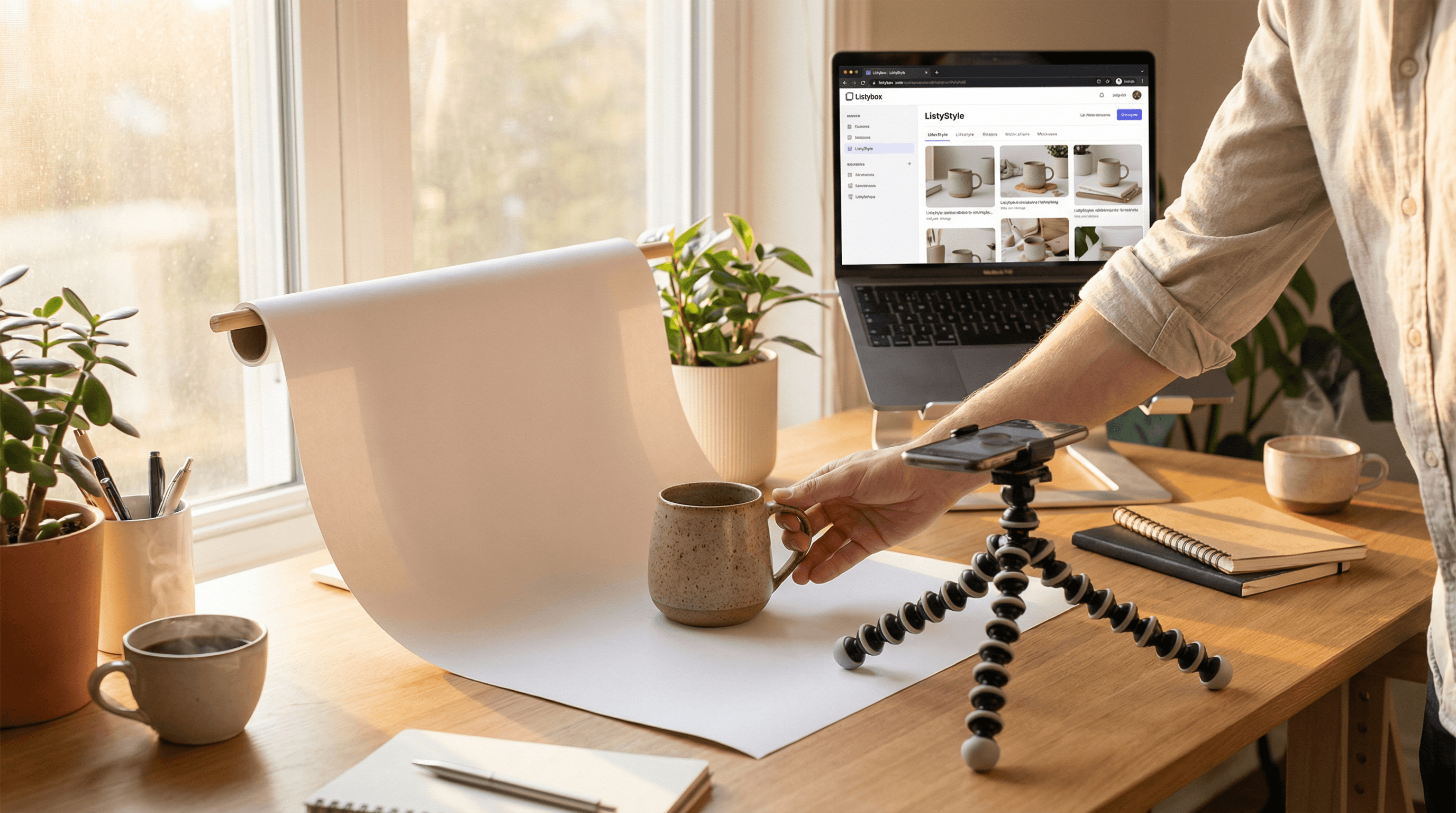
The secret to seamless backgrounds? Use a "sweep." Tape poster board to your table and curve it up against the wall. This infinity sweep makes your product look like it's floating in space without any distracting lines or corners.
How Can POD Sellers Create Professional Photos Without Physical Samples?
Here's where print-on-demand sellers face a unique nightmare. Traditional photography requires one thing you simply don't have: physical products.
Meet Sarah, a graphic designer who decided to launch a POD t-shirt shop. Her designs were incredible. She spent weeks perfecting her Etsy SEO, studying competitors, and building her brand identity. Then reality hit.
To photograph her products traditionally, she would need to order samples of every design, in every color, on every product type. At $15-20 per sample, her 50-design collection across 10 products would cost over $7,500 just for photography. And that's before counting her time setting up shoots, editing photos, and storing inventory she'd never sell.
She tried using the generic mockups from her print provider. But scrolling through Etsy, she noticed something devastating: dozens of competitors had identical images. Same angle, same lighting, same boring flat design overlay. Her unique artwork looked exactly like everyone else's.
This is the POD photography paradox. You can't photograph what you don't own, but generic mockups make you invisible in a sea of sameness.
The AI Alternative
This is exactly why Listybox developed ListyStyle mockup creator. Instead of fighting the impossible battle of traditional photography, ListyStyle uses Listybox's fine-tuned AI engine built specifically for Etsy to generate hundreds of completely unique, hyper-realistic lifestyle photos from a single design upload.
The difference is staggering. While competitors are stuck with the same flat mockup templates everyone uses, your products appear in authentic real-world scenes: a cozy coffee shop, a sunlit bedroom, a model walking through a farmer's market. Each image is completely original, generated specifically for your design and your brand.
Our internal data shows that sellers using ListyStyle see click-through rates increase by up to 5x compared to standard mockups, with conversion rates jumping as high as 10x for certain product categories.
What Types of Product Photos Increase Etsy Sales?
Etsy allows up to 20 images per listing, and using all 20 spaces improves conversions because each additional image adds more information for potential buyers.
Not every photo serves the same purpose. Understanding the role of each image type helps you build listings that answer questions before customers ask them.
Hero Shots
Your first photograph is everything. It's the thumbnail that appears in search results and determines whether shoppers click or scroll past. Make your main image a clear, eye-catching photo with proper lighting and a clean background. This is your billboard.
Detail Close-ups
Show off your craftsmanship. Focus on impressive details that would be missed in a wide shot. For apparel, this might mean fabric texture. For jewelry, the clasp and finish. These details build trust and justify premium pricing.
Scale and Comparison Shots
Shoppers want to know exactly what they're buying. Include images with common objects for size reference, or show products in use to communicate dimensions clearly. A mug next to a coffee maker tells buyers more than any measurement in your description.
Group and Variation Shots
If you offer different colors, sizes, or styles, photograph them together. This increases perceived value and helps customers visualize their options without clicking between listings. It's also a powerful upselling opportunity.
Packaging Photos
Knowing how products are packaged gives customers a better sense of your branding and what to expect in the mail. A beautiful packaging shot can also convey that your item makes a great gift, opening up an entirely new buyer motivation.
How Do Lifestyle Images Improve Click-Through Rates?
This is where the science of selling meets the art of photography. Lifestyle shots help people imagine what their lives would be like if they owned your product. This aspirational style of photography creates emotional connections that product-only images simply cannot achieve.
Studies show lifestyle mockups increase conversion rates by up to 50% compared to flat designs. The reason is psychological: customers buy what they can visualize. When they see your t-shirt on someone enjoying a festival, or your mug on a desk beside morning coffee, they're not just seeing a product. They're seeing themselves.
But here's the challenge for traditional sellers: lifestyle photography is expensive. You need locations, models, props, and professional lighting. A single lifestyle photoshoot can cost $500-2,000, making it impossible to create unique imagery for every product variation.
This is precisely why ListyStyle transforms the economics of Etsy selling. Instead of paying thousands for a single photoshoot, you can generate unlimited lifestyle variations for every product in your catalog. Different seasons, different moods, different audiences. All from a single design file.
Imagine launching your Valentine's Day collection with cozy romantic scenes, then regenerating the same designs in bright summer settings for your spring push. No reshoots. No additional costs. Just endless creative possibilities. Check out our complete Etsy SEO guide to learn how to pair these stunning visuals with optimized listings.
Can AI Replace Traditional Product Photography for Etsy?
The short answer: for print-on-demand sellers, yes. And it's not even close.
Traditional product photography involves a long chain of steps: ordering samples, setting up equipment, shooting, transferring files, manual retouching, background cleanup, and creating platform-specific versions. Each step adds time, cost, and opportunities for error.
AI-powered product photography collapses this entire workflow into seconds. Upload your design, describe the scene you want, and receive professional-quality imagery that would have taken hours to produce manually.
But not all AI tools are created equal. Generic AI image generators struggle with print-on-demand products because they don't understand how designs wrap around fabric, how lighting affects print colors, or how products look in realistic e-commerce contexts.
Why ListyStyle Is Different
ListyStyle was built from the ground up for Etsy POD sellers. Listybox's intelligent automation system customized for Etsy sellers understands your specific products, your target audience, and the visual language that converts browsers into buyers.
The system analyzes your design and automatically generates contextually appropriate scenes. A camping-themed design appears on a hiker in the mountains. A cute cat illustration shows up in a cozy living room. A motivational quote finds its way onto someone's morning coffee table.
Every image is unique to your store. You'll never see your scenes on another seller's page because they're generated specifically for you, based on your design's content and your brand's aesthetic.
For sellers managing hundreds of products, this isn't just convenient. It's transformational. Our data shows ListyStyle users reduce their product launch time by an average of 85%, going from weeks of photography preparation to minutes of AI generation.
And unlike flat mockup overlays where buyers can spot when the design doesn't match the product's curves, ListyStyle creates photorealistic integration with proper shadows, fabric drape, and lighting consistency.
From Photography Struggle to Scaling Success
Let's return to Sarah, our graphic designer stuck in the POD photography paradox. After discovering Listybox, she uploaded her 50 designs to My Artworks upload in a single batch. Within minutes, she used the Creation Wizard to apply those designs across 20 different products, generating 1,000 unique product variations.
Then she clicked ListyStyle.
Instead of $7,500 in sample costs and weeks of photography work, she generated thousands of lifestyle images in an afternoon. Beach scenes, urban settings, home environments. Each one perfectly showcasing her designs in contexts that resonated with her target customers.
Her listings went live with visuals that looked like a professional agency produced them. Within her first month, she achieved click-through rates 4x higher than her competition. Her conversion rate doubled. And she never touched a camera or ordered a single sample.
The photography bottleneck that stops most POD sellers before they start? It simply didn't exist for her.
Your Path Forward
Product photography will always matter on Etsy. Buyers rely entirely on images to judge quality, accuracy, and credibility. The question isn't whether visuals are important. It's how you create them.
If you're selling handmade or vintage items where you own physical inventory, the photography fundamentals in this guide will serve you well. Master natural lighting, invest in a simple setup, and create a visual brand that builds trust.
But if you're in the print-on-demand world, fighting the traditional photography battle is a losing strategy. You'll exhaust your budget on samples, waste weeks on photoshoots, and still end up with imagery that looks identical to your competitors.
The sellers winning in POD today have realized something important: the game has changed. AI-generated lifestyle photography isn't just acceptable. It's superior. It's faster, cheaper, more creative, and more scalable than anything traditional photography can offer.
ListyStyle gives you the power to create professional, conversion-optimized product imagery without ever owning a camera or ordering a sample. Combined with Listybox's suite of automation tools, from SEO-optimized listings with the Magic Wand SEO tool to passive income through Zero-Touch Order Management, you have everything you need to build a thriving Etsy business.
Does all of this feel overwhelming? You don't have to start from scratch. With Listybox Store Setup, our expert team sets up your Etsy store, lists your first 10 products with professional imagery and SEO optimization, and gets you ready to sell. This service is included FREE with annual Starter and Professional plans!
Stop struggling with the photography problem that defeats most sellers before they start. Start your free trial - no credit card required and discover why thousands of Etsy sellers have made ListyStyle their secret weapon for visual success.
Never Miss an Update
Get actionable Etsy tips delivered to your inbox every week. No spam, unsubscribe anytime.