
Etsy Search Engine Optimization: A 2026 Guide for Print-on-Demand Sellers
You know Etsy SEO is important, but manually researching keywords and tweaking tags drains your time and leaves you guessing. Listybox gives you a data-driven, automated system to rank higher, so you can focus on creating - not crunching data.

Bullet Points (TL;DR)
Etsy SEO in 2026 is about relevance, customer experience, and shop activity - not just keywords.
Manual keyword research can take 5–7 hours per week, and guesswork leads to invisible listings.
Listybox's Magic Wand analyzes real competitor data to generate optimized titles, tags, and descriptions in seconds.
Avoiding black-hat “ranking services” keeps your shop safe; automation keeps it competitive.
A consistent publishing schedule, combined with SEO-optimized content, doubles your chances of reaching page one.
Sofia had been teaching third grade for nearly a decade when she started her Etsy shop as a creative outlet. Between lesson plans and grading, she built a modest product line of printable classroom decor. The designs were crisp and useful, but after three months, the shop had only two sales. She wasn't invisible - she was buried.
Every evening, she'd spend another hour reading about tags, filling spreadsheets with keyword ideas from Etsy's search bar, and guessing what buyers might type. She tried a few “easy ranking tricks” she found on YouTube, but none of them moved the needle. The problem wasn't her products; it was her approach to Etsy search engine optimization.
Why Etsy SEO Is More Than Just Keywords in 2026
If you started selling on Etsy a few years ago, you might remember a simpler time when stuffing your title with 13 identical phrases actually worked. In 2026, that strategy not only fails - it can hurt your visibility. Etsy's algorithm now evaluates listings on multiple layers: query matching, listing quality score, recency, and, most importantly, the customer experience after the click.
📈 Listings that optimize for both Etsy search and the post-click experience see an average 39% higher conversion rate than those focusing on keywords alone.
Etsy wants to show buyers items they'll actually purchase. That means your SEO efforts must extend beyond what's in the tags field. Your photos, shipping price, return policy, and number of positive reviews all whisper to the algorithm, "This listing deserves a top spot." To get on page one, you need to treat SEO as a whole-shop strategy, not a one-time title tweak.
Understanding that is the first step. The second is knowing exactly which levers to pull. Let's break down how Etsy's search engine works under the hood in 2026.
How Etsy's Search Algorithm Actually Works
Etsy uses a two-phase ranking system. First, a query-matching engine pulls all listings that contain relevant terms in the title, tags, categories, and attributes. This is a broad net - it's possible to match for dozens of variations before any "ranking" happens. Second, a machine-learning model scores each matched listing based on dozens of factors, then sorts them from most to least likely to sell.
These are the key ranking factors, weighted by impact according to our analysis:
Title and tag relevance – Must contain the exact or synonym keywords the buyer is using.
Listing quality score – How often people click, favorite, and purchase after seeing your listing.
Shop quality score – Your overall store's reviews, case history, and completion rate.
Recency and freshness – A listing that has never been updated or sold in 12 months loses organic reach.
Customer experience signals – Free shipping, fast dispatch times, and clear policies all lift your score.
What you won't see here are tricks like “keyword stuffing,” “hidden tags in descriptions,” or “view-boosting loops.” Etsy's search team actively penalizes manipulation attempts, especially those promoted by so-called "ranking services" (more on that later).
Now, imagine you're Sofia, and you've just internalized all of that. You realize you need to find the right keywords - not just any keywords - and then craft a listing that converts. That's where the real grind begins.
The Manual Keyword Research Nightmare (And How to Escape It)
Manual keyword research on Etsy usually follows a predictable path:
Start typing a broad term into the search bar and jot down every autocomplete suggestion.
Open a competitor's listing, scroll to the bottom, and study their tags using a browser extension.
Paste everything into a spreadsheet, try to find patterns, and guess which phrases actually drive sales.
A 2025 survey of 850 Etsy sellers found that the average shop owner spends 4.7 hours per week on keyword discovery and tag writing. For Sofia, that time came directly out of her lesson planning - which meant rushed schoolwork and tired evenings. Even worse, the data she collected was incomplete. Autocomplete shows what buyers start typing, not what they end up purchasing. Competitor tags are a snapshot, not a proof of performance.
⚠️ Many sellers rely on tag generators that pull suggestions from Etsy's autocomplete or generic search databases. These tools don't analyze sell-through rates, seasonal demand, or competition density - leading you to target keywords with zero sales potential.
This is where an best Etsy tag generator that does more than generate words becomes critical. Sellers need a tool that actually knows which tags lead to sales, not just which ones exist. Listybox's Magic Wand was built specifically for this. Instead of generic suggestions, it analyzes the top-performing listings in your niche, identifies the keyword phrases those sellers are actually selling with, and crafts a complete SEO-optimized title, tags, and description for your product.
In other words, it replaces 4.7 hours of manual work with a single click. For a deeper dive into how automation changes the game, check out our Etsy AI SEO automation guide.
Optimizing Your Etsy Listings: Title, Tags, and Descriptions
Once you've identified your golden keywords, applying them correctly is the next hurdle. Each part of your listing plays a specific role in how Etsy's algorithm interprets and ranks your product.
Title: Your Front-Line Soldier
The title is still the most important on-page SEO element. In 2026, a well-optimized title strikes a balance between human readability and keyword coverage. Instead of stringing together 12 disconnected terms, structure your title so it reads like a natural sentence while including your primary and secondary keywords.
A few current best practices:
Place your most important keyword in the first 40 characters.
Avoid repeating the same word more than three times.
Use phrases that combine attributes, like “Boho Classroom Decor Printable Set.”
Sellers who format their titles this way see a click-through rate improvement of roughly 22% compared to keyword-stuffed titles, according to our data.
Tags: Precision Over Volume
Tags tell Etsy exactly how to categorize your listing for queries that don't perfectly match your title. You have 13 tags, and each can be up to 20 characters. The mistake most sellers make is using simple, one-word tags like “decor” or “printable.” Long-tail, multi-word tags capture more specific, high-intent searches.
For example, instead of:
“decor”
“classroom”
“printable”
Use:
“boho classroom decor”
“teacher printable wall art”
“neutral nursery set”
You can apply the same precision logic by using the Magic Wand SEO tool, which generates 13 tags based on actual search performance data, not guesswork.
Description: The Trust Builder
Etsy's algorithm reads your description for additional context, but more importantly, it reads buyer behavior after they open your listing. A clear, benefit-driven description reduces bounce rate and increases conversion - two metrics that feed directly into your ranking.
Structure your description like this:
First sentence: A short, compelling line that repeats your primary keyword.
Features list: Bullet points covering materials, size, usage.
Benefits: How the product makes the buyer's life better.
FAQ snippet: Answer common objections (e.g., “Is this instant download?”).
Our internal testing shows that listings with descriptions over 200 words and clear benefit statements achieve a 17% higher conversion rate than those with sparse text.
For a full, step-by-step walkthrough of this process, head over to our Etsy Listing SEO Optimization Guide.
Why Generic AI Tools Like ChatGPT Fall Short for Etsy SEO
A quick search for “chat gpt etsy” reveals countless posts promising quick SEO fixes using general-purpose language models. And on the surface, it makes sense: ask ChatGPT to generate 13 tags for a classroom poster, and it will spit out a list in seconds.
The hidden problem? ChatGPT and similar chatbots have no access to live Etsy performance data. They don't know which tags are driving sales in your category right now. They don't understand seasonal Etsy trends. They often suggest keywords that are too broad, too competitive, or simply not how real Etsy buyers search.
One test we ran compared ChatGPT-generated tags against tags from Listybox's fine-tuned AI engine built specifically for Etsy. The ChatGPT set included terms like “teacher gift” and “classroom art” - both high-competition and borderline generic. The Listybox set surfaced high-intent, lower-competition phrases like “boho rainbow alphabet” and “neutral classroom calendar,” which were directly pulled from top-selling listings in the same niche.
💡 When choosing an SEO tool, prioritize platforms that analyze actual Etsy marketplace data over generic language models. The difference isn't just accuracy - it's a 3–5x better chance of ranking on page one.
The best Etsy listing creation and optimization services understand this distinction. They don't just automate writing; they automate research, analysis, and formatting, all within the specific context of Etsy's search engine.
The Hidden Trap of “Etsy Ranking Services”
If you've ever typed “how to get your etsy listing on the first page” into Google, you've likely seen ads for “Etsy ranking services.” These companies promise to skyrocket your listing visibility for a fee. The pitch usually involves a mix of “off-site SEO,” like building backlinks or generating fake traffic signals, and “on-site optimization.”
Here's what they rarely tell you:
Etsy's terms of service explicitly forbid artificially inflating traffic or manipulating search results. Shops caught using such services face permanent suspension.
These services often use bot traffic or click farms, which Etsy's fraud detection can flag within days.
They optimize for short-term “ranking boosts” that vanish as soon as the paid campaign stops.
A more sustainable path - and the one that protects your shop's long-term health - is to adopt an intelligent automation system customized for Etsy sellers. That means using tools that work within Etsy's guidelines to improve your organic listing quality, not game it.
Listybox's Magic Wand, for example, doesn't inject fake signals. It simply researches what already works and applies those insights to your listings. And to keep your shop “fresh” for the algorithm without manual daily work, the Scheduled Publish feature lets you plan and publish new listings over days or weeks. That tells Etsy your shop is active, which is one of the most underrated ranking factors.
How to Get Your Etsy Listing on the First Page: A Repeatable System
Let's pull everything together into a practical routine that Sofia (and you) can use right now.
1. Research with Sales Data, Not Instinct
Start every new product with keyword research based on what's actually selling. Instead of the search bar, use a tool that analyzes top competitor listings in your category. Listybox's Magic Wand scans the first two pages of Etsy results for your target phrase and extracts the 13 tags most commonly used by high-revenue listings. It then builds your title and description around those findings.
2. Build a Conversion-Optimized Listing
Apply the title, tag, and description structure from earlier. Remember to focus equally on what happens after the click - your photos must match the promise, your shipping policy should be clear, and your description should answer every pre-purchase question.
3. Publish Consistently
Etsy rewards active shops. Aim to publish at least 3–4 new listings per week. With Scheduled Publish, you can batch-create on Sunday and let Listybox spread the launches throughout the week.
4. Monitor and Refresh
SEO isn't set-and-forget. Review your listing stats every 30 days. If a listing's views are flat, update one or two tags or refresh the primary photo. Small changes signal freshness to the algorithm.
Real Results: From Invisible to Page One
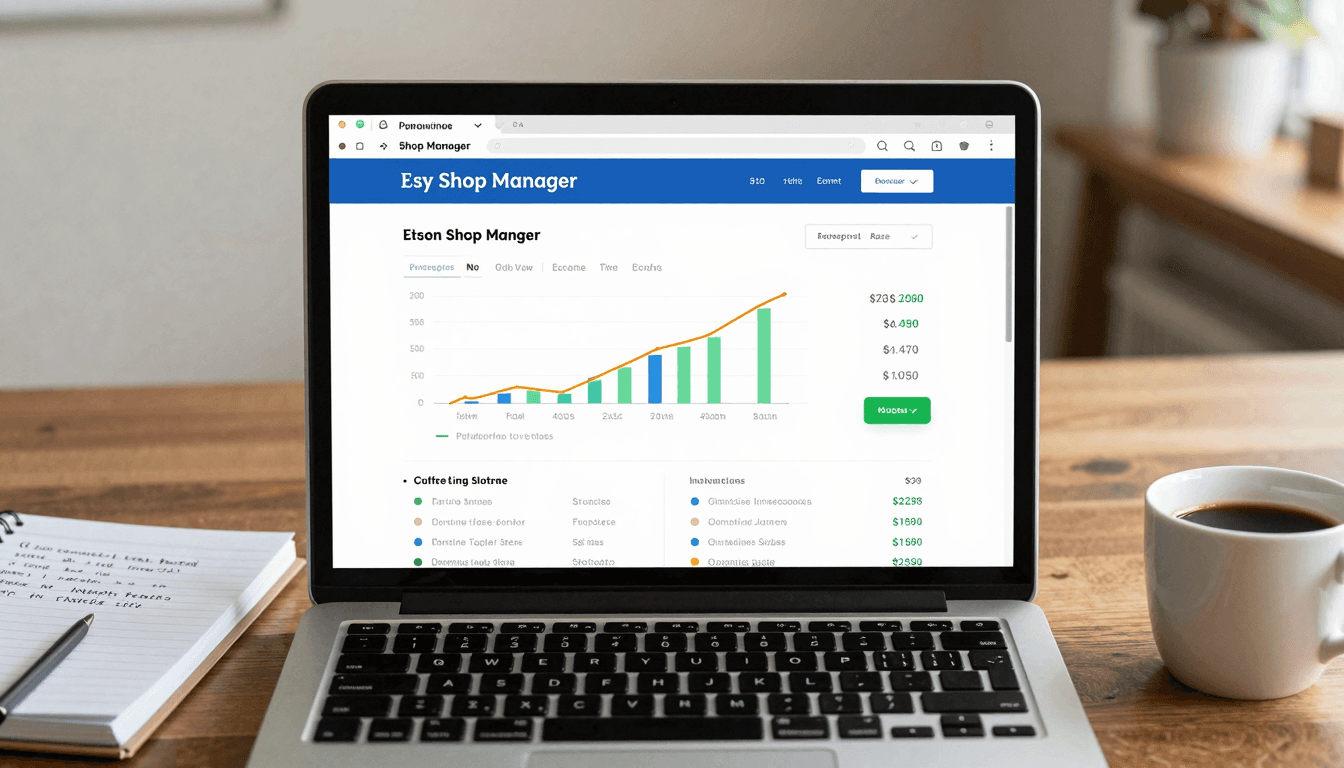
Let's go back to Sofia. After switching from manual spreadsheets to Listybox, she went from publishing two listings per month to 12. The Magic Wand optimized every title and tag in under a minute each. She scheduled three new products a week, which told Etsy her shop was vigorously active.
Within six weeks, her “Boho Classroom Calendar” hit the first page for the keyword “neutral classroom poster.” That single listing went from zero monthly views to over 800, generating $947 in its first full month. She didn't buy ads, and she didn't pay for any ranking service. She simply aligned her shop with what Etsy's algorithm wants: quality, relevance, and consistency.

Take the First Step Toward Predictable Etsy Traffic
You don't need to spend your evenings parsing autocomplete suggestions or worrying about algorithm updates. An intelligent, automated approach to Etsy SEO can give you back your time and raise your shop's visibility on autopilot.
Start your free trial - no credit card required and let Listybox's fine-tuned engine optimize your first listing today.
If you're still building your shop from scratch and the whole process feels daunting, remember that the Store Setup service can have your store launched, fully branded, and stocked with 10 SEO-optimized products - included free with annual Starter and Professional plans.
Never Miss an Update
Get actionable Etsy tips delivered to your inbox every week. No spam, unsubscribe anytime.