



Key takeaways
Learn a four-step framework to choose a print-on-demand niche instead of guessing.
See how to check product fit and competition before you spend time designing.
Understand why a small, focused test batch of listings is smarter than opening a general store.
Find out how tools like the Creation Wizard and Magic Wand turn a niche idea into a ready-to-launch shop in minutes, not hours.
Noah spent months building a dropshipping store. He chased trending products, ran ads, and dealt with long shipping times. When the wave passed, he was left with thin margins, customer complaints, and a feeling that he had built a business on sand. He didn’t want to give up on selling online. He wanted something he could control, something creative that could grow steadily. That is when he found Etsy print-on-demand. But he hit a wall immediately: with thousands of possible directions, what Etsy shop ideas were actually worth his time?
This is the exact spot where many sellers freeze. The fear of picking the wrong niche after a previous failure is real. You don’t need a list of a hundred random slogans. You need a repeatable way to evaluate an idea, test it, and launch it without wasting months. This guide gives you that framework, built for the practical realities of print-on-demand.
How to Brainstorm Etsy Shop Ideas Without Chasing Random Trends
Scrolling through bestseller lists or watching what went viral last week is a trap. By the time you see a trend, the market is already crowded. A better approach is to start with audiences, not products. Think about groups of people you understand or are curious about. New parents. Marathon runners. Cottage gardeners. Tabletop gamers. People who foster rescue dogs. These are audiences with ongoing interests and specific language they use to describe their world.
Once you have a few audience ideas, ask three questions. First, what do they read, watch, or follow? A niche like “cottage gardeners” might follow specific YouTube channels, magazines, or Instagram hashtags. Second, what do they complain about or celebrate? A new parent might joke about cold coffee, while a marathon runner celebrates a personal record. These emotional moments are design gold. Third, what do they already buy? Look at what physical goods exist in that world. Gardeners buy gloves, kneelers, and sun hats. Runners buy moisture-wicking shirts, hats, and water bottles. You are not inventing a new product category. You are adding a specific, audience-aware design to a product people already use.
This approach keeps you away from generic “funny cat t-shirt” territory and pushes you toward a shop that feels like it was made for a specific person. When a customer lands on your shop and thinks, “Finally, a shop that gets me,” you have built a brand, not just a listing.
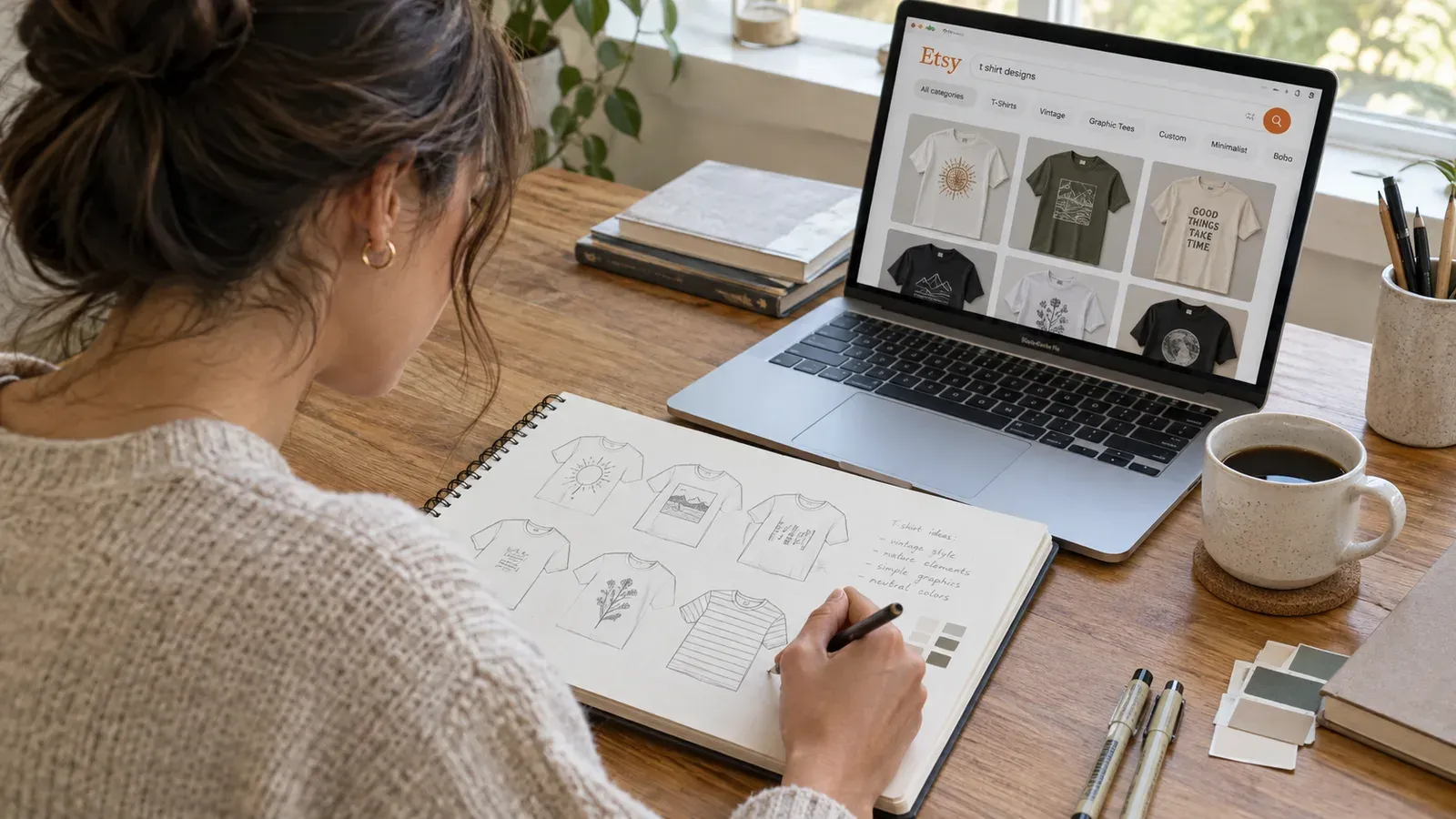
💡 Practical tip: Instead of guessing, spend an afternoon reading reviews on products in your target audience’s world. Customer reviews are full of unfiltered language you can use in your designs and listing copy.
Checking If a Niche Has Enough Product Fit for Print-on-Demand
A strong audience idea falls apart if the products don’t work with the print-on-demand model. You need products that are printable, shippable, and have a proven supplier base. This means moving from a brainstorm to a practical checklist.
A good print-on-demand niche has variety. If your audience idea only works on a t-shirt, it is fragile. A strong niche can live on a t-shirt, a hoodie, a tote bag, a mug, and a wall canvas. This gives you multiple ways to reach a customer and increases the average order value. Before you commit to an idea, browse a product catalog and see how many items naturally fit the audience. For example, a “cottage gardener” niche fits beautifully on canvas tote bags, sun hats, garden flags, and ceramic mugs. A “tabletop gamer” niche fits on dice bags, hoodies, and metal water bottles for long game sessions.
You can explore this quickly inside Listybox. With the Creation Wizard, you can select a design and preview it across dozens of products in minutes. This visual check tells you immediately whether an idea has enough product range to build a real shop. If a design looks awkward on most items, the niche might be too narrow.
⚠️ Important warning: Avoid niches that rely on a single product type. If your entire shop depends on one t-shirt design, a single production issue or a shift in Etsy’s algorithm can wipe out your visibility.
How to Check Competition Without Getting Discouraged
Looking at the competition is where most new sellers either panic or get overconfident. Panic comes from seeing thousands of results for a broad term like “funny teacher t-shirt.” Overconfidence comes from seeing very few results and assuming you found a goldmine. Often, a low number of results means there is no demand, not that there is no competition.
The goal is to find the middle ground: a niche with clear demand but room for a fresh perspective. Start by searching Etsy with the exact phrases your customer would use. A gardener doesn’t search “plant t-shirt.” They search “cottagecore gardening shirt” or “perennial gardener gift.” Look at the first two pages of results. Are the designs all similar? Are the mockups all the same generic t-shirt on a white background? Are the descriptions thin and keyword-stuffed?
If the answer is yes, you have found an opportunity. You don’t need to be the only shop. You just need to be noticeably better in one specific way. Your designs could be more thoughtful. Your mockups could show the product in a real garden, using the Listystyle feature to generate lifestyle images that the competition isn’t using. Your listing titles and tags could be more precise, written with the help of the Magic Wand to match exactly how that audience searches. This is how you carve out space in an existing market without needing to be the first mover.
For a deeper dive into how Etsy search works, read our guide on Etsy Search Engine Optimization: A 2026 Guide for Print-on-Demand Sellers.
Reading the Reviews of Your Future Competitors
Your best competitive research tool is not a software. It is the review section of the top shops in your niche. Read the one-star and three-star reviews. Customers will tell you exactly what is missing. The shirt shrank. The print felt cheap. The design was fun but only came in a unisex cut that didn’t fit. The mug arrived broken because the packaging was flimsy.
These reviews are a free product development brief. If multiple reviews mention that a shirt feels cheap, you know to choose a higher-quality blank. If customers wish a design came on a v-neck or a hoodie, you know to offer that variation from day one. You can then address these gaps proactively in your own listings. Your description can say, “Printed on a ring-spun cotton tee that holds its shape, wash after wash.” You are not just competing on design. You are competing on the details that frustrated customers already spelled out for you.
How to Test Your Etsy Shop Idea with a Small First Batch
The biggest mistake after a previous business failure is going too big, too fast. Noah’s dropshipping store failed partly because he spread himself thin across too many products. The antidote on Etsy is a tightly focused test batch. The goal of your first batch is not to make a living. It is to answer one question: will a stranger pay money for this?
Pick one audience and one design direction. Create a small collection of ten to fifteen listings. Each listing should feel like part of a set, not a random assortment. If your niche is marathon runners, your first batch might be three t-shirt designs, two tank tops, a hoodie, a water bottle, and a wall print with motivational running quotes. This small batch lets you see which product types get traction without overwhelming you with inventory management. Since this is print-on-demand, you have no inventory risk, but you do have a time risk. Every listing you create takes effort, and a focused batch protects your energy.

With Listybox, this test batch approach is fast. You upload your designs to My Artworks. Then, you use the Creation Wizard to combine those designs with your chosen products. Instead of creating each listing manually, one at a time, you build the entire batch in one session. The Wizard generates all the mockups and variations for you. You stay in control, reviewing each design placement with the Placement Editor before finalizing. What used to take days of repetitive work now takes minutes, leaving you time to focus on the creative decisions that matter.
Setting Up Your Shop Correctly From Day One
Your test batch needs a professional home. A half-finished Etsy shop with no banner, no policies, and an empty “About” section will not convert visitors, no matter how good the designs are. Before you publish your first listing, your shop needs to look complete. This means a clear shop name, a banner that shows your style, a written “About” section that tells your story, and shop policies that are in place.
If the technical setup feels like a barrier, the Store Setup service handles this for you. The Listybox team opens your Etsy shop, configures your branding, lists your first ten products with SEO optimization, and provides onboarding training. It is available on Starter and Professional annual plans, and it is included once on the Enterprise plan. This removes the setup friction so you can focus on testing your niche idea rather than wrestling with shop configuration.
How to Turn a Tested Niche Into a Growing Etsy Shop
Your first batch of listings is live. You are starting to see which designs get favorites and which ones get ignored. This is the signal you need to double down. The shops that grow are not the ones that constantly jump to new niches. They are the ones that listen to the data from their test batch and expand thoughtfully within their chosen audience.
Look at your Etsy stats. If a specific t-shirt design is getting all the traffic, create that design on a hoodie, a long-sleeve tee, and a tote bag. You can do this in one session using the Creation Wizard. You are not creating new designs from scratch. You are extending a proven design across more products. This is the lowest-risk way to grow because you already have evidence that the design resonates.
At the same time, refine your listings based on what you learn. If a listing gets clicks but no sales, the issue might be the mockup. Try a new lifestyle image with Listystyle that shows the product in context. If a listing gets few impressions, the issue might be the keywords. Use the Magic Wand to regenerate a title and tags with a slightly different angle. This cycle of small, data-informed tweaks is how a shop moves from a test batch to a reliable revenue stream.
For more on reading your shop’s performance, see our guide on Etsy Shop Stats: Your Data-Driven Path to Print on Demand Success.
💡 Practical tip: Set a schedule for publishing new listings. The Scheduled Publish feature lets you spread out your new listings over days or weeks, keeping your shop active in Etsy’s algorithm without you having to manually publish every day.
Automating the Busywork So You Can Focus on Design
Once your shop moves past the test phase, the operational tasks multiply. Orders come in. Tracking numbers need to be updated. Customers need shipping notifications. Doing this manually for even a handful of orders a day can eat into the time you need for creating new designs.
This is where Zero-Touch Fulfillment changes the game. When an Etsy order comes in, Listybox automatically detects it, routes it to the best-performing manufacturer, and sends the production details. When the item ships, the tracking number is pulled back, the Etsy order is marked as shipped, and the customer is notified. All of this happens without you clicking a button. You wake up, check your dashboard, and see that yesterday’s orders are already in production. This is not about making the business “passive” in a get-rich-quick sense. It is about removing the repetitive operational work so you can spend your working hours on what actually grows the shop: new designs, new product ideas, and deeper connections with your audience.
What to Do When You Feel Stuck Choosing an Idea
Despite all the frameworks and checklists, sometimes you just feel stuck. Every idea seems either too competitive or too obscure. This is not a sign that you lack creativity. It is often a sign that you are trying to predict the future instead of starting small and learning.
Give yourself permission to start with a niche that is simply “good enough” and interesting to you. You do not need a lifelong passion. You just need enough curiosity to design twenty items without getting bored. The market will tell you if the idea has legs. Your job is to launch the test batch, not to have perfect foresight.
If you are still unsure, take our 2-minute quiz for a personalized recommendation on where to start. Sometimes an external prompt is all you need to break the cycle of overthinking.
Remember Noah? He eventually chose a niche around ultralight backpacking. It was not a massive market, but it was a specific, passionate audience he knew from his own weekends on the trail. His first batch of fifteen listings included trail-themed topographic t-shirts, lightweight hoodies, and durable water bottles. He used the Creation Wizard to build the listings in one afternoon. He used Listystyle to create mockups that showed the products on actual trails, not just white backgrounds. A few weeks later, he got his first sale: a hoodie with a minimalist mountain range design. It was not a viral moment. It was a real customer who found his shop through a specific search, saw a product that felt authentic, and bought it. That is the quiet, sustainable success that a practical Etsy shop idea can build.
Start free - no credit card required
Listybox
Create listings 10x faster with Listybox.
Frequently asked questions
Put this into practice in your shop.
Every step from design to live listing, on one platform. Start on the free plan.
Related posts


Want to go deeper? Read our in-depth Etsy guides · Browse 100 Etsy niche guides