


Key takeaways
Trust equals Conversion: Complete policies reduce buyer anxiety, leading to a measurable increase in sales.
Protect Your Profits: Clear rules on returns and cancellations save you from absorbing costs for buyer mistakes.
POD Specifics: Print-on-demand sellers need specific clauses to handle “made-to-order” exemptions legally.
Automate Compliance: Use tools like Zero-Touch Fulfillment to ensure your physical shipping matches your written promises.
Store Setup: Our team helps you set up your Etsy store. It is available inside a custom Enterprise+ offer.
Your Etsy shop policies are not just a legal requirement; they are a psychological trigger. When a customer lands on your product page, they are looking for reasons to trust you. A blank policy section screams “amateur risk,” while a professional, detailed section whispers “safe, reliable brand.”
Many sellers treat policies as an afterthought, copying generic text or leaving sections empty. This is a critical mistake. In the competitive world of e-commerce, clarity is currency. This guide will show you how to craft policies that not only protect you from disputes but actively help convert hesitant browsers into loyal buyers.
This topic is covered in depth in our Etsy seller guide, your go-to resource for building a trustworthy and profitable shop.
The Trust Equation: Why Policies Drive Sales
Think about your own shopping habits. Would you buy from an unknown website that didn’t say if you could return a broken item? Probably not. Your customers feel possible anxiety before every purchase. Your policies are the antidote to that anxiety.
By clearly stating how you handle shipping, returns, and privacy, you remove the friction from the buying process. You are telling the customer, “I have a plan, and I will take care of you.” This emotional reassurance is often the tipping point between an abandoned cart and a completed sale.
Furthermore, Etsy’s search algorithm favors completed shops. Filling out your policies is a signal to Etsy that you are a serious business, potentially boosting your visibility in search results.
Trust by the Numbers
The impact of trust is measurable. Stores with comprehensive, custom-written policies see a higher conversion rate than those with default or incomplete policy sections. That is essentially free revenue just for filling out a form correctly.
Try it in your shop.
Every step from design to live listing, on one platform. Start on the free plan.
Essential Elements of a Bulletproof Policy
To maximize trust and protection, your policies need to cover specific bases. Avoid legal jargon; speak directly and kindly to your customer.
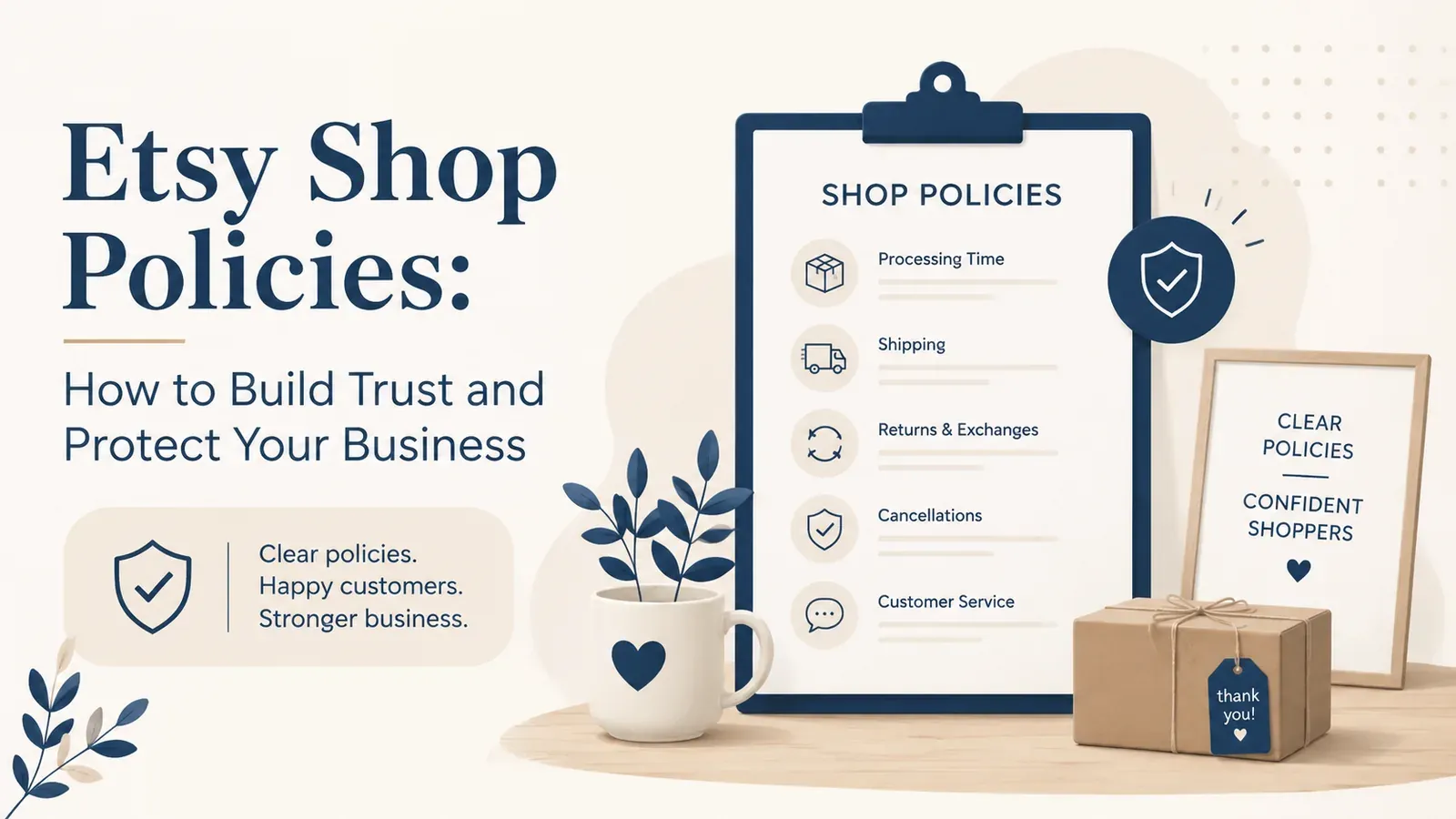
1. Returns and Exchanges This is the most read section. Be explicit.
Timeframe: How many days does the buyer have to contact you? (e.g., 14 days).
Conditions: Who pays for return shipping? (Usually the buyer). Must the item be in original condition?
Exclusions: What items cannot be returned? (Custom orders, digital downloads).
2. Shipping Information “I don’t know where my package is” is the most common customer complaint. Pre-empt this.
Processing Time: The time to make the item, not deliver it.
Estimated Delivery: Be realistic. Under-promise and over-deliver.
Customs/Duties: Explicitly state that buyers are responsible for any customs fees.
3. Cancellations
Can a buyer cancel an order? If so, when? For Print on Demand (POD) items, typically once production starts, cancellation is impossible. State a clear window, such as “Cancellations accepted within 1 hour of purchase.”
The POD Challenge: Managing Returns Without Inventory
For Print on Demand sellers, standard retail policies do not apply. Since you do not hold inventory, accepting a return for a size mismatch means you pay for the product out of pocket. You need a specialized strategy.
Your POD policy must educate the customer. Explain that each item is unique and made specifically for them. Therefore, you cannot accept returns for stylistic preferences or size errors. However, you must promise to replace any item that arrives damaged or with a print error.
This balance protects your margins while assuring the customer that they won’t be stuck with a defective product. Delivering on this promise requires a fulfillment process that is as reliable as your written word. This is where Zero-Touch Order Management becomes essential.
Real-World Scenario: The Cost of Ambiguity
Meet Elena, a talented graphic designer who just opened her Etsy shop.
Her goal is simple: replace her freelance income by selling custom tote bags and mugs featuring her art.
She rushes the setup, skipping the policy section because she “wants to focus on designing.” She lists 20 items and starts getting traffic.
Then, the hidden trap springs. A customer orders 5 custom mugs for a bridal shower but enters the wrong date. They arrive, and the customer demands a full refund, claiming “the shop didn’t say I couldn’t return them.” Etsy mediates, sees Elena’s blank policies, and sides with the buyer. Elena loses $120 and hours of stress.
Now, imagine if Elena had written her policies on day one. They would clearly state “No returns on personalized items.”
With clear policies, the dispute would likely be resolved in her favor. Instead of losing money, she keeps her profit and her confidence, free to focus on her next bestseller.
Copy-Paste Policy Templates
While you should adapt these to your specific tone, these templates provide a solid foundation for a POD business.
For Returns (POD Friendly)
“Because our products are made specifically for you upon order, we do not accept returns or exchanges for sizing issues or buyer’s remorse. However, if your item arrives damaged or with a print defect, please contact us with a photo within 14 days, and we will send a free replacement immediately.”
For Shipping > “Our items are made to order. Please allow 2-5 business days for production before shipping. Once shipped, standard delivery is 3-5 business days. Please note that holiday volumes may affect these times.”
How Automation Backs Up Your Words
Writing a policy is one thing; living up to it is another. If your policy says “ships in 3 days,” but you forget to process the order manually, you have broken your contract.
Consistency builds a brand. Using Listybox’s Zero-Touch Fulfillment means your Etsy orders appear in My Orders, and once you pay for production and shipping there, the order goes to our partner print providers. This reduces the “lag time” that human error introduces.
Additionally, managing varying production times for different products (e.g., mugs vs. hoodies) can be a headache. The Custom Product Hub allows you to organize these logistical details on the backend, so your public-facing promises are always accurate.
Start Professional from Day One
Does all of this legal phrasing and setup feel overlapping? You don’t have to navigate it alone.
With Listybox Store Setup, our team helps you set up your Etsy store. It is available inside a custom Enterprise+ offer, so plan a demo or write to [email protected].
Don’t let the administrative side of Etsy slow you down. Build your foundation correctly, automate the boring stuff, and focus on creating designs that sell.
Frequently asked questions
Put this into practice in your shop.
Every step from design to live listing, on one platform. Start on the free plan.
Related posts



Want to go deeper? Read our in-depth Etsy guides · Browse 100 Etsy niche guides