



Key takeaways
Understand the difference between gross revenue and taxable net profit.
Learn which everyday business expenses qualify as valid tax deductions.
Keep personal and business finances completely separate to avoid audit risks.
Track print-on-demand production costs accurately to determine your true margins.
Centralize your daily operations to create a cleaner, easier-to-manage financial trail.
Meet Sofia. She is a middle school math teacher who decided to share her love for geometry through custom apparel. She opened an online shop using print-on-demand. For the first few months, she treated it like a fun weekend project. Then, the holiday season arrived. Her math-joke hoodies became popular, and sales poured in. She was thrilled until January rolled around. She realized she had to report this income, but she had kept absolutely no records of her expenses. She was staring at a gross revenue number that looked great, but her actual bank account balance was much lower because of production costs and platform fees. She panicked, realizing she might pay taxes on money she never actually kept.
This is a common scenario. Many sellers start their journey focusing entirely on designs and marketing. They push administrative tasks to the side. But understanding your expenses is not just about staying out of trouble. It is about keeping more of the money you earn. When you know what qualifies as a valid expense, you can accurately report your business activities and avoid overpaying.
This guide explores the essential aspects of managing your shop’s finances. We will look at what qualifies as a business expense, how to organize your records, and how to set up systems that make the end of the year less stressful.
What Are Etsy Tax Deductions and Why Do They Matter?
When you sell items online, the total amount of money customers pay you is your gross revenue. However, you do not pay income tax on that entire amount. You only pay tax on your net profit. Net profit is the money left over after you subtract all the costs required to run your business. These subtracted costs are your deductions.
The primary rule from tax authorities is that an expense must be both ordinary and necessary for your business. “Ordinary” means it is a common and accepted cost in your specific industry. “Necessary” means it is helpful and appropriate for your trade. For a print-on-demand seller, paying a supplier to print a shirt is both ordinary and necessary.
Understanding this concept changes how you view your business purchases. A software subscription that helps you design products is not just a lost cost; it is an expense that lowers your taxable income. By carefully tracking every eligible cost, you ensure that you are only taxed on your true profit. This is why keeping meticulous records from day one is so important.
If you ignore your expenses, you will end up paying taxes on your gross revenue. This mistake can cost you a significant portion of your earnings. It is crucial to build a habit of recording every business-related transaction.
The Difference Between a Hobby and a Business
Before diving into specific costs, you must determine how the tax authority classifies your shop. Is it a hobby or a business? The distinction is critical.
If your shop is classified as a business, you can deduct your business expenses. If your expenses exceed your income, you might even be able to claim a loss, which could offset other types of income. However, if your shop is classified as a hobby, the rules are much stricter. You generally cannot use hobby losses to reduce your other taxable income.
The main factor is your intent to make a profit. Do you carry on the activity in a businesslike manner? Do you keep complete and accurate books and records? Do you depend on income from the activity for your livelihood? Even if you have a full-time job like Sofia, you can still operate your shop as a true business as long as your intention is to generate profit and you treat the operation seriously.
The Most Common Etsy Tax Deductions for Print-on-Demand Sellers
Print-on-demand is unique. Unlike traditional retail, you do not buy inventory upfront. You do not have a garage full of unsold t-shirts to count at the end of the year. This makes some aspects of accounting much easier. However, you still have plenty of eligible expenses to track.
Let us break down the most common categories of expenses you will encounter.
Platform Fees and Listing Costs
Running a shop on a marketplace comes with built-in costs. These fees are entirely deductible because they are required to operate your store.
Etsy charges a $0.20 USD fee for listing an item for sale. Taxes may also apply.
Beyond the listing cost, you also pay transaction fees when an item sells. There are payment processing fees for handling the credit card transaction. If you use the platform’s advertising system, those charges are also deductible. You should regularly download your financial statements from the seller dashboard. These documents clearly outline the total fees deducted from your sales throughout the year.
For a deeper look at how these platform costs add up, you can read our guide on What Percentage Does Etsy Take? A Complete 2026 Fee Breakdown for Sellers.
Cost of Goods Sold (COGS)
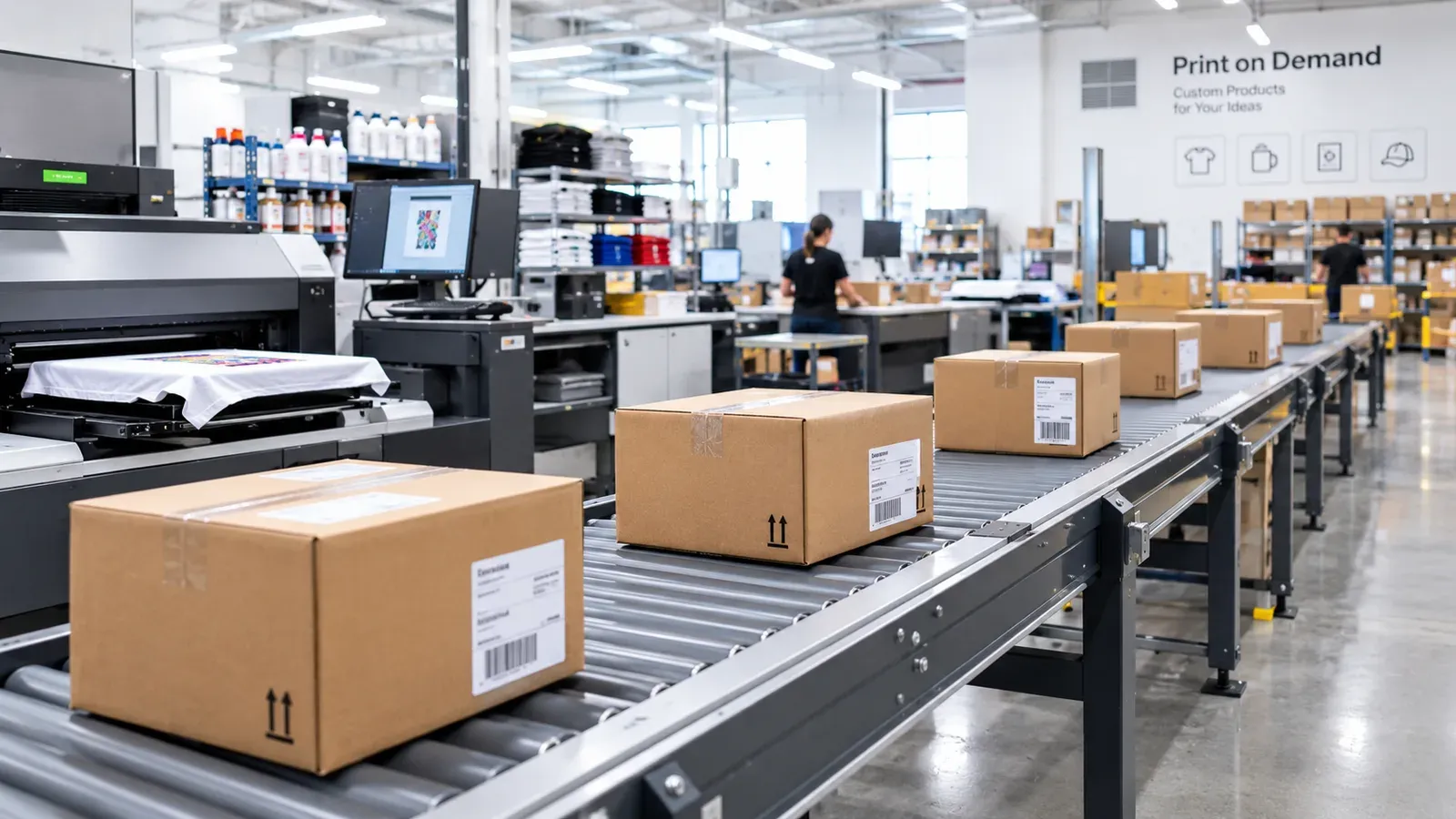
For a print-on-demand seller, this is usually your largest expense category. When a customer buys a mug from your shop, you pay a print provider to manufacture and ship that mug. The money you pay to the supplier is your Cost of Goods Sold.
Because you only pay for a product after a customer orders it, your COGS directly aligns with your sales. You must keep the receipts or invoices from your production partners. These invoices prove exactly how much it cost to fulfill each order.
Software and Subscription Expenses
Running a modern e-commerce business requires digital tools. The subscriptions you pay for these services are generally deductible.
This includes graphic design software used to create your artwork. It includes keyword research tools. It also includes platforms that help you manage your shop. If you pay a monthly fee for cloud storage to keep your design files safe, that is an eligible expense.
When you use a system to organize your daily tasks, the cost of that system is a business expense. Keeping all your designs organized in a central place makes your workflow much smoother.
Home Office and Workspace Expenses
Many sellers operate their businesses from their homes. You may be eligible to deduct a portion of your housing expenses if you use a specific part of your home exclusively and regularly for your business.
This means you cannot deduct the cost of your dining room table if you also eat dinner there. However, if you have a spare bedroom or a dedicated corner of a room that is only used for your business activities, you can calculate the percentage of your home’s total square footage that this space occupies. You can then apply that percentage to your rent or mortgage interest, utilities, and insurance.
There is often a simplified method available where you calculate the deduction based on a set rate per square foot of your workspace. This method requires less record-keeping than tracking every utility bill for the entire year.
⚠️ The home office deduction has very strict rules regarding exclusive use. Always consult a tax professional before claiming this deduction to ensure your workspace qualifies.
Internet and Phone Bills
You need the internet to upload designs, manage listings, and communicate with customers. Therefore, a portion of your internet bill is a valid business expense.
However, you cannot deduct the entire bill if you also use the connection to stream movies or browse social media for personal use. You must estimate the percentage of your internet usage that is strictly for business. The same rule applies to your mobile phone bill. If you use a dedicated business phone line, the entire cost is deductible.
Education and Professional Services
Investing in your skills is a recognized business cost. If you purchase books about e-commerce, pay for online courses on marketing, or attend a conference related to selling online, these costs are deductible.
Additionally, the fees you pay to professionals to help you run your business are deductible. This includes paying a graphic designer to create a logo. Most importantly, it includes the fees you pay to a Certified Public Accountant (CPA) or bookkeeper to prepare your taxes and manage your financial records.
How to Track Your Expenses Without Losing Your Mind
Knowing what you can deduct is only the first step. The real challenge is keeping track of these expenses throughout the year.
Let us return to Sofia. In her first year, she tried to find all her expenses in January. She spent hours digging through her personal bank statements, trying to remember if a specific charge was for a design asset or a personal purchase. She had to log into multiple supplier websites to download dozens of individual invoices. The process was exhausting and prone to errors.
💡 Open a dedicated business checking account as soon as you decide to treat your shop as a business. Use this account exclusively for shop income and expenses.
The Importance of Separate Accounts
The single most effective step you can take is separating your personal and business finances. Open a dedicated business checking account. Route all your sales deposits into this account. Pay for all your business expenses using a debit or credit card linked only to this account.
When you do this, your bank statement becomes a clear, chronological ledger of your business activity. You no longer have to separate your grocery bills from your platform fees.
Choosing a Tracking Method
You need a system to record these transactions. For a very small shop, a simple spreadsheet might be enough. You can create columns for the date, the vendor, the amount, and the expense category.
However, as your shop grows, a spreadsheet becomes difficult to maintain. Many sellers upgrade to dedicated bookkeeping software. These programs can connect directly to your business bank account and automatically import your transactions. You then simply review and categorize each item.
Whatever method you choose, the key is consistency. Do not wait until the end of the year. Set aside time each week or month to update your records.

Managing Your Etsy Print-on-Demand Workflow Efficiently
Your accounting is heavily influenced by how you run your daily operations. A chaotic workflow leads to chaotic financial records. When your designs, products, and fulfillment processes are scattered across multiple platforms, tracking the associated costs becomes a nightmare.
This is where centralizing your operations becomes crucial. By bringing your tasks into a single environment, you reduce the number of separate invoices and platforms you need to monitor.
Centralizing Your Product Catalog
When you create new items, you need a clear record of the base costs. If you use different suppliers for different items and track them manually, calculating your true profit margin is difficult.
Using a unified system helps. With the Custom Product Hub, you can clone catalog items, adjust suppliers, and set your pricing structures clearly. When your product details are organized in one place, you always know exactly what your base costs are. This makes calculating your Cost of Goods Sold much more straightforward at the end of the month.
If you want to understand more about building a profitable catalog, read our article: Passive Income with Print on Demand: A Realistic Guide for Etsy Sellers.
Automating the Fulfillment Process
Fulfillment is the busiest part of a print-on-demand business. When an order arrives, it must be sent to the manufacturer, paid for, and tracked. Doing this manually for every single order generates a massive paper trail of individual receipts.
A better approach is to automate this process. When you use Zero-Touch Fulfillment, orders are automatically detected and routed to the manufacturer. This not only saves you hours of manual data entry but also creates a cleaner digital trail of your production costs. You spend less time matching order numbers to supplier invoices and more time focusing on growth.
Creating Product Visuals
High-quality images are essential for sales. Many sellers spend money buying individual mockup files or paying for multiple subscriptions to image editing tools. These are valid deductions, but managing multiple small subscriptions can be tedious.
Instead of juggling different tools, you can generate your visuals directly within your workflow. Using Listystyle Video, you can create professional lifestyle videos from your product images in minutes. Consolidating your tools means fewer receipts to track and a cleaner expense report.
Common Tax Mistakes Etsy Sellers Make
Even with good intentions, sellers often fall into common traps. Being aware of these pitfalls can save you from stressful audits and unexpected tax bills.
Ignoring Self-Employment Taxes
Many new sellers only think about income tax. They forget about self-employment tax. In many jurisdictions, if you work for yourself, you are responsible for paying both the employer and employee portions of social security and medicare taxes.
This tax is calculated based on your net profit. It is a separate calculation from your standard income tax. Sellers who fail to account for this often face a much higher tax bill than they anticipated. This is why setting aside a portion of every sale for taxes is a crucial habit.
Missing Quarterly Estimated Payments
When you have a traditional job, your employer withholds taxes from every paycheck. When you are self-employed, no one is withholding taxes for you.
Tax authorities generally require you to pay taxes on your income as you earn it throughout the year. If you expect to owe a certain amount in taxes for the year, you may be required to make quarterly estimated tax payments. These payments are typically due in April, June, September, and January.
If you wait until the annual tax deadline to pay your entire bill, you may face penalties and interest charges for underpayment throughout the year.
Forgetting to Track Mileage
Even as a print-on-demand seller, you might drive for your business. Perhaps you drive to a local office supply store to buy printer ink for your home office. Maybe you drive to a networking event for small business owners.
The miles you drive for business purposes can often be deducted. You can usually choose between tracking your actual vehicle expenses or taking a standard mileage rate set by the tax authority. However, you must keep a detailed logbook of the date, distance, and purpose of every business trip.
Understanding Sales Tax vs. Income Tax
A common area of confusion for new sellers is the difference between sales tax and income tax. They are entirely separate systems with different rules.
Income tax is based on your net profit - the money you actually make after expenses. This is what you report on your annual tax return. The deductions we have discussed so far apply to your income tax.
Sales tax, on the other hand, is a tax paid by the consumer. When a customer buys a mug from your shop, they may be charged an additional percentage based on their location. As the seller, you are theoretically responsible for collecting this tax and remitting it to the appropriate state or local government.
Marketplace Facilitator Laws
Fortunately, recent legal changes have made sales tax much easier for marketplace sellers. Most major platforms now operate under Marketplace Facilitator laws. This means that the platform automatically calculates, collects, and remits the sales tax on your behalf for orders shipped to most jurisdictions.
You do not have to register for a sales tax permit in every state where you have a customer. You do not have to file monthly sales tax returns for those platform sales. The marketplace handles the entire process.
However, it is vital to understand that this collected sales tax is not part of your gross revenue for income tax purposes. You never actually receive this money; it goes directly from the customer to the platform, and then to the government. When you look at your financial statements, make sure you are not accidentally including collected sales tax in your total income, as this would artificially inflate your revenue and cause you to overpay on your income tax.
When You Might Need to Collect Sales Tax
There are exceptions. If you sell products outside of the marketplace - for example, if you set up your own independent website or sell items in person at a local craft fair - you are responsible for collecting and remitting sales tax for those transactions.
You must understand the concept of nexus. Nexus is a connection to a state that requires you to collect sales tax there. Physical nexus is established by having a physical presence, such as living in the state, having an office, or storing inventory there. Economic nexus is established by reaching a certain threshold of sales revenue or transaction volume in a state.
If you only sell through a platform that acts as a marketplace facilitator, your sales tax obligations are minimal. But the moment you expand your sales channels, you must consult a professional to ensure you remain compliant with local tax laws.
Preparing for Tax Season as an Etsy Seller
The end of the year should not be a time of panic. If you have maintained your records, tax season is simply a matter of compiling the data you already have.
Gathering Your Documents
Start by downloading your annual summary from your marketplace dashboard. This document will show your gross sales, refunds, and total platform fees.
Next, gather the reports from your bookkeeping software or your manual spreadsheets. Ensure that every transaction in your business bank account has been categorized correctly. Collect all your receipts for software subscriptions, education, and home office expenses.
Working with a Professional
While it is possible to file your business taxes yourself, working with a qualified CPA or tax professional is highly recommended. Tax laws change frequently. A professional can help you navigate complex rules, ensure you are claiming every deduction you are entitled to, and help you avoid costly mistakes.
The fee you pay to the tax professional is also a deductible business expense for the following year. It is an investment in the financial health and compliance of your business.

Launching and Scaling Your Shop the Right Way
Understanding the financial side of your business is just as important as creating great designs. When you know your numbers, you can make informed decisions about pricing, advertising, and growth.
If you are just starting out, getting everything configured correctly can feel daunting. You have to worry about listing optimization, product creation, branding, and setting up your financial tracking. Does all of this feel overwhelming? You don’t have to start from scratch. With Listybox Store Setup, our expert team sets up your Etsy store, lists your first 10 products, and optimizes everything for SEO. See the pricing page for what this service covers and what it costs.
Once your foundation is solid, you can focus on building a sustainable operation. By keeping your expenses organized and your workflow efficient, you position yourself for long-term success. You stop worrying about administrative headaches and start treating your shop like a true business. By reading our guide on How to Make Money Online in 2026: A Complete Guide to Etsy Print on Demand Passive Income, you can learn more about building a profitable structure from day one.
If you are ready to organize your daily tasks, centralize your product creation, and build a more efficient print-on-demand business, it is time to take the next step. Start free - no credit card required.
Listybox
Create listings 10x faster with Listybox.
Frequently asked questions
Put this into practice in your shop.
Every step from design to live listing, on one platform. Start on the free plan.
Related posts



Want to go deeper? Read our in-depth Etsy guides · Browse 100 Etsy niche guides