


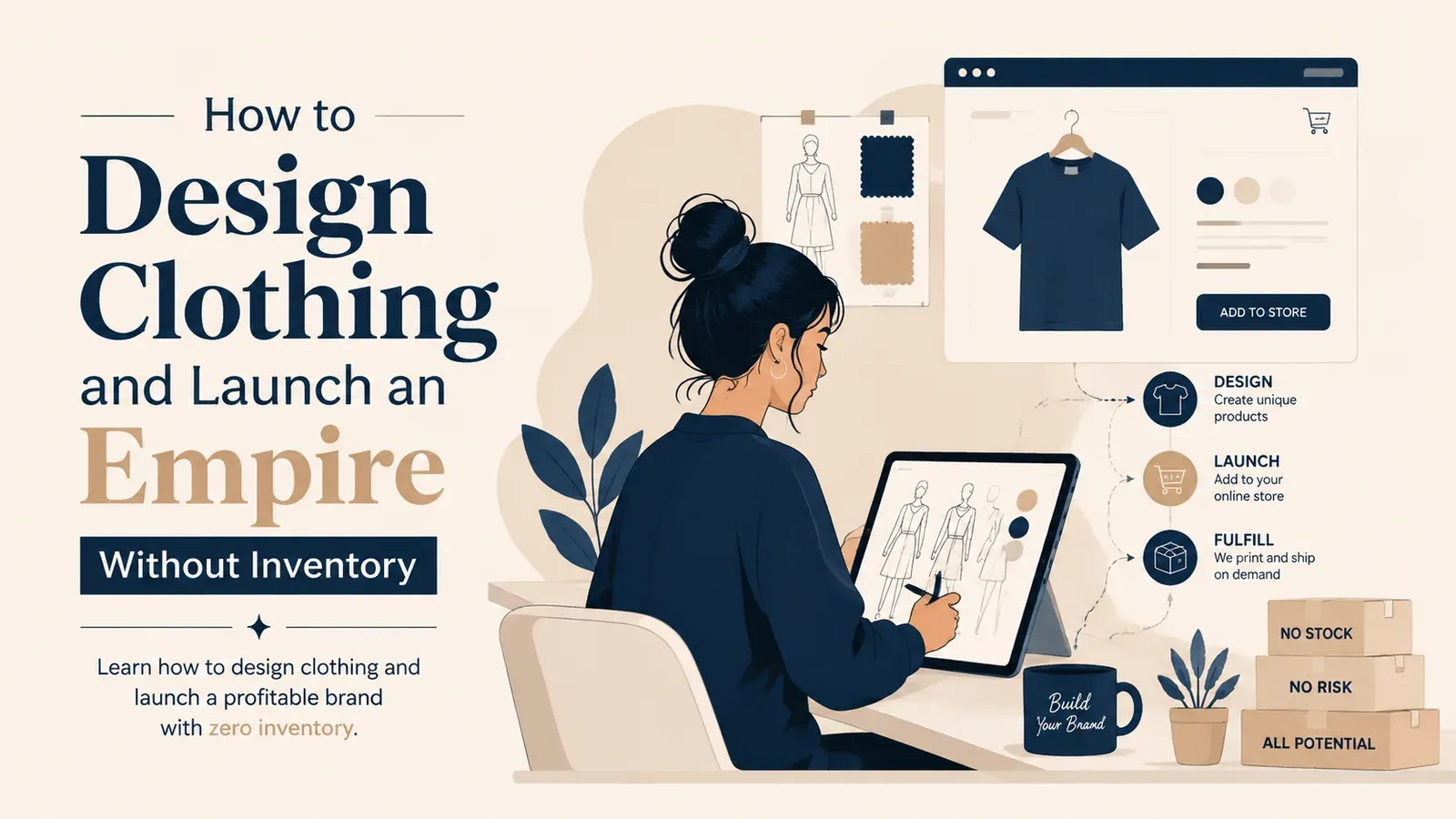
Key takeaways
Eliminate Inventory Risk: Use Print-on-Demand to sell custom clothing without buying stock upfront.
Design Without Drawing: Leverage tools like Canva and pre-made assets to create professional apparel designs instantly.
Automate Your Mockups: distinct from generic templates, use AI to generate infinite, unique lifestyle photos of your products.
Scale with Speed: Turn one design into hundreds of listings across different products in minutes, not days.
Master SEO Hands-Free: Stop guessing keywords and let intelligent automation write high-ranking titles and tags for you.
The fashion industry is notoriously difficult to break into. The traditional path involves sketching technical packs, sourcing fabrics overseas, paying for expensive sample runs, and risking thousands of dollars on inventory that might never sell. For decades, this kept the power in the hands of major corporations and wealthy investors.
Today, the landscape has shifted entirely. The rise of Print-on-Demand (POD) combined with intelligent automation has democratized fashion. You can now design clothing and launch a global brand from your laptop with zero inventory risk. However, simply having access to these tools isn’t enough. To succeed, you must move faster and smarter than the competition, avoiding the manual traps that slow down most new sellers.
How Do I Find a Profitable Niche?
Before you engage in the actual work to design clothing, you must identify who you are designing for. A common mistake is creating “cool shirts” that appeal to everyone and, consequently, no one. The secret to a successful Etsy store is specificity.
Analyzing Market Gaps
You need to find the intersection between high demand and low quality supply. Browsing Etsy might reveal thousands of “Dog Mom” shirts, but perhaps there is a lack of “Retro Greyhound Dad” hoodies. Manual research involves hours of scrolling and checking competitor sales numbers.
Listybox users leverage the Trend Compass trend finder to automate this. Instead of guessing, you can see exactly which sub-niches are rising in the hourly news scan and exclusively tailor your designs to those waves before they crash.
Data-Backed Decisions
Inventing a niche is risky; verifying one is strategic. Stores launching with niche-specific designs (e.g., “Nurse Graduation 2026”) see a faster first-sale rate compared to generalist stores. By focusing on a tight niche, your store becomes the go-to authority for that specific customer, increasing conversion rates and repeat purchases.
Try your first design.
Try your design on a product and prepare its Etsy listing in Listybox.
How Can I Design Clothing Without Drawing Skills?
The biggest myth in the POD industry is that you need to be a professional illustrator or an Adobe Photoshop wizard. While artistic skill helps, modern tools act as a force multiplier for your creativity.
Leveraging Pre-Made Assets
You do not need to start with a blank canvas. Platforms like Canva allow you to combine typography and elements to create stunning apparel designs. The key is workflow efficiency. Moving files between design tools and your selling platform can be a bottleneck.
This is solved by the Canva integration within Listybox. You can modify your designs in Canva and sync them directly to your product library without downloading and re-uploading heavy files.
The Asset Library Advantage
For those who want to skip the design phase entirely, you can utilize the Artwork Gallery. This is not just a collection of stock images; it is a library of researched, trend-focused designs that are ready to sell. By using high-quality, pre-vetted assets, you ensure your clothing line looks professional from day one, regardless of your personal artistic ability.
How Do I Create Professional Product Mockups?
Once your design is ready, you face a critical challenge: presentation. In e-commerce, the customer cannot touch the fabric. Your photo is the product.
The Problem with Generic Mockups
Most beginners use the standard, flat mockups provided by their print provider. These look sterile and uninviting. The next step up is buying Photoshop templates, which are expensive and time-consuming to edit. A store filled with identical, flat t-shirt images signals “amateur” to a buyer.
The Automated Lifestyle Solution This is where automation changes the game. Meet Sarah, a graphic designer who wanted to break free from client work.
Her Challenge: Sarah wanted to launch “Neon Nostalgia,” a retro 80s clothing brand. She had amazing designs but no money for a photoshoot.
The Manual Grind: She spent her first week trying to use free online mockups. They were blurry, poorly lit, and the models didn’t fit her brand vibe. She wasted 15 hours and hated the result.
The Hidden Trap: She launched anyway. Her designs were great, but her click-through rate was abysmal because her main images looked like everyone else’s.
The Listybox Solution: Sarah discovered the Listystyle mockup creator. She selected her target demographic and aesthetic. In seconds, the AI generated hundreds of unique, high-resolution photos of models wearing her exact shirts in retro diners and arcades.
The Transformation: Her store transformed overnight from a generic POD shop into a cohesive, branded fashion label. Her click-through rate doubled, and she never had to hire a photographer.
How Can I Scale My Clothing Brand Efficiently?
Designing one shirt is fun. Managing a catalog of 500 products is a logistical nightmare if done manually.
The Creation Bottleneck
To design clothing for a serious income, you need volume. You might have one “hero” design, but you need to offer it on t-shirts, sweatshirts, hoodies, and tote bags to maximize value. Doing this manually on platforms like Etsy involves creating a new listing for every single variation - copying and pasting titles, tags, and syncing shipping profiles. It is tedious and prone to error.
The Assembly Line Approach
Efficient sellers use the Creation Wizard. This tool allows you to take that single “hero” design and apply it to dozens of products simultaneously. You can generate the bulk of your catalog in minutes.
Furthermore, you can group these items using Combo Listings. Instead of having separate listings solely for a sweatshirt and a t-shirt with the same design, you combine them. This consolidates your social proof (reviews and favorites) onto one listing, signaling to the Etsy algorithm that your product is popular, which boosts your organic ranking significantly.
Do I Need Inventory to Start a Clothing Line?
The short answer is no. Utilizing a Print-on-Demand model eliminates inventory risk, but it introduces a new complexity: fulfillment management.
Managing Orders Without Madness
When an order comes in, the “passive income” dream often breaks. You have to manually order the item from the printer, enter the customer’s address, and later paste the tracking number back into Etsy. One typo in an address can cost you a refund and a bad review.
The superior method is Zero-Touch Order Management. This system acts as your personal Chief Operating Officer. When an order comes in on Etsy, it appears in My Orders. You pay for production and shipping there, the order goes to production, and the tracking number is written back to your Etsy order. This frees you from data entry, so you can focus on the next collection.
Starting From Scratch?
Does all of this feel overwhelming? It is normal to feel that way when looking at the entire roadmap. You don’t have to start from scratch or figure out the technical setup alone. With Listybox Store Setup, our team helps you set up your Etsy store. It is available inside a custom Enterprise+ offer, so plan a demo or write to [email protected].
By removing the barriers of inventory, design skills, and technical setup, the ability to design clothing and sell it globally is now accessible to anyone willing to use the right tools. The only thing standing between you and your own fashion brand is the decision to start.
Frequently asked questions
Put this into practice in your shop.
Every step from design to live listing, on one platform. Start on the free plan.
Related posts


Want to go deeper? Read our in-depth Etsy guides · Browse 100 Etsy niche guides