


Key takeaways
You need a valid ID, bank account, and email to open an Etsy shop - the technical setup takes under 30 minutes.
Etsy charges a $0.20 listing fee per item and a 6.5% transaction fee on the sale price, plus payment processing fees that vary by country.
Your first listing must have a keyword-rich title, all 13 tags filled, and high-quality mockup images to rank in Etsy search.
New shops often wait weeks for a first sale unless you list consistently and use a tool like Scheduled Publish to stay active daily.
The biggest mistake is manual burnout - automating listing creation, SEO, and fulfillment with the right tool lets you scale without quitting your day job.
Liam is an engineer. He spends his days solving complex problems, but after work he wants something different: a side income that doesn’t require another 40-hour week. He heard about Etsy print-on-demand and the idea of selling products without holding inventory clicked. He opened his laptop, typed “how to open an Etsy shop” into Google, and expected a quick, logical process. What he found instead was a maze of conflicting advice, hidden fees, and tasks that ate up his evenings for weeks. He almost gave up before his first sale.
Liam’s story is common. The gap between “I want to open an Etsy shop” and actually making money is filled with manual work that most guides gloss over. This article walks you through every step of opening an Etsy shop in 2026, but more importantly, it shows you how to avoid the hidden trap that burns out 90% of new sellers before they ever see a profit. By the end, you’ll know not just how to open a shop, but how to open one that is set up to sell without you chained to your computer.
Step 1: What You Need Before You Open an Etsy Shop
Before you even click “Sell on Etsy,” a few essentials must be in place. Etsy requires a government-issued ID, a bank account for deposits, a valid email address, and a physical address (which can be your home address). This verification is mandatory and helps keep the marketplace trustworthy. For a detailed walkthrough, our Etsy Seller Requirements 2026: What You Really Need to Start a Shop covers the entire ID verification process and country-specific rules.
You’ll also need a product idea. If you’re going the print-on-demand route, you don’t need to manufacture anything. You just need designs that people want to buy. Many new sellers get stuck here because they think they need to be a graphic designer. That’s not true. You can use ready-made designs, modify templates, or hire a designer. What matters is that your designs match a specific niche or trend that shoppers are already searching for.
💡 Spend 30 minutes browsing Etsy’s bestseller lists and note what themes, colors, and styles repeat across top-selling products. This gives you a data-backed starting point instead of guessing.
Step 2: The Real Cost of Opening an Etsy Shop (It’s Not Free)
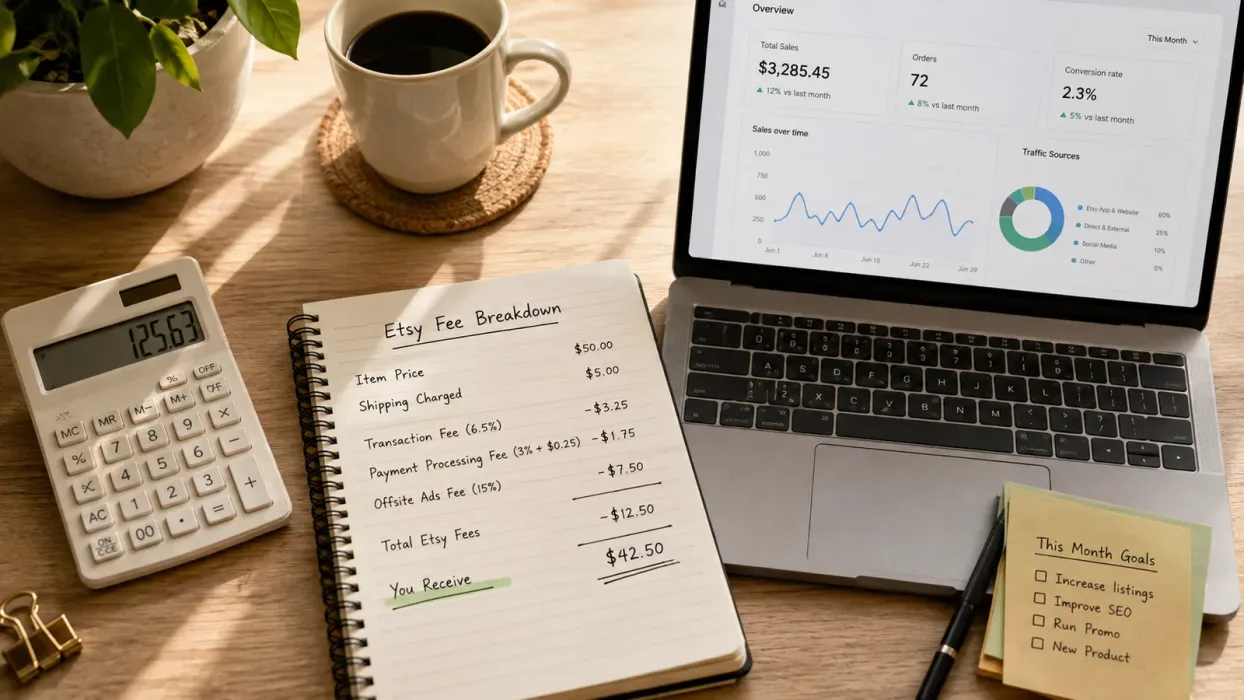
“It’s free to open an Etsy shop” is technically true, but it’s misleading. You don’t pay a monthly subscription to create a shop, but every action you take to sell costs money. According to Etsy’s official fee page, as of 2026 you’ll pay:
A $0.20 listing fee for each item you publish, which renews every four months or when the item sells.
A 6.5% transaction fee on the total sale price (including shipping).
A payment processing fee that varies by country (for US sellers, it’s 3% + $0.25 per transaction).
Let’s put that in context. If you sell a t-shirt for $20 with free shipping, you’ll pay roughly $2.35 in total fees per sale. That’s nearly 12% of your revenue gone before you even factor in production costs. If you set your profit margin too low, you’ll lose money on every order. Our guide How Much Does Etsy Take From Sellers? The 2026 Fee Breakdown breaks down these numbers with examples for different product prices and countries.
📈 On a $20 sale, Etsy fees alone can eat up 11-12% of your revenue. Always price your products with these fees in mind.
Liam, the engineer, initially priced his mugs at $14.99 because he saw competitors doing it. After calculating fees and production costs, he realized he was making $2 per sale. He had to raise his prices and still felt the pinch. Don’t make that mistake.
Step 3: Setting Up Your Shop the Right Way
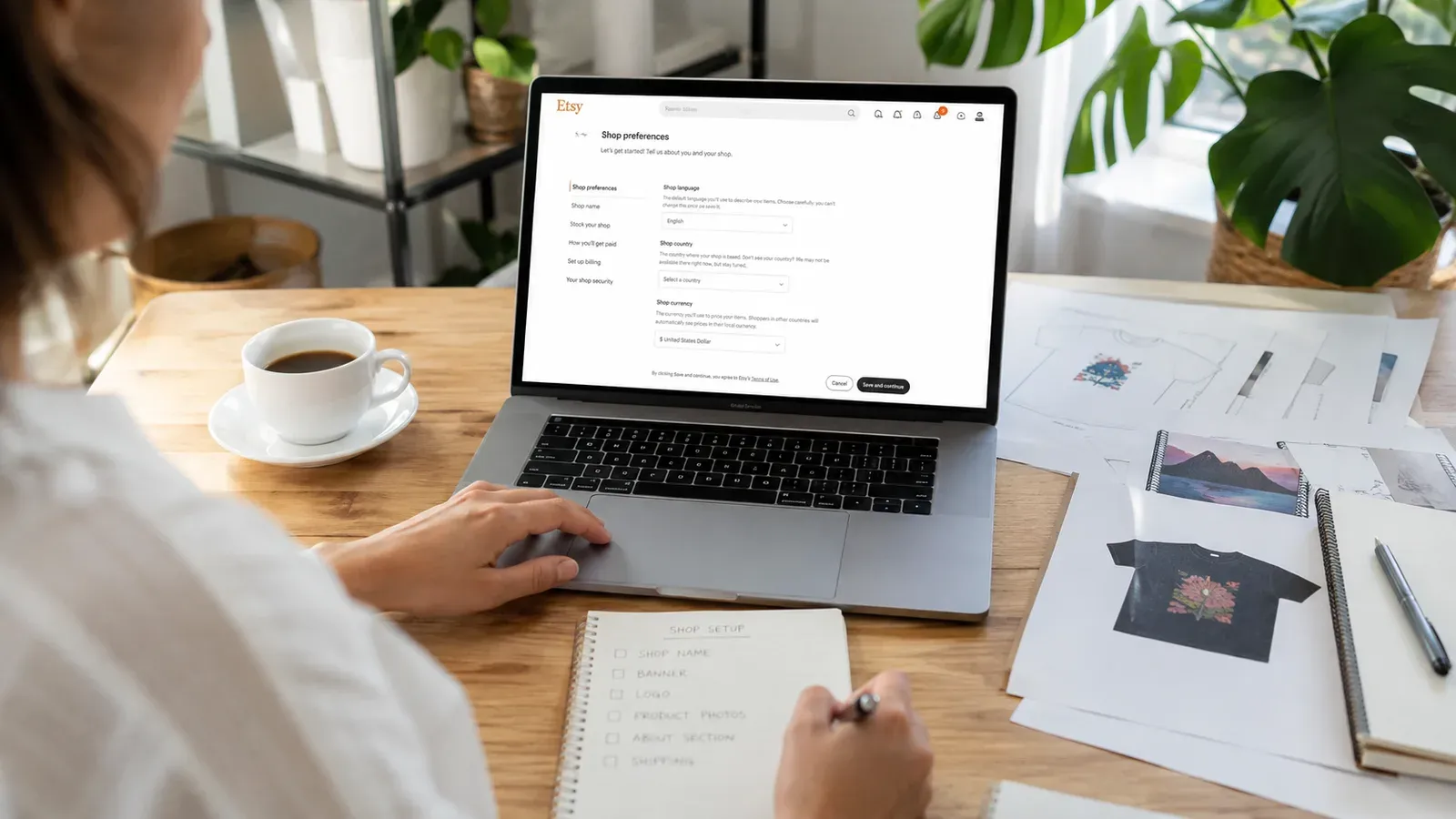
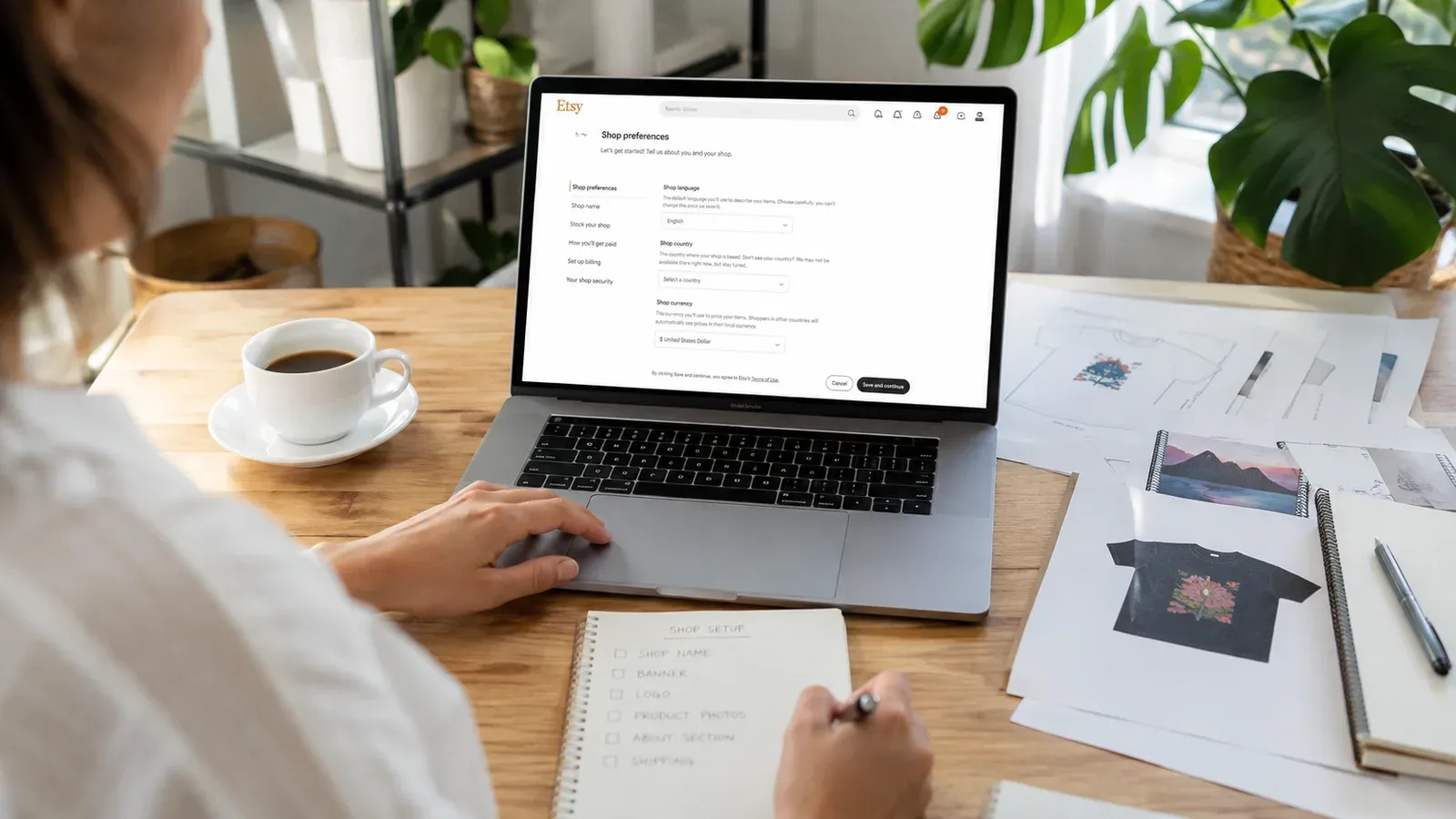
Once you have your documents and a pricing strategy, the actual setup takes about 20 minutes. You’ll choose a shop name (you can change it later, but pick something memorable), upload a banner and logo, write a short “About” section, and set your shop policies. This is where many new sellers rush and end up with a generic storefront that blends into the millions of other shops.
Your shop branding matters. According to Etsy’s own Seller Handbook, shops with complete branding and clear policies tend to rank higher in search and convert better. For a deep dive into visual identity, read Etsy Branding: The Complete Guide to Building a Powerful Visual Identity for Your Print-on-Demand Shop.
But here’s the reality: if you’re a first-time seller, you might not know what a good banner looks like or how to write policies that protect you from returns. You can spend hours watching YouTube tutorials and still feel unsure. This is where a done-for-you service changes the game.
Does all of this feel overwhelming? You don’t have to start from scratch. With Listybox Store Setup, our expert team sets up your Etsy store, lists your first 10 products, and optimizes everything for SEO. See the pricing page for what this service covers and what it costs.
Step 4: Creating Your First Listing That Actually Gets Seen
A listing is not just a photo and a price. It’s a combination of a title, 13 tags, a description, attributes, and images that all tell Etsy’s algorithm what you’re selling. If you skip keyword research, your listing will sit on page 20 and never be found.
Etsy’s search algorithm considers factors like listing quality, relevance, and recency. The title should include your main keyword naturally. For example, if you’re selling a “funny engineer mug,” your title might be “Funny Engineer Mug, Engineering Graduation Gift, Civil Mechanical Electrical Engineer Coffee Cup.” Then you need to fill all 13 tag slots with variations like “engineer gift,” “funny coffee mug,” “graduation present,” etc.
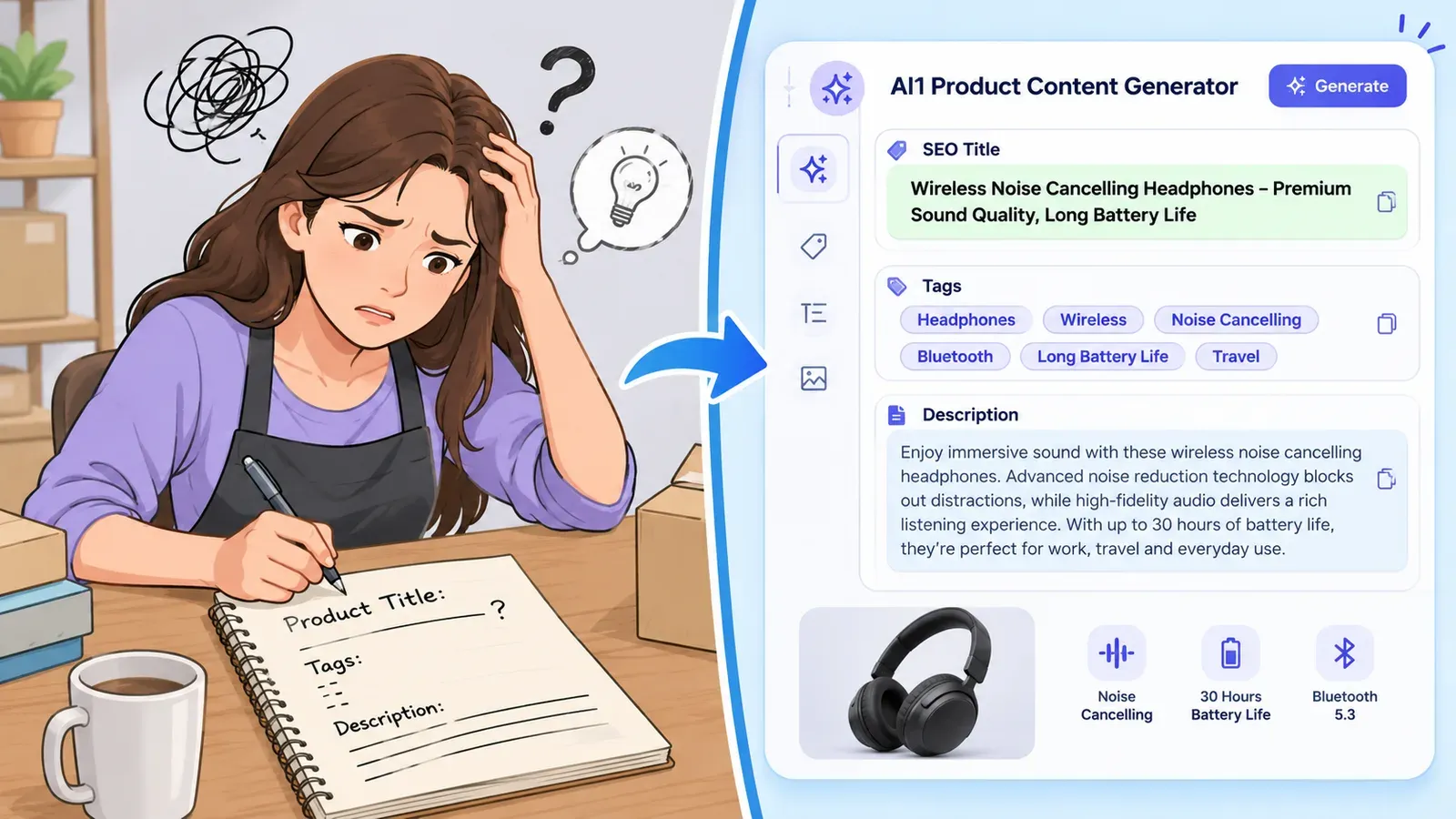
Liam spent three evenings researching keywords for just 10 listings. He used free tools, checked competitors, and still wasn’t sure if he was doing it right. The average new seller spends 4-6 hours per week on listing SEO alone, according to a survey by Etsy’s community forums. That’s time you’re not spending on design, marketing, or simply living your life.
This is where the Magic Wand feature changes the workflow. Instead of manually researching keywords, you select your product and design, and Magic Wand generates an SEO-optimized title, all 13 tags, and a product description based on what top-selling listings in your niche actually use. You can edit everything before publishing, so you stay in control. The result is a listing that is built to rank from day one, without the guesswork. For a complete strategy on ranking, check out How to Get Your Etsy Listing on the First Page: The 2026 Playbook.
Step 5: How to Get Your First Sale Faster
A new shop with zero sales looks risky to buyers. Etsy also gives a small visibility boost to new listings, but that fades quickly. To get your first sale, you need two things: traffic and trust.
Traffic comes from search, social media, and sometimes Etsy ads. Trust comes from a shop that looks professional and has some social proof. Even a few five-star reviews can make a huge difference. But how do you get reviews without sales? You can offer a small discount to friends or family to make the first purchase, or you can run a limited-time promotion.
Consistency is the secret most guides miss. Etsy’s algorithm favors shops that add new listings regularly. If you upload 20 products on day one and then do nothing for a month, your shop will stagnate. The shops that grow fastest are the ones that publish something new every day or every few days. Manually, that’s impossible if you have a job. That’s where Scheduled Publish comes in. You can create a batch of listings in one sitting, then schedule them to go live automatically over the next days or weeks. Your shop stays active, and you don’t have to log in daily.
For new sellers, the first sale often takes 2-4 weeks. Our guide First Etsy Sales: How New Sellers Can Break Through Faster in 2026 outlines specific tactics to shorten that window, including how to use social media and Etsy’s offsite ads.
Liam’s first sale came after he had 25 listings live and started posting one process video on TikTok. That single video brought 200 visits and his first order. He realized that the “build it and they will come” approach doesn’t work on Etsy. You need to actively drive initial traffic.
Step 6: The Hidden Trap That Kills Most New Etsy Shops
Here’s what nobody tells you: the real challenge isn’t opening the shop. It’s keeping it running without burning out. After the initial excitement, the daily grind sets in. You need to create new designs, optimize old listings, answer customer messages, process orders, track shipments, and handle returns. For a side hustle, this quickly becomes a second full-time job.
Liam found himself working until midnight on weekdays just to keep up with 30 listings. He was making sales, but his hourly rate was below minimum wage. He was trapped in what we call the “manual grind” - doing everything by hand because he thought automation was too expensive or complicated.
The solution isn’t to work harder. It’s to automate the repetitive parts so you can focus on growth. For example, instead of manually creating a listing for every product type (t-shirt, hoodie, mug, canvas), the Creation Wizard lets you combine one design with multiple products in a single click. You select your design, pick the products you want, and it generates all the variants with mockups in minutes. What took Liam 4 hours now takes 5 minutes.

Then there’s fulfillment. When an order comes in, you normally have to manually enter the customer’s address, choose a production partner, and upload the design. With Zero-Touch Fulfillment, the order is automatically routed to your print provider, produced, and shipped. The tracking number syncs back to Etsy, and the customer is notified. You don’t touch it. This is how you build a side income that doesn’t steal your evenings.
For a full breakdown of how automation turns a POD shop into a passive income stream, read Automatic Fulfillment Power: How to Build a Truly Passive Etsy Empire.
Opening an Etsy Shop Is the Easy Part - Scaling It Is Where Most Fail
By now, you know the steps to open an Etsy shop. You have your ID, your bank account, your first product ideas. You understand the fees and how to price profitably. You know how to create a listing that can rank. But the difference between a shop that makes $100 a month and one that replaces a full-time income isn’t more hours - it’s smarter systems.
The sellers who succeed in 2026 are the ones who treat their shop like a business from day one, not a hobby. They use tools that handle the busywork so they can spend their time on strategy, design, and marketing. They don’t burn out trying to do everything manually.
If you’re ready to open your Etsy shop and set it up to grow without the grind, start with a tool that handles the heavy lifting. Start Listybox now - no credit card required and get your first 10 products listed with professional SEO in under an hour.
Frequently asked questions
Put this into practice in your shop.
Every step from design to live listing, on one platform. Start on the free plan.
Related posts


Want to go deeper? Read our in-depth Etsy guides · Browse 100 Etsy niche guides