


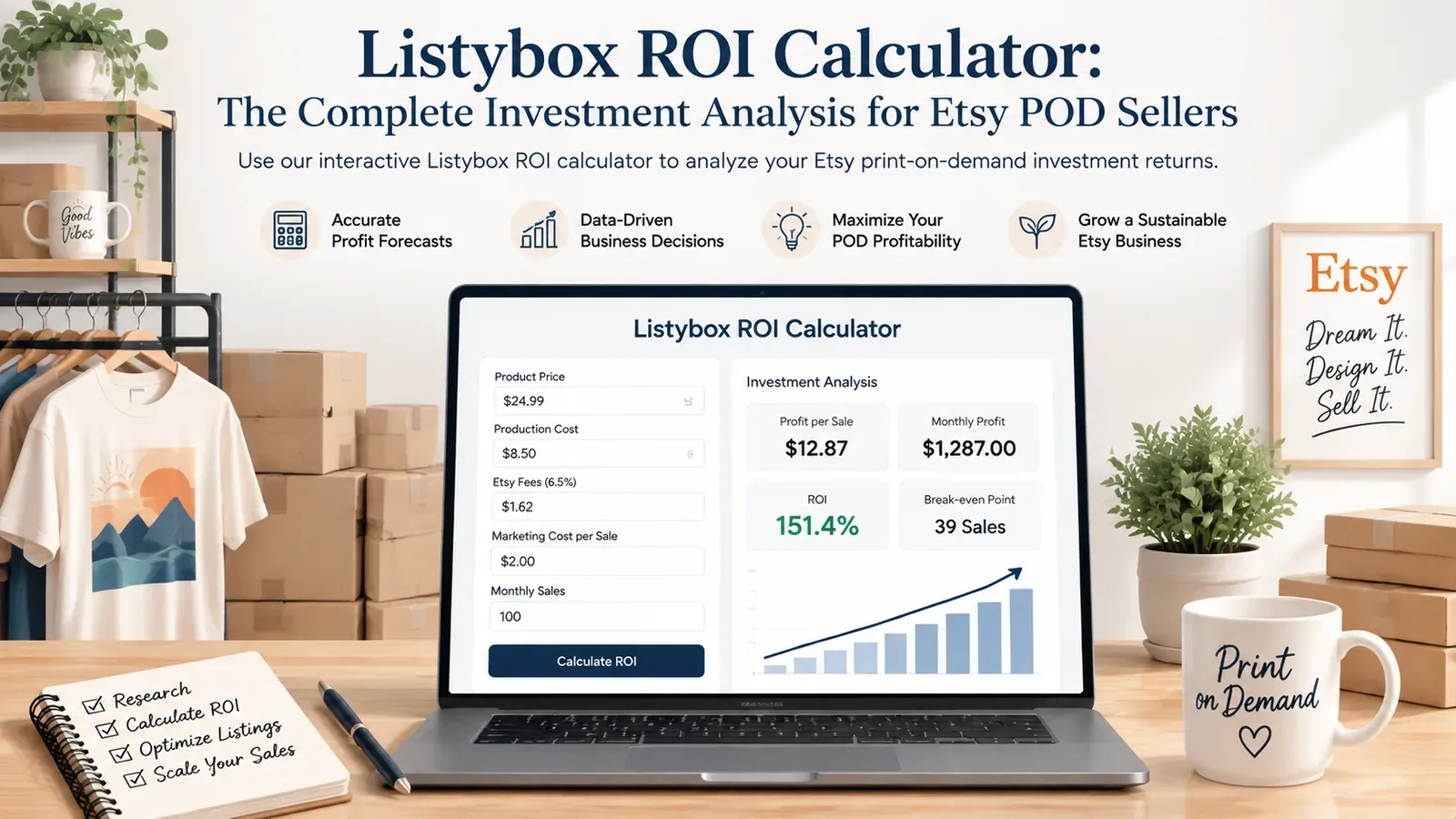
Key takeaways
Calculate True ROI: Factor in all hidden costs including time investment, Etsy fees (6.5% transaction + 3% payment processing), and production expenses to understand your real profit margins.
Time Is Money: Manual POD operations cost sellers an average of 15-20 hours weekly. At even minimum wage, that represents $2,400+ monthly in hidden costs.
Maximize Profit Margins: Target 30-40% profit margins on POD products.
You started your Etsy print-on-demand business with high hopes. The dream was simple: create designs, list products, and watch the passive income roll in. But somewhere between your 50th listing and your 100th hour of manual work, you realized something was wrong. Your bank account told a different story than your sales numbers.
This disconnect is the silent profit killer that defeats most POD entrepreneurs. They focus on revenue while ignoring the complete investment picture. Understanding your true Return on Investment requires looking beyond simple sales minus costs. It demands accounting for every hour spent, every fee paid, and every opportunity lost to manual processes.
How Do I Calculate My True ROI on Etsy Print-on-Demand?
The fundamental ROI calculation seems straightforward: (Gains - Investment) / Investment × 100. But for Etsy POD sellers, the challenge lies in accurately defining what counts as “investment.” Most sellers dramatically undercount their true costs, leading to inflated profit perceptions that mask underlying problems.
The Hidden Costs Most Sellers Ignore
Your investment extends far beyond production costs and Etsy fees. Consider the complete picture:
Time Investment: How many hours do you spend on research, design, listing creation, SEO optimization, order management, and customer service?
Opportunity Cost: What else could you be doing with those hours? Even valuing your time at minimum wage ($15/hour) adds up quickly.
Tool Subscriptions: Mockup generators, SEO tools, design software, and spreadsheet templates all eat into margins.
Mental Energy: Decision fatigue and burnout have real costs that manifest in poor decisions and reduced output.
The average entrepreneur spends hours each week on manual operations. At just $15/hour, that represents $280 weekly in hidden labor costs, or over $14,500 annually, that never appears on any balance sheet.
A Real-World ROI Calculation
Meet David, a mid-level POD seller who thought he was profitable. His monthly numbers looked healthy on the surface:
David generated $4,200 in monthly revenue across 120 orders. His production costs totaled $1,680, Etsy fees consumed $546, and shipping ran $360. On paper, his profit appeared to be $1,614, a seemingly healthy 38% margin.
But David spent hours each week on his store. Valuing that time at $20/hour, his actual labor cost was $1,600 monthly. His true profit? Just $14, representing a 0.3% margin. David wasn’t running a business; he was working a job that paid 17 cents per hour.
This is where intelligent automation transforms the equation. When David discovered Listybox’s Creation Wizard, his 15 designs became 500+ listings in under an hour instead of 40+ hours. His weekly time investment dropped from 20 hours to 4 hours, saving $1,280 monthly in labor costs and converting his near-zero profit into $1,294 monthly genuine profit.
Try your first design.
Try your design on a product and prepare its Etsy listing in Listybox.
What Is a Good Profit Margin for Print-on-Demand Products?
Understanding healthy profit margins is essential for evaluating your POD investment. Industry benchmarks provide the context you need to assess your own performance.
Industry Standard Margins
Print-on-demand profit margins vary significantly based on product type, niche selection, and operational efficiency:
Survival Level (10-20%): Many beginners operate here. These margins leave no room for error, growth investment, or unexpected costs.
Sustainable Growth (30-40%): This is where successful POD businesses live. These margins allow for reinvestment, marketing spend, and weather unexpected challenges.
Premium Territory (40-50%+): Achieved by sellers with strong branding, unique products, and operational excellence.
The key insight? Your operational efficiency directly determines which tier you occupy. Two sellers with identical products and pricing can have dramatically different margins based purely on how they manage their business.
The Automation Margin Advantage
Consider the margin impact of automation on a standard t-shirt sale:
Manual Seller Scenario:
Sale Price: $28.00
Production Cost: $12.50
Etsy Fees (total): $3.64
Shipping: $4.00
Time Cost (1 hour total work per sale): $15.00
True Profit: -$7.14 (NEGATIVE)
Automated Seller Scenario (with Listybox):
Sale Price: $28.00
Production Cost: $12.50
Etsy Fees (total): $3.64
Shipping: $4.00
Time Cost (5 minutes per sale via automation): $1.25
True Profit: $6.61 (24% margin)
The difference of $13.75 per sale might seem modest until you multiply it across 100, 500, or 1,000 monthly orders. At scale, automation creates a $13,000+ monthly advantage.
How Do Etsy Fees Affect My POD Profits?
Etsy’s fee structure creates a complex cost environment that many sellers fail to fully understand. Accurate ROI calculation requires complete fee awareness.
Breaking Down Etsy’s Fee Structure
Every Etsy sale incurs multiple fees that compound your costs:
Listing Fee: $0.20 per listing, charged at creation and renewal (every 4 months)
Transaction Fee: 6.5% of total sale price (including shipping)
Payment Processing: 3% + $0.25 in the US per transaction
Regulatory Operating Fee: 0.25% of total sale
Offsite Ads Fee: 12-15% on sales driven by Etsy’s external advertising (mandatory for shops over $10,000 annual sales)
For a $28 product with $5 shipping, you might pay:
Transaction Fee: $2.15
Payment Processing: $1.24
Regulatory Fee: $0.08
Potential Offsite Ads: $3.96
Total Fees: $7.43 (22.5% of sale value)
Strategic Fee Reduction
Smart sellers reduce effective fee impact through strategic approaches:
Combo Listings Strategy: Instead of creating 12 separate listings for one design across different products (paying $2.40 in listing fees), use Combo Listings to consolidate into a single super-listing. This saves $2.20 per design.
Volume Through Automation: Higher sales volume dilutes fixed costs like subscription fees and design time across more transactions. When the Magic Wand SEO tool generates optimized titles and tags in seconds instead of hours, you can list more products in the same time.
How Can I Maximize My Print-on-Demand Investment Returns?
Maximizing ROI in POD requires attacking inefficiency from multiple angles simultaneously. The most successful sellers optimize across two dimensions: time and cost.
The Time Multiplier Effect
Time is the most undervalued asset in POD businesses. Consider what happens when you reclaim hours each week from manual tasks:
Content Creation: Launch 50 new designs monthly instead of 10
Market Research: Identify trending niches using Trend Compass
Strategic Growth: Focus on brand building, marketing, and customer relationships
Personal Life: Reduce burnout and maintain sustainable energy
The Cost Optimization Chain
Every percentage point of cost reduction compounds across all future sales. Strategic optimization targets multiple cost centers:
Mockup and Design Costs: Instead of paying $15+ monthly for mockup generators like Placeit, Listystyle mockup creator generates hundreds of unique, professional lifestyle images with a single click. This eliminates subscription costs.
SEO Tool Costs: Monthly subscriptions to keyword research tools add $30-50 to your overhead. Listybox’s fine-tuned engine built specifically for Etsy integrates SEO optimization directly into the listing process, eliminating external tool dependencies.
Is Investing in POD Automation Tools Worth the Cost?
This is the crucial ROI question. How do you evaluate whether automation tools deliver positive returns?
The Investment Analysis Framework
Meet Priya, a POD seller considering whether automation tools justify their cost. She runs a modest operation with 200 listings generating $2,500 monthly revenue with a 25% profit margin ($625 monthly profit).
Priya spends hours each week on her business. Her current hourly return is $7.10, below minimum wage. She’s essentially running an unprofitable hobby.
With automation, Priya’s projections change dramatically. Her weekly time drops to 6 hours while her listing count expands to 800+ products. Conservative estimates project $8,000 monthly revenue at the same margin, generating $2,000 monthly profit. Her new hourly return becomes $83.33.
Beyond the Numbers: Strategic Value
Automation ROI extends beyond direct financial returns:
Scalability: Manual operations hit a ceiling. You cannot work 80-hour weeks forever. Automation reduces the manual steps.
Consistency: Zero-Touch Order Management sends the orders you have paid for to production and writes the tracking number back to Etsy.
Speed to Market: When trends emerge, automation lets you capitalize in hours instead of weeks.
Sustainability: Reduced burnout means you actually stay in business long enough to see long-term returns.
Calculate Your Personal ROI
To determine your specific automation ROI, gather these numbers:
1. Current weekly hours spent on POD business 2. Your hourly value (what you could earn elsewhere) 3. Current monthly revenue and profit 4. Current listing count 5. Cost of subscriptions and tools you currently use
Then project the automated scenario:
1. Estimated weekly hours with automation 2. Potential listing expansion 3. Revenue potential from expanded listings 4. Eliminated tool subscription costs
Run Your Own Numbers
The mathematics of POD success are unforgiving. Sellers who rely on manual processes are competing with one hand tied behind their back. They work longer hours for lower returns while automated competitors capture market share.
Frequently asked questions
Put this into practice in your shop.
Every step from design to live listing, on one platform. Start on the free plan.
Related posts



Want to go deeper? Read our in-depth Etsy guides · Browse 100 Etsy niche guides