

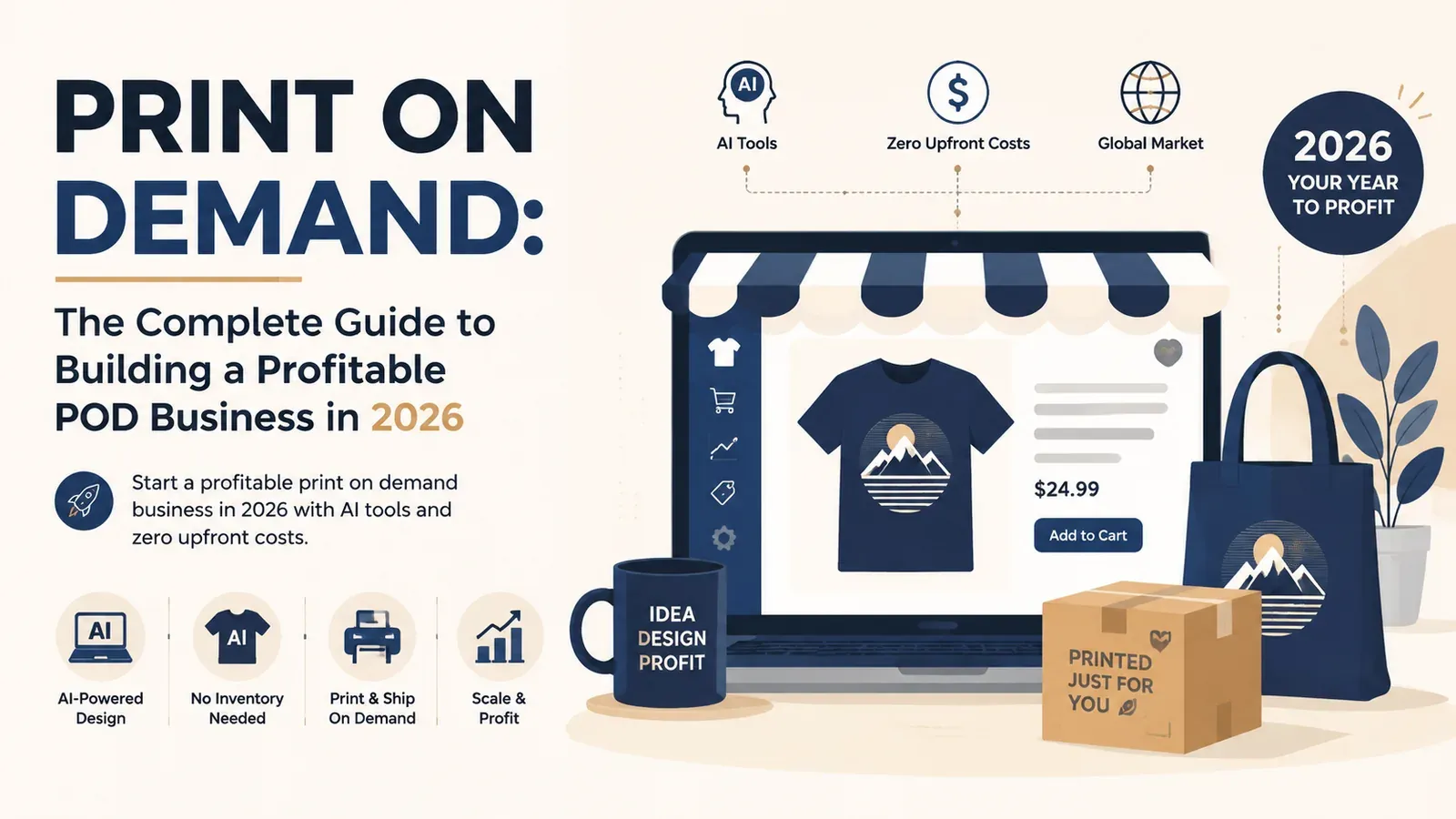
Print on Demand: The Complete Guide to Building a Profitable POD Business in 2026

Key takeaways
Start your POD journey with no money: free platforms and AI tools make it possible.
Leverage AI to create designs, listings, and market your products for passive income in 2026.
Etsy remains the top marketplace for POD beginners due to its massive traffic and low fees.
Follow our step-by-step guide to launch your first products and scale to a full-time income.
The dream of running an online business used to require a significant gamble. You would spend thousands on inventory, fill your garage with boxes, and pray that customers would actually buy. If you guessed wrong on a design or a product, you were stuck with dead stock and a lighter wallet.
Print on demand has completely rewritten these rules. It is a business model that removes almost all the traditional barriers to entry, allowing anyone with a creative spark to launch a custom product business with virtually zero financial risk. But while the model is simple, building a truly successful POD business requires strategy, the right tools, and a deep understanding of how to stand out in a crowded market.
What Is Print on Demand and How Does the Business Model Work?
At its core, print on demand is elegantly simple. You create a design, upload it to a platform, and apply it to a product like a t-shirt, mug, or poster. That product is then listed in your online shop. When a customer places an order, a third-party printing partner produces that single item and ships it directly to the customer on your behalf.
You never touch the product. You never manage inventory. You only pay for the item after you have already been paid by the customer. This is the fundamental mechanic that makes the model so accessible.
How a Typical POD Order Flows
Understanding the journey of a single order helps clarify why this model is so powerful:
Customer Orders: A buyer finds your unique mug design on Etsy and places an order.
Order Sent to Printer: The order details are automatically forwarded to your print-on-demand fulfillment partner.
Production: The printer produces that single, custom mug with your design.
Shipping: The printer packs the mug and ships it directly to the customer’s doorstep.
You Profit: You keep the difference between what the customer paid and the base production cost.
This “made-to-order” system eliminates the risk of unsold inventory. Whether you sell one item or one thousand, the process scales effortlessly.
What Are the Advantages of Print on Demand Over Traditional E-Commerce?
If you have ever considered selling physical products, you know the traditional path is filled with obstacles. Print on demand solves nearly all of them, which is why it has become one of the most beginner-friendly ways to launch an online business.
Virtually Zero Startup Costs
With traditional retail, you might spend $5,000 or more ordering bulk inventory, only to find out your designs do not sell. With POD, you pay for a product only after a customer has already purchased it. This means you can launch a store, test dozens of designs, and find your winners without any financial risk.
No Inventory Management Nightmares
Forget about renting warehouse space, tracking stock levels, or dealing with expired seasonal products. Your printing partner holds all the blank inventory. They handle the printing, packing, and shipping. You handle the creativity and marketing.
Limitless Product Testing and Creativity
Have an idea for a funny quote on a hoodie? You can create a listing in minutes and see if it sells. If it flops, you lose nothing but the time it took to design. If it becomes a bestseller, you can expand it across dozens of other products instantly. This freedom to experiment is the engine of POD success.
Global Reach Without Global Headaches
Many print providers have fulfillment centers around the world. This means when a customer in London orders your product, it can be printed and shipped from a European facility, reducing shipping times and costs without you lifting a finger.
Is Print on Demand Still Profitable in 2026?
This is the question every aspiring seller asks, and the answer is a resounding yes, but with a critical caveat. The days of uploading generic Canva designs and watching sales roll in are over. The market is more competitive, but this has simply raised the bar for quality and rewarded those who treat POD as a real business.
The numbers speak for themselves. The global print-on-demand market reached approximately $10 billion in 2024 and is projected to grow at a 25% or higher annual rate through 2033. This explosive growth is driven by consumers’ increasing desire for personalized and unique products.
The Profitability Pillars
Successful POD sellers in 2026 understand that profitability rests on a few key principles:
Niche Selection: Targeting a specific audience allows you to create designs that deeply resonate with buyers, making them willing to pay a premium.
Unique Designs: Your artwork is your moat. Original, high-quality designs cannot be easily copied and command customer loyalty.
Strategic Pricing: Most established POD sellers aim for 30-40% profit margins. Achieving this requires understanding your production costs and the perceived value of your products.
Volume and Consistency: Winners upload new products regularly. Consistent activity signals to marketplace algorithms that your shop is active, which boosts visibility.
The challenge for most sellers is that the manual work required to consistently list new, optimized products is immense. This is where intelligent automation becomes not just helpful, but essential. Platforms like Listybox are built specifically to handle the heavy lifting. Features like the Creation Wizard can turn a single design into hundreds of product listings in minutes, not days, freeing you to focus on strategy and design.
How Is Print on Demand Different From Dropshipping?
This is one of the most common points of confusion for new e-commerce entrepreneurs. While both models share similarities, they lead to fundamentally different business outcomes.
The Core Difference: Creativity vs. Commodity
In traditional dropshipping, you act as a middleman. You find a pre-made product from a supplier, list it in your store, and when a customer orders, the supplier ships it. The product is generic and available to any of the thousands of other sellers who source from the same supplier.
In print on demand, you sell your own unique creations. A blank t-shirt is a commodity. A t-shirt with your original design is a branded product that no one else can offer. This is the single most important distinction.
Brand Control
Dropshipping: Low. You are selling someone else’s product with no ability to differentiate beyond price.
Print on Demand: High. Every product carries your unique design and brand identity, creating a defensible market position.
Competition Dynamics
Dropshipping: Brutal. If 50 other stores sell the same phone case, the only way to compete is to lower your price, which crushes your margins.
Print on Demand: Defensible. Your unique cat-themed motivational poster is yours alone. Customers who love it will buy from you, not a competitor.
Customer Loyalty and Long-Term Value
Dropshipping: Difficult to build. Customers have no reason to return to your store if they can find the same product elsewhere.
Print on Demand: High potential. A customer who loves your brand and design aesthetic will become a repeat buyer and recommend you to others.
The bottom line is this: dropshipping can be a way to make quick cash, but print on demand is a path to building a lasting brand. For creatives and entrepreneurs who want to build something meaningful, POD is the superior model.
How Do I Start a Print on Demand Business on Etsy?
Etsy is one of the best platforms for launching a POD business, and for good reason. It has a built-in audience of over 90 million active buyers who are specifically searching for unique, handmade, and personalized products. You do not have to build your own audience from scratch; you just need to learn how to get your products in front of the right people.
A Realistic Scenario: The Manual Grind vs. Smart Automation
Meet Sarah, a graphic designer with a passion for vintage botanical illustrations. She decides to launch an Etsy shop selling her artwork on apparel and home decor.
She starts by manually creating her first listing. She uploads her design to a POD provider, chooses a t-shirt, creates a mockup, then copies everything into Etsy. She writes a title, struggles to come up with 13 tags, and drafts a product description. After an hour, she has one listing live.
Sarah wants to put that same design on a hoodie, a tote bag, a mug, and a poster. She realizes this means repeating the entire process four more times. By the end of the day, after 5 hours of tedious work, she has 5 listings. She has 20 designs she wants to sell. The math is demoralizing.
Then, her first order comes in. She is thrilled, but the joy quickly fades. She now has to manually copy the customer’s address, go to her print provider’s website, place the production order, pay for it, and then wait for a tracking number. When the tracking number arrives days later, she has to go back to Etsy and update the order status. For one sale. The process feels completely unsustainable.
This is the breaking point where many sellers give up. But it does not have to be this way.
The Smarter Path with Listybox
Now imagine Sarah discovers a platform built specifically for Etsy POD sellers. Instead of the manual nightmare, her workflow transforms:
Bulk Creation: Using the Creation Wizard, Sarah uploads her 20 designs and selects 10 different product types. With a few clicks, the platform generates all 200 product “creations,” complete with mockups and variants, in minutes.
Intelligent SEO: For each product, she uses the Magic Wand SEO tool. Listybox’s fine-tuned engine, built specifically for Etsy, analyzes top-performing listings and generates optimized titles, all 13 tags, and persuasive descriptions tailored to her niche. No more guessing.
Professional Visuals: Generic mockups blend into the sea of competition. With Listystyle mockup creator, she generates unique, professional lifestyle photos that make her products stand out and command higher prices.
Hands-Off Fulfillment: When her orders start rolling in, Zero-Touch Order Management takes over. Orders are automatically routed to the best print provider, produced, and shipped. Tracking numbers are captured and sent to the customer, and the Etsy order is closed. Sarah does not have to copy a single address.
Before automation, Sarah was trapped in an endless cycle of manual labor that would cap her growth. After automation, she is free to focus on what she loves: creating beautiful designs and building her brand. Sellers who adopt this end-to-end automation strategy list an average of far more products per month than those who work manually.
Your First Steps to Launch
If you are ready to start, here is a simplified roadmap:
1. Choose Your Niche: Do not try to sell everything to everyone. Focus on a specific passion or audience, like gifts for cat owners, or decor for plant lovers. 2. Create Unique Designs: Use tools like Canva or professional design software. Originality is your greatest asset. 3. Select a POD Platform: Choose a provider that integrates well with Etsy and offers quality products. Listybox offers a Lowest Price Guarantee to maximize your profit on every sale. 4. Master Etsy SEO: Your products cannot sell if no one finds them. This is not optional. Learn how keywords work or use a tool that does it for you. Our Etsy SEO guide is a great place to start. 5. Automate Everything Possible: From listing creation to order fulfillment, every manual task is a bottleneck to your growth.
Starting from scratch can feel overwhelming, but you do not have to do it alone. If the idea of setting up your Etsy store feels like too much, Learn more about Store Setup. With Listybox Store Setup, our expert team creates your Etsy store, handles the branding, lists your first 10 products with full SEO optimization, and provides onboarding training. See our pricing page for which plans include it.
Your Print on Demand Journey Starts Now
Print on demand is not a get-rich-quick scheme. It is a legitimate business model that rewards creativity, strategy, and consistent effort. The market is growing rapidly, and for sellers who are willing to build a real brand and leverage the right tools, the opportunity has never been greater.
The difference between the sellers who burn out and the sellers who build thriving, passive income businesses comes down to one thing: automation. Handling everything manually is a path to exhaustion. Letting a purpose-built platform handle the operational grind is the path to freedom.
Are you ready to stop dreaming about your POD business and start building it?
Frequently asked questions
Put this into practice in your shop.
Every step from design to live listing, on one platform. Start on the free plan.
Related posts


Want to go deeper? Read our in-depth Etsy guides · Browse 100 Etsy niche guides