


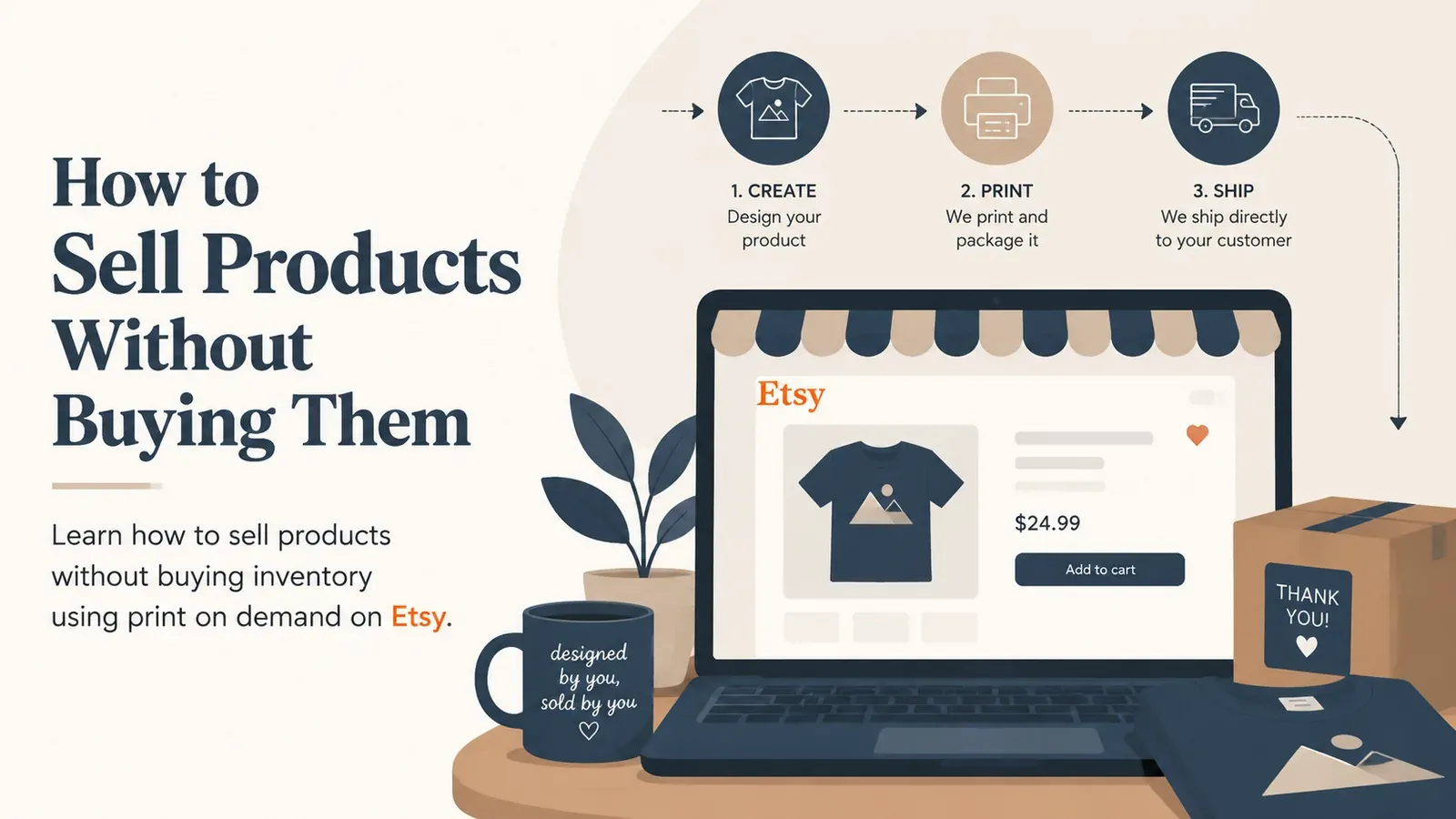
Key takeaways
Sell without inventory by using print on demand; you pay only after a customer buys.
Etsy is the ideal marketplace for no-inventory sellers due to its gift and personalization focus.
Avoid hidden fees by calculating Etsy charges.
Scale with automation tools like Creation Wizard, Bulk Editing, and Scheduled Publish to save hours each week.
Start free with Listybox and no credit card required to test the model risk-free.
The dream of selling products online usually comes with a nightmare: a garage full of boxes, a credit card maxed out on inventory, and the constant fear that nothing will sell. But what if you could list hundreds of products on Etsy, take orders, and get paid without ever purchasing a single unit upfront? That is the core promise of print on demand (POD), and it is not a gimmick. It is how thousands of sellers, including those burned by traditional dropshipping, have built stable income streams.
Meet Noah. He spent $4,000 on a Shopify dropshipping store, only to watch his supplier ship cheap knockoffs and his PayPal account get frozen. When he moved to Etsy POD with no inventory risk, he realized the difference: the product is printed only after a customer pays. No warehouse, no bulk orders, no guessing. This guide breaks down exactly how to sell products without buying them, step by step, with the tools that make it sustainable.
What Does It Mean to Sell Products Without Buying Them?
Selling without buying inventory means you never pay for a product until a customer has already paid you. You list a design on a product, set your price, and when someone buys, a third-party supplier produces and ships the item. You keep the difference between your selling price and the production cost plus fees. No stock, no storage, no risk of unsold goods.
There are three main models that let you sell without buying products upfront: print on demand, dropshipping, and digital products. Dropshipping has a terrible reputation because suppliers are often overseas, shipping takes weeks, and quality is inconsistent. Digital products have no physical fulfillment, but the market is crowded and you still need to create the product. Print on demand sits in the sweet spot: physical products that feel handmade, produced on demand, with your design as the only unique asset.
The Old Way vs. The No-Inventory Way
Traditional retail forces you to guess. You buy 500 t-shirts in five sizes, hoping the design sells. If it flops, you are stuck with boxes in your living room. Print on demand flips the economics. You pay nothing until a sale happens.
⚠️ Dropshipping is not print on demand. Dropshipping suppliers often ship directly from AliExpress with 20-day delivery and no quality control. POD partners print locally or regionally. Choose POD over dropshipping if you want your store to survive past the first chargeback.
For the cost breakdown, see hidden costs and fees.
Try it in your shop.
Every step from design to live listing, on one platform. Start on the free plan.
How Does Print on Demand Work on Etsy?
Etsy is the perfect marketplace for no-inventory selling because its buyers already search for unique, personalized, and giftable items. The process is straightforward, but many beginners stall at the technical steps. Here is the exact flow.
The Etsy POD Flow in 4 Steps
Choose a product and a design. You pick a blank item from a catalog (t-shirt, mug, canvas, tote) and apply your artwork using a design tool.
List it on Etsy with title, tags, and description built for Etsy search. This is where SEO makes or breaks your visibility.
Customer places an order. Etsy deposits the money into your account minus its fees.
Your POD supplier receives the order automatically, prints the design, and ships it to the customer with your branding.
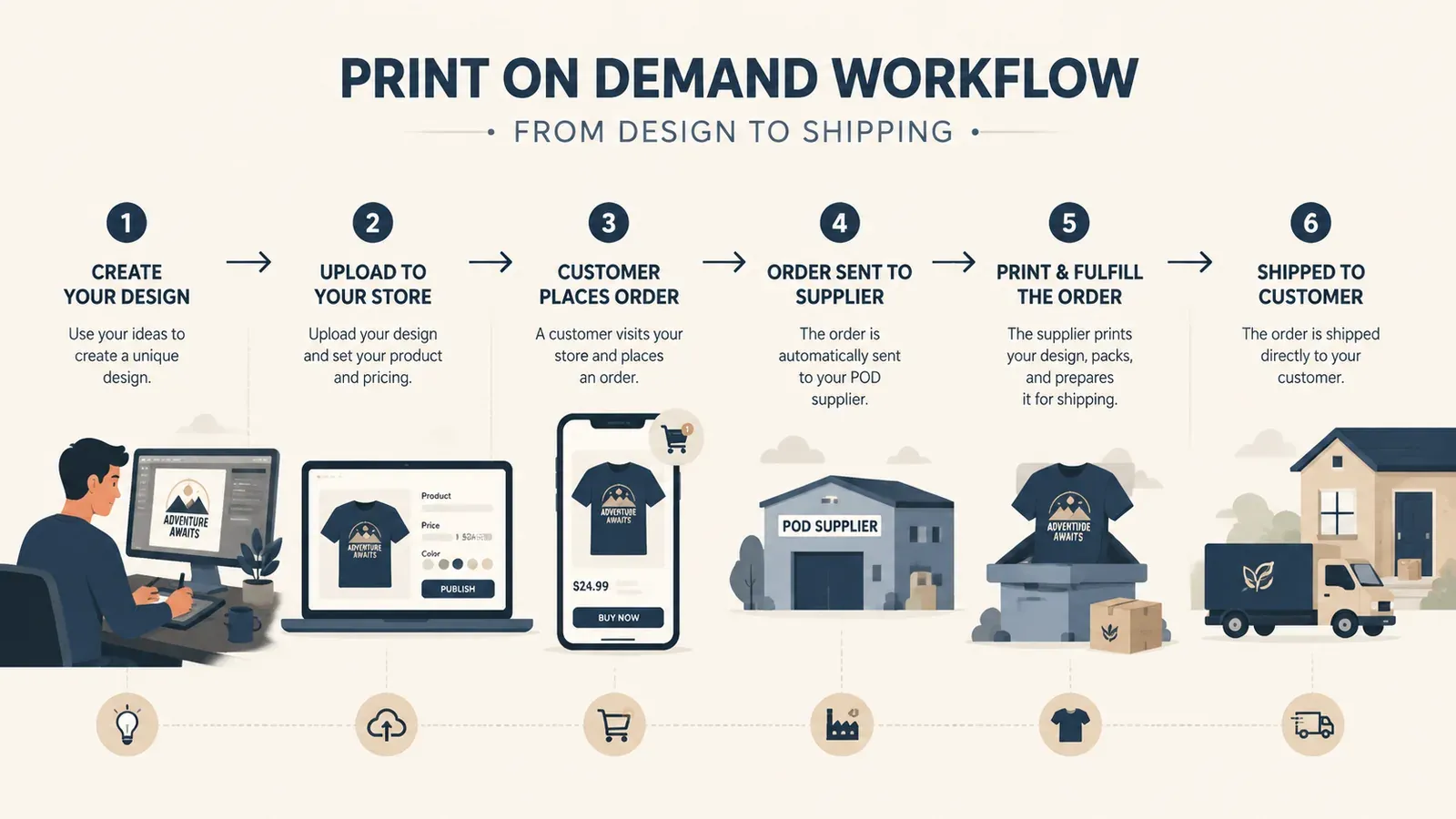
The magic is in step 4. You never touch the product. But you do need a system that connects your Etsy store to a production partner. That is where a tool like Listybox comes in. Instead of manually uploading each design to a printing service, you can use the Creation Wizard to apply your designs to multiple products in a single click. It generates all the mockups and variants you need to list professionally.
💡 Pro tip: List your first 20 products with at least 5 photos each. Etsy’s algorithm favors listings with more images listings with 5+ images get more clicks than those with 1-2 images.
For the written parts, do not stare at a blank title box. The Magic Wand feature writes titles, 13 tags, and descriptions for your specific product and design. You can edit every word before publishing, so you stay in control.
What Are the Best Products to Sell Without Inventory?
Not all POD products are equal. Some have higher profit margins, lower competition, or better repeat purchase rates. Here are the top categories for 2026.
Top 5 Categories for 2026
T-shirts: The evergreen bestseller. A $6 production cost can sell for $24-$30, leaving healthy margins after fees. Design trends shift, but basic tees always move. Check our guide on Print on Demand T-Shirts: Your 2026 Blueprint for Selling Without Inventory.
Mugs: Mugs are gifts, office essentials, and seasonal winners. Production cost around $4-$5, selling price $18-$25.
Wall art: Digital prints on canvas or posters have near-zero weight and shipping cost advantages. A single design can be sold on paper, canvas, or framed print with no extra work.
Tote bags: Eco-conscious buyers love them. Low production cost ($5-$7) and high perceived value for handmade markets.
Phone cases: Fast trends, but saturated. Use the Trend Compass to spot trending topics.
For a data-driven breakdown of more product ideas, read Best Products to Sell Online in 2026: A Data-Driven Guide for Etsy Sellers.

How Do I Avoid Hidden Costs and Fees When Selling Without Buying Stock?
Selling without inventory does not mean selling without costs. Etsy takes a cut, the POD supplier takes a cut, and if you are not careful, your profit disappears. The biggest mistake new sellers make is pricing too low to cover all the hidden fees.
The Math That Kills Unprepared Sellers
Etsy charges a $0.20 listing fee, a 6.5% transaction fee, and a payment processing fee of around 3% + $0.25 in the US. On a $25 t-shirt, that is roughly $1.63 in Etsy fees plus the $6 production cost, leaving you about $17.37 before shipping. If you offer free shipping but do not factor it into your price, you could lose another $4-$6. Suddenly your $19 profit is closer to $8.
The official Etsy fee schedule is available on their site (https://www.etsy.com/legal/fees/), but for a plain-English breakdown, see our article How Much Does Etsy Take From Sellers? The 2026 Fee Breakdown.
⚠️ Never set your price without calculating production cost, Etsy fees, payment processing, and shipping. A common pitfall is pricing at $15 for a t-shirt and then realizing after the sale you made only $1. Use a profit calculator before you list.
How Can I Scale a No-Inventory Etsy Business Without Burning Out?
The first 20 products are fun. Listing 500 products by hand is a full-time job. The sellers who scale do not work harder; they automate the repetitive parts and focus on strategy. Here is the automation stack.
The Automation Stack That Gives You Time Back
Bulk Editing lets you update titles, tags, or descriptions across hundreds of listings in minutes. Seasonal changes or trademark cleanup no longer require clicking through each item.
Scheduled Publish drips your new listings out one by one on a schedule you choose.
Zero-Touch Fulfillment sends the orders you have paid for to production and writes the tracking number back to your Etsy order. No more copying addresses at 2 a.m.
The result is less manual work as your catalog grows.
If you are ready to stop doing everything by hand, start with the tools that make it possible. Start free - no credit card required and build your first no-inventory listing today.
Does all of this feel overwhelming? You do not have to start from scratch. With Listybox Store Setup, our team helps you set up your Etsy store. It is available inside a custom Enterprise+ offer, so plan a demo or write to [email protected].
Selling products without buying them is no longer a secret; it is a proven business model with lower risk and higher flexibility than traditional retail. The key is pairing the right marketplace with the right tools. By using print on demand on Etsy and automating the heavy lifting, you can turn a simple idea into a stream of sales without ever ordering a single box of inventory. Start small, stay consistent, and let the tools take care of the repetitive parts.
Frequently asked questions
Put this into practice in your shop.
Every step from design to live listing, on one platform. Start on the free plan.
Related posts


Want to go deeper? Read our in-depth Etsy guides · Browse 100 Etsy niche guides