
The Ultimate Stockless Ecommerce Guide: Dropshipping vs. POD in 2026
Running an online store doesn't mean drowning in boxes or managing a warehouse. This guide explores the most profitable stockless ecommerce models for 2026, comparing Dropshipping vs. Print on Demand, and reveals how successful sellers use intelligent automation to build brand-focused, inventory-free empires.
Bullet Points (TL;DR)
Inventory Freedom: Start a scalable business without buying stock or renting a warehouse.
Brand Control: Choose Print on Demand over generic dropshipping to build a defensible, long-term brand.
Automated Growth: Use AI to handle SEO, mockups, and order fulfillment automatically.
Risk Mitigation: Test new product ideas instantly without financial risk using digital mockups.
Speed to Market: Launch hundreds of products in minutes, not weeks, using bulk creation tools.
The dream of ecommerce used to be synonymous with a garage full of cardboard boxes and the constant stress of unsold inventory. But in 2026, the game has changed. The smartest entrepreneurs are building six-figure empires without ever touching a roll of packing tape.
Stockless ecommerce is not just a trend; it is the most efficient way to mitigate risk while maximizing agility. However, not all stockless models are created equal. Choosing the wrong path can lead to customer service nightmares and razor-thin margins. This guide will dismantle the myths, compare the giants - Dropshipping vs. Print on Demand - and show you how to build a business that runs on autopilot.
What Is Stockless Ecommerce and How Does It Work?
At its core, stockless ecommerce decouples the sales process from the fulfillment process. In a traditional model, you buy 500 units of a product, store them, and ship them as orders come in. If the product flops, you lose your investment.
In the stockless model, the supply chain is reactive rather than proactive. You list a product on a marketplace like Etsy or Shopify. A customer buys it. Only then do you pay your supplier, who ships the item directly to the customer. You keep the difference between the retail price and the wholesale cost.
This fundamentally shifts your focus from logistics to marketing and design. However, the mechanism varies significantly depending on whether you choose generic Dropshipping or Print on Demand (POD).
The Battle of Models: Dropshipping vs. Print on Demand
Many beginners confuse these two, but their long-term viability is vastly different. Here is why savvy entrepreneurs are flocking to Print on Demand.
Brand Identity and Control
Dropshipping: Low. You are often selling the same generic fidget spinner or phone case as 10,000 other sellers. Price wars are inevitable, and building a loyal brand is nearly impossible because the product is not unique.
Print on Demand: High. Every product carries your unique design. You are selling your creativity, not a commodity. This allows you to build a defensible brand that customers return to.
Shipping and Quality Speed
Dropshipping: Unpredictable. Goods often ship from overseas (e.g., China), taking 2-4 weeks to arrive. Quality control is out of your hands, leading to high return rates.
Print on Demand: Reliable. Most robust POD networks have local production centers in the US and Europe.
Profit Margins and Stability
Dropshipping: Razor-thin. To compete, you must slash prices. Sudden supplier changes can kill your best-selling listing overnight.
Print on Demand: Healthy and Stable. Because you sell unique conversational pieces or emotional designs, customers are less price-sensitive. With Listybox's Lowest Price Guarantee, you lock in production costs that protect your margins regardless of market fluctuations.
The Trap of "Passive" Income
Let's introduce Marcus, a graphic designer who wanted to escape the 9-to-5 grind. His goal was simple: launch a side hustle to pay his mortgage.
Marcus started with traditional dropshipping. He spent weeks curating gadgets from AliExpress. The nightmare began when his first viral product resulted in 50 orders - and 20 angry emails about shipping delays. The stress of customer service and quality disputes nearly made him quit entirely. He pivoted to Print on Demand, realizing that selling his own art on t-shirts was safer. But soon, a new trap appeared: the "upload grind."
Creating a design was easy. But uploading that design to Printify, manually adjusting it for t-shirts, hoodies, and mugs, writing SEO titles, and researching tags for each listing took him 40 minutes per product. To list his 50 designs would take over 30 hours of boring, repetitive clicking.
Just as he was about to burnout again, Marcus discovered the Listybox Creation Wizard. Instead of creating products one by one, he uploaded his 50 designs into the My Artworks upload center. In three clicks, the Creation Wizard applied those designs to t-shirts, mugs, and totes simultaneously.
Before Listybox, Marcus was a data entry clerk in his own business. After Listybox, he generated 500 listings in the time it took to drink his coffee. He was finally free to focus on being a creator.
How to Automate Your Success
Automation is the difference between owning a business and owning a job. Successful stockless sellers do not guess; they use data and tools to ensure every hour spent yields a return.
1. Automate Your SEO Getting found on Etsy is difficult if you don't speak "algorithm." Writing descriptions manually is tedious and often ineffective. Our internal data suggests that sellers using AI-assisted SEO see a 40% increase in initial visibility compared to manual entry. You can achieve this with the Magic Wand SEO tool, which analyzes top-performing listings and writes keyword-rich titles and tags for you instantly.
2. Automate Visual Marketing In a stockless world, your photo is the product. Generic mockups kill conversion rates. Instead of paying for expensive photographers or subscription sites, successful sellers use the ListyStyle mockup creator. This tool places your designs into realistic, high-conversion lifestyle scenes that look like a professional photoshoot, building instant trust with buyers.
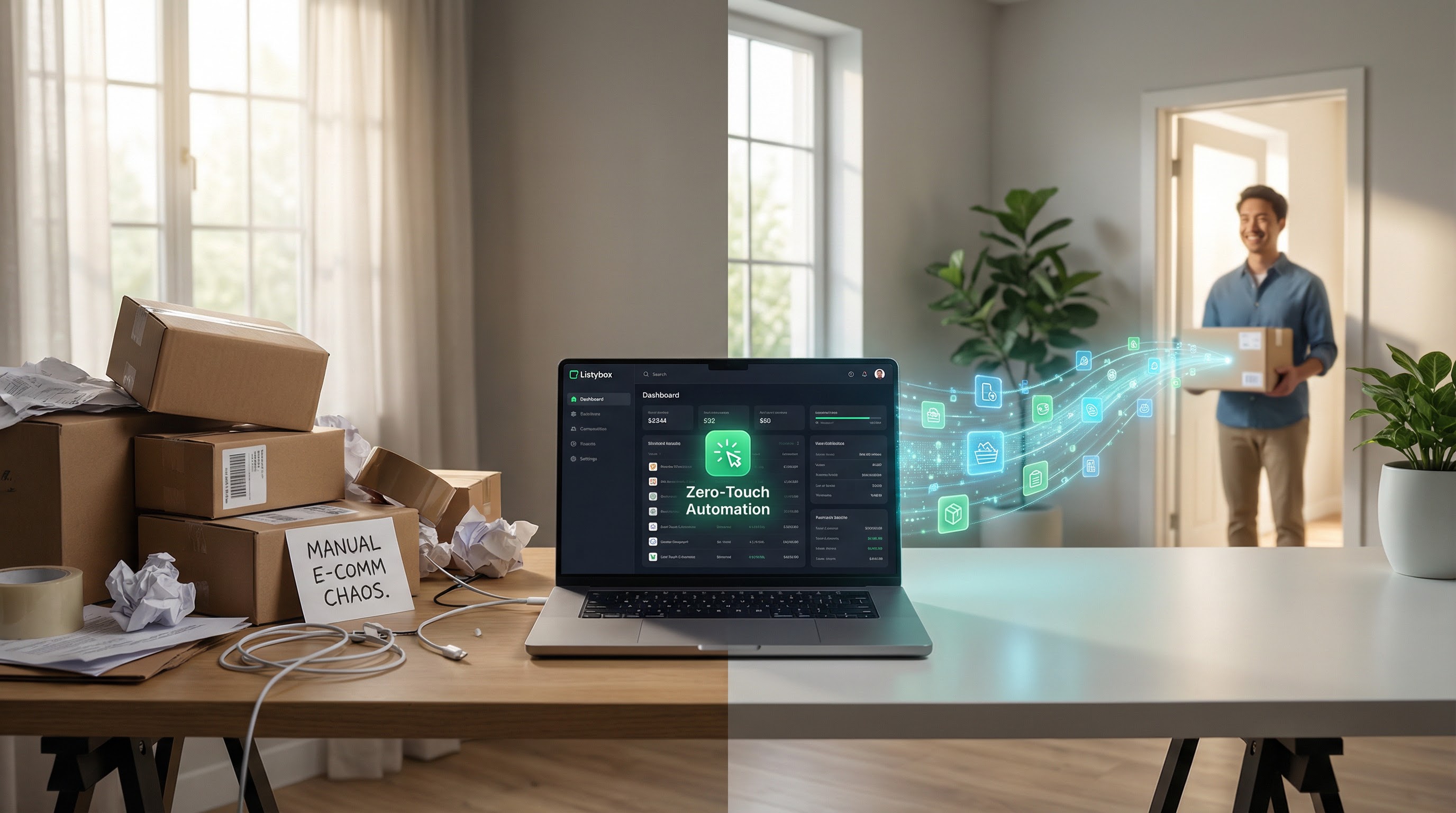
3. Automate Fulfillment The goal is to sleep while you earn. You shouldn't have to copy-paste addresses or tracking numbers. Zero-Touch Order Management acts as your invisible COO. When an order comes in on Etsy, Listybox detects it, routes it to the best producer, and updates the tracking info automatically when it ships.
Starting From Zero? Here is the Shortcut
Does all of this feel overwhelming? You don't have to start from scratch. Many potential sellers stop before they start because setting up the shop feels too technical.
With Listybox Store Setup, our expert team sets up your Etsy store, installs professional branding, lists your first 10 products, and optimizes everything for SEO. This service is included FREE with annual Starter and Professional plans, essentially handing you a "business in a box" ready for sales.
Stockless ecommerce is the future of retail freedom. By choosing Print on Demand and leveraging the right automation tools, you can build a brand that serves you - not the other way around.
Ready to stop manual labor and start smart scaling? Start Listybox now - no credit card required.
Never Miss an Update
Get actionable Etsy tips delivered to your inbox every week. No spam, unsubscribe anytime.