


Key takeaways
Understand the Terminology: Use both “tee” and “t-shirt” in your SEO strategy to capture maximum search traffic.
Eliminate Inventory Risk: Use Print on Demand to sell custom apparel without buying stock upfront.
Automate Creation: Use the Creation Wizard to turn one design into multiple listings in minutes.
Write SEO Faster: Stop guessing keywords and let the Magic Wand write titles and tags for you.
Design Without Skills: Leverage the Artwork Gallery and Canva integration to create professional products without being an artist.
The humble t-shirt is a staple of global fashion, a wardrobe essential that transcends culture, age, and style. For an aspiring entrepreneur, it represents something even more powerful: a blank canvas for profit. But before diving into the world of e-commerce, a common question arises in search bars everywhere: is there a difference between a “tee” and a “t-shirt”?
While the answer might seem like semantics, understanding the nuance is the first step in mastering the keywords that drive sales. However, knowing the difference isn’t enough to build a business. The real challenge lies in the execution - transforming digital designs into physical products without drowning in logistics. This guide will clarify the terminology and, more importantly, show you how to leverage automation to turn a simple “tee” into a scalable income stream.
Tee vs. T-Shirt: Is There a Difference?
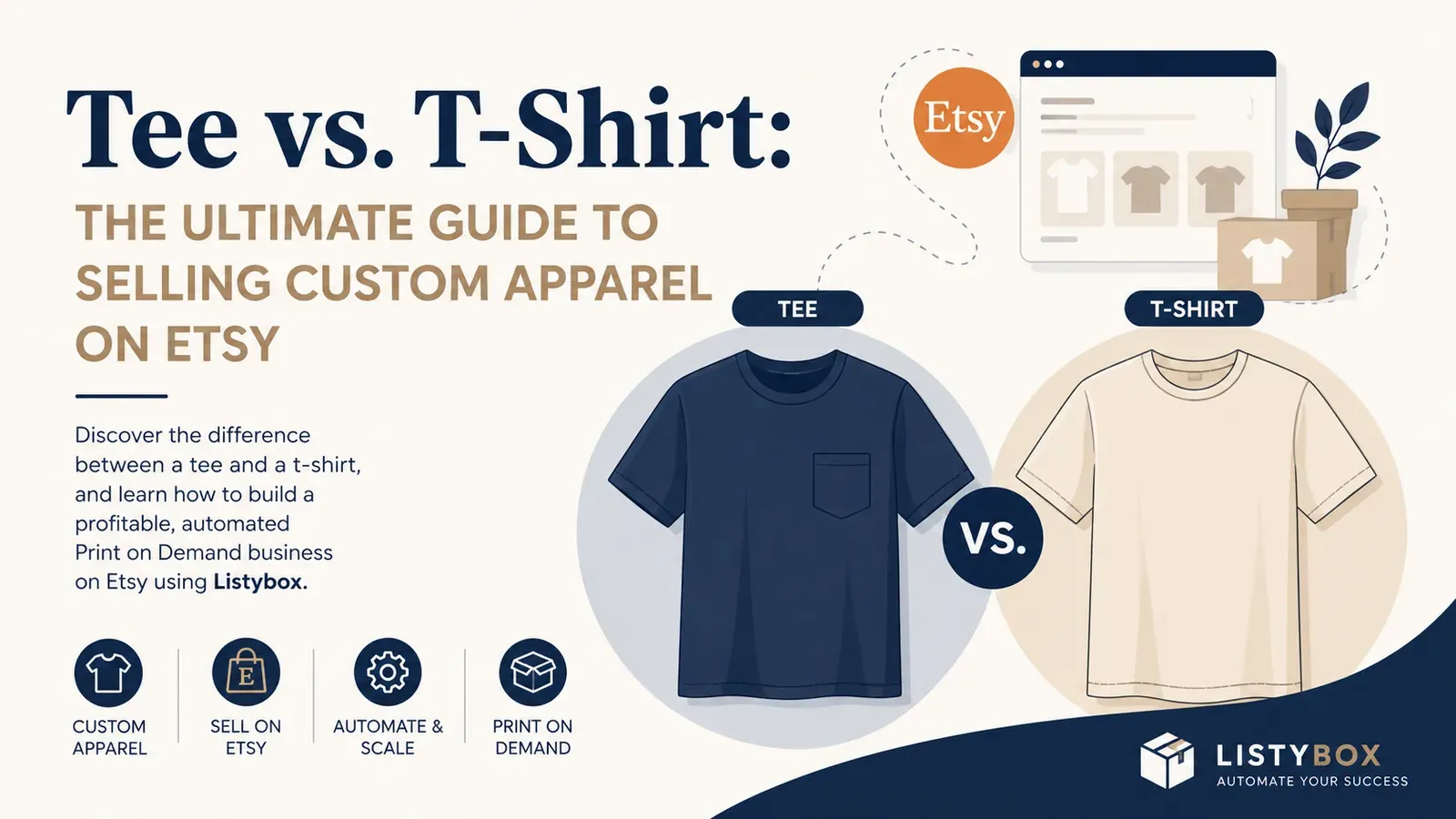
Strictly speaking, “tee” is simply a colloquial abbreviation for “t-shirt.” The term “t-shirt” comes from the T-shape of the garment’s body and sleeves. Over time, “tee” has evolved to sound slightly more casual, modern, and youthful, while “t-shirt” remains the formal, standard descriptor.
Why It Matters for Etsy Sellers
As a seller, you aren’t a linguist; you are a strategist. The distinction matters purely for Search Engine Optimization (SEO). Some customers search for “vintage tees,” while others type “cotton t-shirt.”
The Strategy: You must use both terms. Ignoring one means leaving money on the table.
The Execution: Manually guessing which term to use in your titles and 13 tags is time-consuming. This is where automation becomes your best friend. Instead of agonizing over synonyms, you can rely on the Magic Wand SEO tool to analyze real-time search data and inject the highest-performing keywords directly into your listings.
Try it in your shop.
Every step from design to live listing, on one platform. Start on the free plan.
The Print on Demand Revolution
Gone are the days when starting a clothing brand meant ordering 500 shirts, storing them in your garage, and praying they sold before the moths got to them. Print on Demand (POD) has democratized the industry.
The Old Way vs. The POD Way
Traditional Retail: High risk. You buy inventory upfront. If it doesn’t sell, you lose money. You pack and ship every order yourself.
Print on Demand: Zero risk. You create a digital listing. When a customer buys it, a provider (like Printify) prints it and ships it. You only pay for the product after you’ve been paid by the customer.
However, even POD has a hidden trap. Managing orders between Etsy and your print provider can quickly become a manual nightmare of copy-pasting addresses and tracking numbers. This friction is the number one reason new sellers burn out.
To truly succeed, you need to automate the bridge between your shop and your production. Zero-Touch Order Management brings your orders into one place. New Etsy orders appear in My Orders in Listybox. You pay the production and shipping cost for each order from this screen, and production does not start before payment. Our partner print providers in the US then print the product and ship it straight to your buyer, and the tracking number is written back to your Etsy order.
How to Start Selling: The Manual Grind vs. The Smart Way
Let’s look at a realistic scenario to understand why most beginners struggle, and how smart sellers thrive.
1. Meet Alex, the Aspiring Designer Meet Alex, a graphic designer with a folder full of witty slogans and cool illustrations. He sees the potential of the $4 billion custom t-shirt market.
2. The Goal Alex wants to launch an Etsy shop called “Alex’s Tees” featuring his top 20 designs. He wants to sell t-shirts, hoodies, and mugs.
3. The Specific Pain of Manual Work
Alex starts manually. He logs into a POD site, uploads a design, selects a shirt, positions the artwork, and writes a description. He then does this again for a hoodie. And again for a mug. It takes him 45 minutes to create listings for one design. For 20 designs, that’s 15 hours of repetitive clicking. He spends his entire weekend glued to his screen, exhausted.
4. The Hidden Trap
Monday comes, and Alex gets his first sale! But he’s at his day job. By the time he gets home, he rushes to fulfill the order manually. In his haste, he makes a typo in the customer’s address. The package gets lost. The customer leaves a one-star review. Alex is devastated.
5. The Listybox Solution
Just as he considers quitting, Alex discovers Listybox. He uploads his 20 designs to the Creation Wizard. In a few clicks, he applies them to t-shirts, hoodies, and mugs simultaneously. The system generates 60 fully optimized listings in under 10 minutes.
6. The Transformation
Alex now spends his weekends designing, not clicking buttons. When a sale comes in, Zero-Touch Order Management brings the order into My Orders. Once Alex pays for it, it goes to production and the tracking number is written back to Etsy. No typos, no stress. His shop, “Alex’s Tees,” grows to 500 listings.
Designing for Success (Even if You Can’t Draw)
You might be thinking, “But I’m not a designer like Alex.” That is no longer a barrier to entry. The definition of a “designer” in the POD world has changed.
Leveraging Existing Assets You don’t need to reinvent the wheel. Simple text-based designs (typography) often outsell complex artwork. ""Best Mom Ever” isn’t high art, but it is high profit.
For those who want visuals without the skills, the Artwork Gallery offers access to over 100,000 professional designs. You can browse, select, and publish. If you prefer to customize, our seamless Canva integration allows you to tweak designs and sync them directly to your store.
The Power of Presentation A great tee design is useless if the product photo looks dull. Customers buy with their eyes. A flat image of a t-shirt on a white background screams “amateur.”
You need lifestyle images - photos that show your product on a real person in a real setting. Hiring models and photographers is expensive, but using the Listystyle mockup creator is not.
Professional Store Setup for Beginners
Does all of this feel overwhelming? You don’t have to start from scratch. If the idea of setting up shipping profiles, branding, and technical SEO sounds daunting, there is a shortcut.
With Listybox Store Setup, our team helps you set up your Etsy store. It is available inside a custom Enterprise+ offer, so plan a demo or write to [email protected].
Conclusion: Start Building
Whether you call it a “tee” or a “t-shirt,” the opportunity is the same. The difference between a hobbyist and a business owner isn’t talent; it’s the tools they use. You can spend hours manually listing products and fighting with keywords, or you can use tools that take care of the repetitive parts.
Don’t let manual tasks kill your creative momentum.
Start for free - no credit card required and start turning your t-shirt ideas into listings today.
Frequently asked questions
Put this into practice in your shop.
Every step from design to live listing, on one platform. Start on the free plan.
Related posts



Want to go deeper? Read our in-depth Etsy guides · Browse 100 Etsy niche guides