
What Does POD Mean? The Ultimate Guide to Starting a Risk-Free Business in 2026
Starting a business usually requires thousands of dollars in inventory, but Print on Demand (POD) changes the rules completely. While the zero-risk model is attractive, managing orders manually can quickly become a full-time nightmare. This guide explains exactly what POD is and how successful sellers use Listybox's automation to turn a side hustle into a hands-free empire.
Bullet Points (TL;DR)
Zero Inventory Risk: You never pay for a product until your customer has already paid you, eliminating financial risk.
Automated Operations: Systems like Listybox handle the printing, packing, and shipping, acting as your personal COO.
Scalability: You can list thousands of products instantly without worrying about warehousing or storage space.
Global Reach: Sell to customers all over the world from your laptop while the logistics are handled automatically.
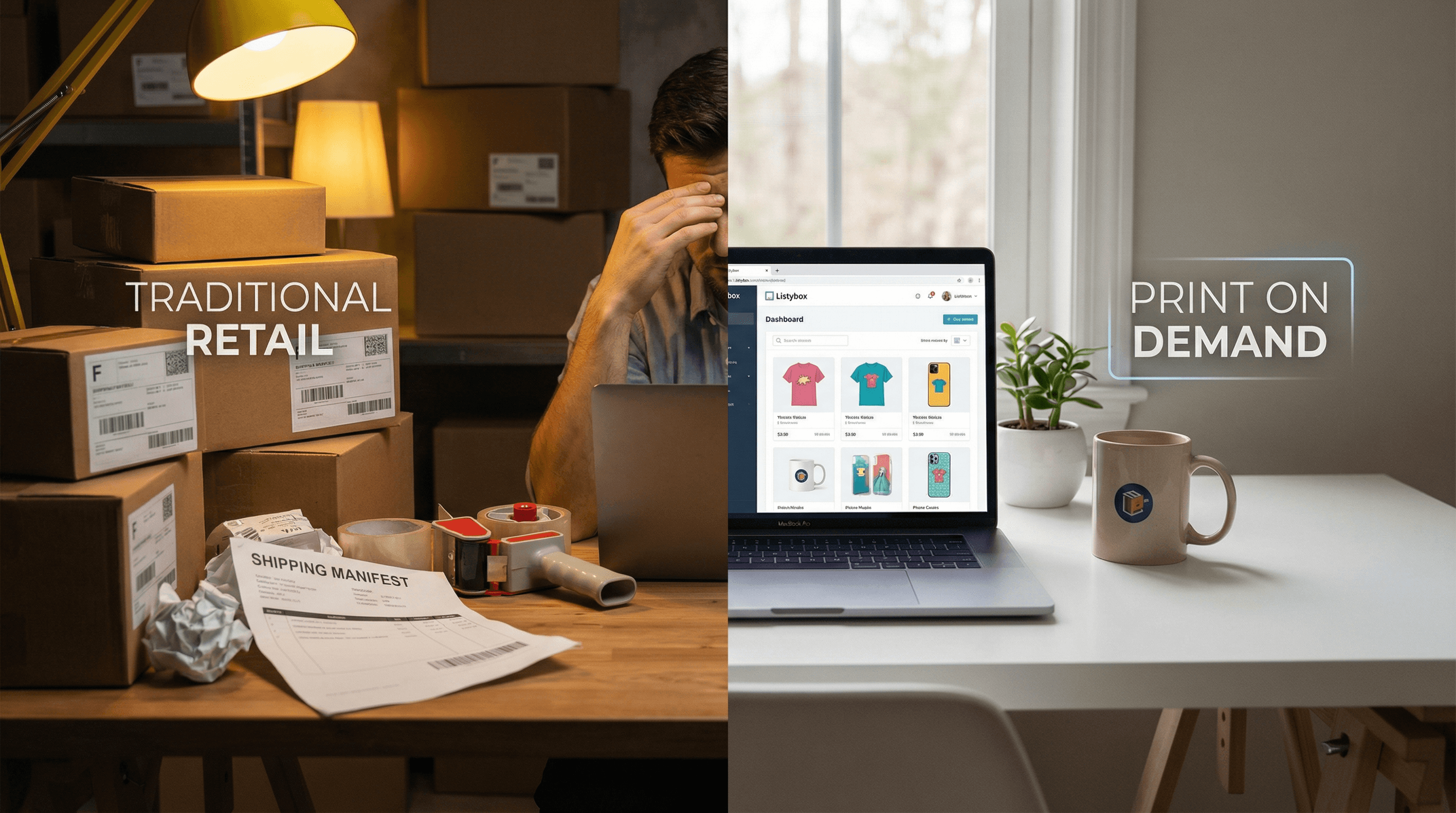
Everyone dreams of starting a business, but the reality usually hits hard: boxes of unsold inventory cluttering your garage, thousands of dollars locked up in stock, and the constant stress of shipping packages. What if you could run a global retail empire without ever touching a roll of packing tape?
This is where the question "what does POD mean" changes everything. POD, or Print on Demand, is not just a buzzword; it is the democratization of e-commerce. It allows anyone with a laptop to sell custom physical products with zero upfront investment. However, knowing the definition is only the first step. The real secret lies in how you execute it.
What Does POD Mean Exactly?
At its core, Print on Demand (POD) is a fulfillment model that allows you to sell customized products without holding any inventory.
In a traditional business, you buy 100 t-shirts, hope they sell, and ship them yourself. In a POD model, you create a digital mockup of a t-shirt. When - and only when - a customer buys it from your Etsy shop, the order data is sent to a manufacturer. They print your design on a blank t-shirt, package it, and ship it directly to your customer under your brand name.
You simply keep the difference between the retail price (what the customer paid you) and the base cost (what the manufacturer charges).
Why It Changes the Game
No Upfront Cost: You don't need capital to buy stock.
No Storage Fees: You don't need a warehouse.
Infinite Variety: You can sell t-shirts, mugs, canvas prints, and hoodies simultaneously without risk.
How Does the Process Work?
Understanding the workflow is crucial to seeing where successful sellers separate themselves from the amateurs.
1. The Design Phase Everything starts with a digital asset. You create a design file that can be printed on products. Most beginners get stuck here, fearing they aren't "artists." Smart sellers bypass this hurdle by using ready-made resources like the Artwork Gallery, which provides access to thousands of data-driven, unmatched designs.
2. The Listing Phase You upload your design to a "mockup" - a digital photo that looks like the real product. You then publish this to a marketplace like Etsy. This is where the manual trap exists. Uploading one design to five different products manually can take hours. This is why tools like the Creation Wizard are essential; allowing you to combine designs with hundreds of products in a single click.
3. The Sale & Fulfillment A customer visits your store and buys a shirt for $25. This is the pivotal moment.
The Manual Way: You see the order, log into a supplier site, manually type the customer's address, pay $12 for the shirt, and hope you didn't make a typo.
The Automated Way: You do nothing. System like Zero-Touch Order Management detect the order, route it to the printer, pay for it, and even update the tracking number on Etsy automatically when it ships.
The Reality of POD: Pros and Cons
To give you a balanced view, we need to look at both sides of the coin. Not all POD businesses succeed, and the difference is often in managing these expectations.
Profit Margins
Traditional Retail: Higher margins, but high risk of unsold stock.
Print on Demand: Lower margins per unit because the supplier handles the labor. However, you can offset this by using tools like our Lowest Price Guarantee, which negotiates bulk rates for everyone, ensuring you keep more profit in your pocket.
Brand Control
Dropshipping: Low. You are often selling generic items from overseas with long shipping times.
Print on Demand: High. Every product carries your unique design. To stand out further, you can use the ListyStyle mockup creator to generate professional lifestyle photos that make your brand look like a high-end boutique, not a generic shop.
Scenario: The "Passive Income" Trap vs. The Automated Reality
To truly understand "what does POD mean" for your daily life, let's look at a realistic scenario.
Meet Sarah, the Aspiring Entrepreneur Sarah is a graphic designer who wants to escape the 9-to-5 grind. She hears about POD and sets a goal: launch an Etsy store with 50 unique mug designs to pay for her family vacations.
The Manual Grind Her plan starts well, but the execution is brutal. She spends her entire weekend manually creating mockups in Photoshop. Then, she struggles with Etsy SEO, guessing which keywords like "funny coffee mug" might work. After 40 hours of work, she has only listed 5 products. She is exhausted, and her "passive income" feels like a second job.
The Hidden Trap Then, her first order comes in! She is thrilled. But in her excitement, she manually enters the customer's address into her print provider's dashboard. She mistypes a zip code. Two weeks later, the customer is angry because the package is lost. Sarah spends hours on the phone with customer support, losing money and sanity.
The Listybox Solution Just as she considers quitting, Sarah discovers Listybox. She connects her store and uses the Bulk Listing Engine. In 20 minutes, her remaining 45 designs are live. She uses the Magic Wand SEO tool to instantly write competitive titles and tags.
The Transformation Most importantly, when the next order comes in, she is asleep. Zero-Touch Order Management processes it automatically. Before Listybox, Sarah was an overworked data entry clerk. After Listybox, she became a business owner focused on creativity.
How to Start a Successful POD Business
The barrier to entry for POD is low, which means competition can be high. To win, you simply need to work smarter, not harder.
1. Choose Your Niche: Don't just sell "t-shirts." Sell "t-shirts for dog moms who love camping." Specificity sells. 2. Create or Source Designs: Use your own art or leverage a library of pre-made assets. 3. Automate Your SEO: You can have the best design in the world, but if no one finds it, it doesn't exist. Our internal data shows that shops utilizing automated SEO features rank for 3x more keywords in their first month than manual stores. Read our Etsy SEO guide to master this. 4. Launch Your Store: This is often the scariest part for beginners.
Need Help Getting Started? Does all of this feel overwhelming? You don't have to start from scratch alone. With Listybox Store Setup, our expert team sets up your Etsy store, lists your first 10 products, and optimizes everything for SEO. This service is included FREE with annual Starter and Professional plans!
Print on Demand is the future of retail for independent creators. Ideally, it removes the financial risk. Realistically, automation removes the time risk. By combining the POD model with intelligent automation, you aren't just opening a store; you are building a machine that works for you.
Ready to launch your empire? [Start Listybox now - no credit card required](https://app-test.listybox.com/auth/register?utm_source=blog&utm_medium=article&utm_campaign=en_content).
Never Miss an Update
Get actionable Etsy tips delivered to your inbox every week. No spam, unsubscribe anytime.