


Key takeaways
Zero Inventory Risk: Utilize Print-on-Demand to sell branded merchandise without ever buying stock or renting a warehouse.
Automate Operations: Use Zero-Touch Fulfillment to send the orders you pay for to production and write the tracking number back to Etsy, freeing you to focus on content creation.
Speed to Market: Leverage the Creation Wizard to turn a single logo or design into a catalog of 50+ products in under 5 minutes.
Global Reach: Break free from local sales limits by using a digital-first logistic network that ships worldwide.
Professional SEO: Ensure your fans can actually find your products with AI-driven keyword optimization.
Merchandising used to be the playground of massive rock bands and global corporations. It conjured images of warehouses stacked to the ceiling with t-shirts, expensive shipping contracts, and the nightmare of unsold inventory gathering dust. If you were an independent artist or influencer, “dropping merch” meant turning your living room into a packing facility.
Today, that model is obsolete. The digital revolution has democratized manufacturing, allowing anyone with an audience - whether you are a YouTuber, a Twitch streamer, or a niche community leader - to build a global retail empire from a laptop. This is not just about selling shirts; it is about monetizing influence through smart, automated systems.
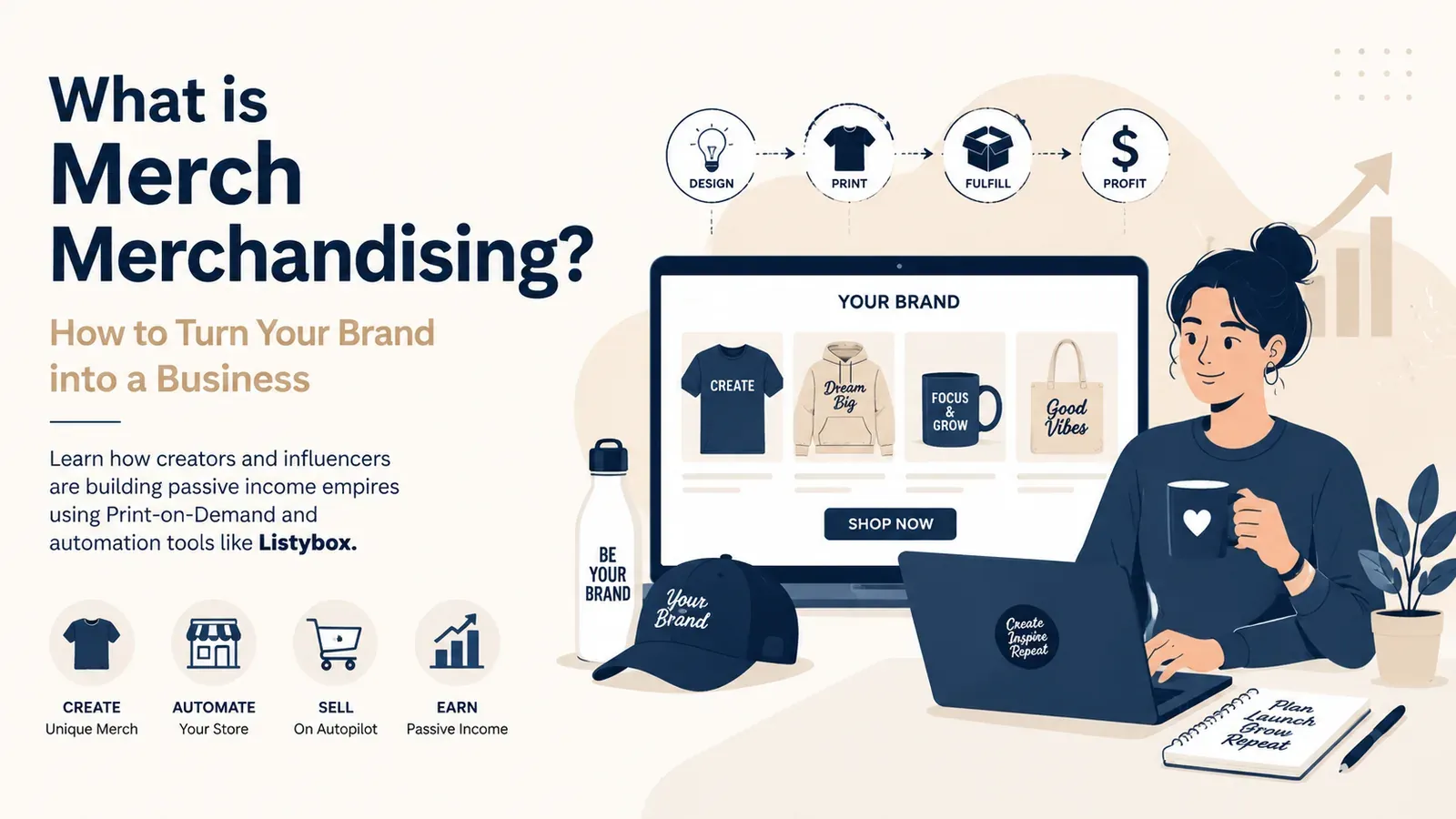
What is Merch Merchandising?
At its core, merch merchandising is the practice of leveraging a brand’s identity to sell physical goods. However, for the modern creator, it is much more than slapping a logo on a generic product. It is a way to deepen the relationship with your audience. When a fan buys your merch, they are buying a membership card to your tribe.
The Three Pillars of Modern Merch
Influencer Merch: Products driven by the personality of a content creator. Catchphrases, inside jokes, and community symbols drive sales. The value lies in the connection, not just the fabric.
Band Merch: The classic example. For musicians, merch often generates more revenue than streaming. It is visual proof of fandom.
Brand Merch: Even small businesses or podcasts use merch to increase brand authorized visibility. A tote bag with a clever slogan becomes a walking billboard.
The old barrier to entry was capital. You needed thousands of dollars to print a run of shirts. The new barrier is simply execution. The challenge has shifted from “How do I pay for this?” to “How do I manage this efficiently so it doesn’t kill my creativity?”
Try it in your shop.
Every step from design to live listing, on one platform. Start on the free plan.
Why Print-on-Demand is the Creator’s Secret Weapon
If you are a creator, your most valuable asset is your time. Every hour spent folding hoodies or printing shipping labels is an hour you are not creating content. This is where Print-on-Demand (POD) changes the game.
POD is a fulfillment model where products are only produced after a customer places an order. There is no inventory, no upfront cost, and no risk. You upload a design, list the product, and when it sells, a third-party provider prints and ships it.
The Financial Freedom of Zero Inventory
Imagine launching a collection of 50 different designs. In the traditional model, this would require an investment of over $10,000 in stock. With POD, the investment is $0. This capital efficiency allows you to take more creative risks.
However, simply knowing about POD isn’t enough. You need an operating system that connects your creativity to the manufacturing world seamlessly. This is where you might look to explore all features of a platform designed specifically for this workflow.
The Speed Barrier: Turning Ideas into Products Instantly
Let’s look at a common scenario that traps many ambitious creators.
Meet Alex. Alex is a digital artist with 50,000 Instagram followers. His goal is simple: launch a clothing line featuring his retro-futurist artwork. He knows his audience is hungry for it.
Alex starts enthusiastically. He opens a generic POD account and begins the manual process. He uploads one design, adjusts it on a t-shirt, writes a description, finds tags, and publishes. It takes him 20 minutes for one product. He has 30 designs and wants them on hoodies, mugs, and caps. He does the math: that is hundreds of hours of manual clicking. He manages to list 10 items before burnout sets in. He misses the holiday shopping rush because he simply couldn’t move fast enough.
This is the “Manual Trap.” It kills momentum.
Now, imagine Alex discovers the Creation Wizard. Instead of one by one, he uploads his entire portfolio of 30 designs into Listybox. He selects “T-Shirts,” “Hoodies,” and “Mugs” from the catalog. With a single click, the engine generates 900 unique, ready-to-sell listings. What would have taken him three weeks of data entry is finished in under 15 minutes.
Before Listybox, Alex was a tired data entry clerk. After Listybox, he is a creative director with a fully stocked store, ready to promote his launch to his waiting fans.
Automating the Boring Stuff: Fulfillment & Operations
Once your store is live and orders start rolling in, a new problem emerges: logistics. Success can actually be dangerous if you aren’t prepared. 100 orders in a day sounds great until you realize you have to manually process each one.
Manual fulfillment involves logging into your store, copying the customer’s name and address, pasting it into the supplier’s site, paying, and then - days later - copying the tracking number back to the customer. It is prone to human error. One wrong address copy-paste can lead to an angry fan and a ruined reputation.
For a merch business to scale, you need a “Chief Operating Officer” that handles the repetitive order steps. This is the role of Zero-Touch Order Management.
How Zero-Touch Saves Your Sanity
Order Detected: When a fan buys a shirt on Etsy, the order appears in My Orders in Listybox.
Payment: You pay the production and shipping cost for that order from My Orders. Production does not start before payment.
Auto-Tracking: After payment, our partner print providers in the US print the item and ship it straight to the buyer, and the tracking number is written back to your Etsy order.
You do not copy addresses or tracking numbers by hand, so you can spend your time creating your next viral video. This reliability is crucial for maintaining a high “Star Seller” rating on Etsy, which further boosts your visibility.
Visibility: Getting Found in a Crowded Market
Having great merch isn’t enough if no one can find it. Your fans will look for you, but you also want to attract new customers who are searching for your niche style. This requires Search Engine Optimization (SEO).
Most creators hate SEO. It feels technical and boring. They guess at keywords like “cool shirt” and wonder why they don’t get sales. Professional sellers know that specific, long-tail keywords are the key to revenue.
Instead of guessing, smart merchandisers use the Magic Wand SEO tool. This AI-driven feature analyzes what is currently selling and automatically writes high-ranking titles, descriptions, and tags for your products. You do not need to become an SEO expert to use it.
Overwhelmed? Let Us Build It For You
Does all of this still feel a bit overwhelming? Starting a new business venture often does. You might have the designs and the audience, but the technical setup of a store feels like a hurdle you can’t jump.
You don’t have to start from scratch. With Listybox Store Setup, our team helps you set up your Etsy store. It is available inside a custom Enterprise+ offer, so plan a demo or write to [email protected].
Conclusion
Merchandising is no longer just about making extra pocket money; it is a legitimate business model that can rival your primary income. The difference between a struggling artist and a merchandise mogul is often just the systems they use.
By leveraging Print-on-Demand and powerful automation tools, you can remove the operational friction that kills creativity. Don’t let logistics hold your brand back.
Start Listybox now - no credit card required and transform your designs into a passive income empire today.
Frequently asked questions
Put this into practice in your shop.
Every step from design to live listing, on one platform. Start on the free plan.
Related posts



Want to go deeper? Read our in-depth Etsy guides · Browse 100 Etsy niche guides