
What Is Stockless Ecommerce? From Manual Grind to Automated Empire
Stockless ecommerce promises freedom, but manual operations can quickly turn into a trap of scattered tools and low margins. This guide explores the critical difference between dropshipping and print-on-demand, revealing how an automated, all-in-one system helps you build a sustainable brand without ever touching inventory.
Bullet Points (TL;DR)
Choose Brand Over Commodity: Print-on-demand offers higher margins and customer loyalty compared to generic dropshipping.
Automate Fulfillment: Use Zero-Touch technology to process orders automatically, acting as your personal COO.
Centralize Your Tools: Replace scattered subscriptions for SEO, mockups, and research with a single operating system.
Leverage AI for Growth: Utilize machine learning to write SEO-optimized listings and generate professional product photos instantly.
Start Risk-Free: Launch your store with no inventory costs and professional setup support.
The dream is seductive: sell products you never touch, ship to customers you never meet, and count the profits from a beach in Bali. This is the promise of stockless ecommerce. But for many, the reality looks more like a nightmare of spreadsheet hell, angry emails about shipping delays, and thin profit margins that vanish with the slightest ad spend.
If you are researching "what is stockless ecommerce," you are likely looking for a way to break free from the traditional constraints of business—inventory costs, warehousing, and shipping logistics. You are on the right path, but the vehicle you choose matters. Today, we aren't just defining the term; we are comparing the two giants of the industry—Dropshipping vs. Print on Demand (POD)—and showing you how to build a business that actually serves you, rather than you serving it.
What Exactly Is Stockless Ecommerce?
At its core, stockless ecommerce removes the heaviest anchor of retail: inventory. In a traditional model, you buy 1,000 t-shirts, store them in your garage, and pray they sell. If they don't, you lose money.
In a stockless model, you sell first and buy later.
You list a product on a marketplace like Etsy or Shopify.
A customer buys it and pays you the retail price (e.g., $30).
You pay your supplier the wholesale price (e.g., $12).
The supplier ships it directly to the customer.
You keep the difference ($18 profit).
It sounds simple, and it is. However, the *type* of product you sell determines whether you are building a flea market stall or a fashion empire.
Dropshipping vs. Print on Demand: Which Builds a Real Brand?
Many beginners confuse these two models. While both are stockless, they are fundamentally different in terms of long-term viability and customer satisfaction.
Product Identity and Control
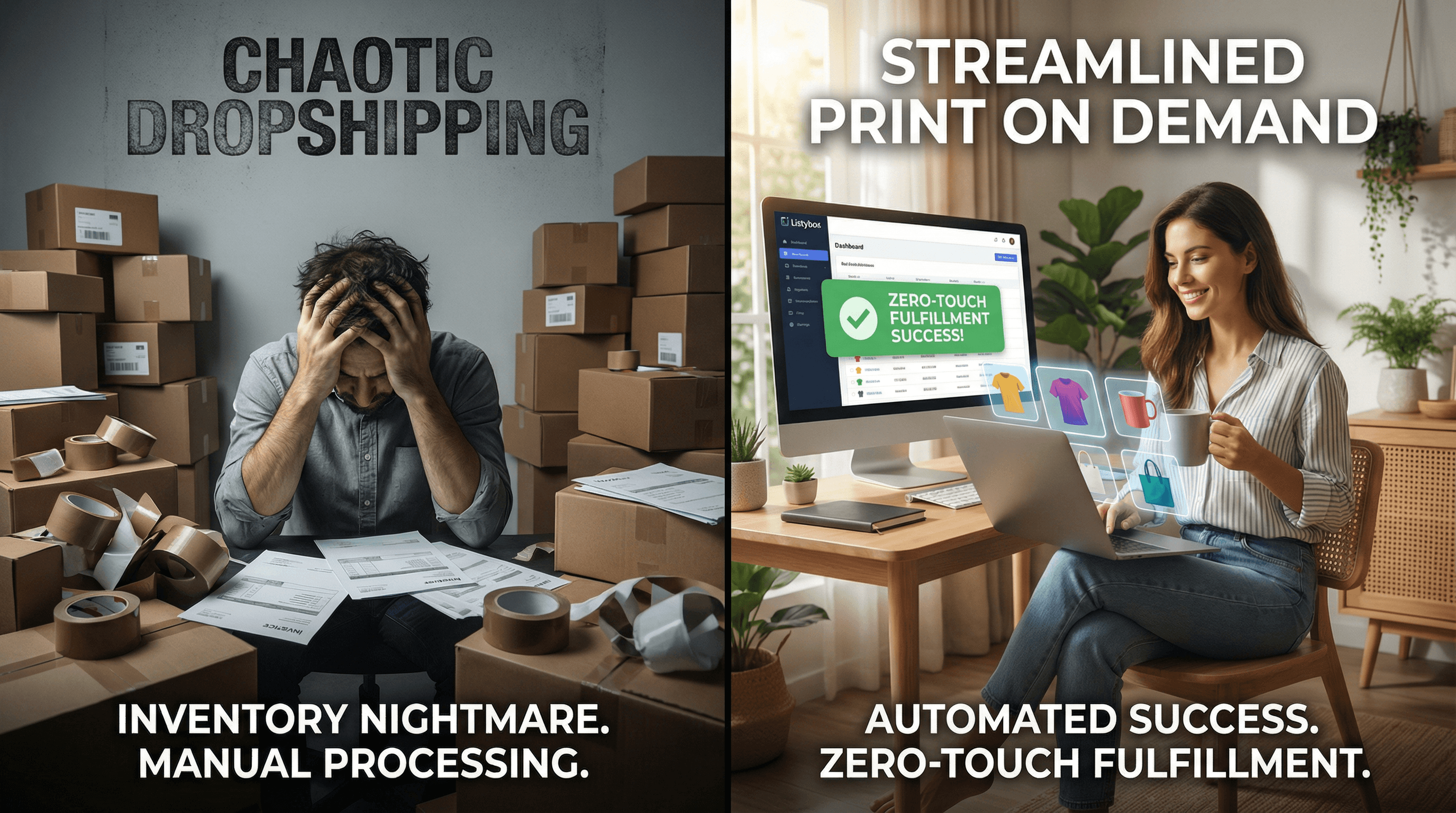
Dropshipping: You serve as a middleman for generic goods. You are likely selling the same $5 phone case that 5,000 other sellers are listing. You have zero control over the product.
Print on Demand: You are a creator. Every product carries your unique design. Whether it's a t-shirt, a mug, or a canvas, the item does not exist until your customer orders it. You build a brand asset that has real equity.
Quality and Logistics
Dropshipping: Often relies on overseas suppliers (like AliExpress). Shipping takes 2-4 weeks. Quality is a gamble. Returns are a logistical nightmare.
Print on Demand: Typically utilizes local production partners in the US or Europe. Shipping takes 2-5 days. With platforms like Listybox, you can even use our Lowest Price Guarantee to ensure you get premium production costs without the premium subscription fees.
The Verdict If you want a quick buck that fades fast, try dropshipping. If you want to build a sustainable business with repeat customers, Print on Demand is the superior choice. It allows you to leverage Listybox's Product Catalog to offer hundreds of high-quality items without spending a dime on stock.
Why Do Most Stockless Entrepreneurs Fail? (The Manual Trap)
The barrier to entry in stockless ecommerce is low, but the barrier to success is high if you try to do everything manually. Let's look at a realistic scenario of a seller who falls into this trap.
Meet Sarah, the Aspiring Entrepreneur Sarah wants to quit her data entry job. Her goal is simple: launch an Etsy store selling custom hoodies using a stockless model. She is creative and motivated.
The Manual Grind Sarah starts by signing up for five different tools: Canva for design, Printify for fulfillment, eRank for SEO, and Excel for accounting. She spends her weekends manually uploading designs to Printify, then manually copy-pasting titles into Etsy. It takes her 45 minutes to launch one single product. After a month, she has only 20 listings.
The Hidden Trap Then, her first few orders trickle in. But one customer wants to change the size, and another enters the wrong address. Sarah misses the email while she is at her day job. She logs into three different dashboards to fix it, makes a typo, and the wrong shirt ships. The customer leaves a 1-star review. Sarah is devastated. She realizes she hasn't built a business; she has built a second, more stressful job.
The Listybox Solution Just as she considers quitting, Sarah discovers Listybox. She realizes she can consolidate her entire "tech stack" into one operating system. She uses the Creation Wizard to turn her next 5 designs into 300 market-ready listings in just 20 minutes.
The Transformation Instead of data entry, Sarah now focuses entirely on design. When an order comes in, she doesn't even log in. Zero-Touch Order Management automatically detects the sale, routes it to the best provider, and updates the tracking on Etsy. Sarah's business now runs while she sleeps.
How Can You Automate a Stockless Business?
The scenario above illustrates the difference between working *in* your business and working *on* your business. True automation in stockless ecommerce requires three specific engines working in harmony.
1. Operations Automation You should not be copy-pasting addresses. Your system should act as your COO.
The Listybox Way: Our intelligent automation handles the entire lifecycle of an order. From the "cha-ching" notification to the delivery at the customer's door, human intervention is removed. This reduces error rates by 99% compared to manual processing.
2. Creation Automation Speed is money. If you have a winning design concept, you need to deploy it across t-shirts, hoodies, mugs, and totes instantly.
The Listybox Way: Use the Creation Wizard. Connect one design asset to dozens of products. Our data shows that sellers utilizing bulk creation tools launch 10x more products in their first month than those using manual uploaders.
3. Marketing & SEO Automation You can have the best product, but if no one sees it, you have zero sales. Most beginners flounder here, guessing at keywords.
The Listybox Way: Stop guessing. Magic Wand SEO tool analyzes real-time market data to write high-converting titles, tags, and descriptions for you. Combine this with our ListyStyle mockup creator, which generates professional lifestyle photos instantly, and you look like a Fortune 500 brand from day one.
Is Stockless Ecommerce Truly Passive Income?
This is the big question. Passive income is not "no work"—it is work done *once* that pays you repeatedly.
Stockless ecommerce becomes passive only when you decouple your time from the fulfillment process. If you have to manually approve every order, your income is active. If you have to manually redesign every mockup, your income is active.
By leveraging a platform like Listybox, you shift the workload to algorithms and automation. You utilize Scheduled Publish to keep your store active even when you are on vacation. You use Trend Compass to find the next winner before the competition wakes up.
Ready to Launch the Right Way?
Does all of this feel overwhelming? You don't have to start from scratch. With Listybox Store Setup, our expert team sets up your Etsy store, lists your first 10 products, and optimizes everything for SEO. This service is included FREE with annual Starter and Professional plans!
Stockless ecommerce is the future of retail for independent creators. The only choice left is whether you want to do it the hard, manual way, or the smart, automated way.
Never Miss an Update
Get actionable Etsy tips delivered to your inbox every week. No spam, unsubscribe anytime.