
What to Sell in Ecommerce: Why Print on Demand Wins in 2026
Choosing the right business model is the single most critical decision for new entrepreneurs, yet many fall into the trap of high-risk inventory or low-quality dropshipping. This guide breaks down why Print on Demand offers the perfect balance of low risk and high reward. Discover how automated systems allow you to build a scalable, zero-inventory business without technical headaches.
Bullet Points (TL;DR)
Eliminate Financial Risk: Traditional retail requires buying stock upfront; Print on Demand allows you to sell first and pay later.
Own Your Brand: Unlike generic dropshipping, POD lets you sell unique, custom-branded items that build customer loyalty.
Automate Operations: Use Zero-Touch Fulfillment to handle shipping and tracking automatically, acting as your personal COO.
Scale Instantly: Tools like the Creation Wizard can turn one design into hundreds of products in minutes, not weeks.
Start for Free: You don't need a credit card to begin building your empire with Listybox's automated tools.
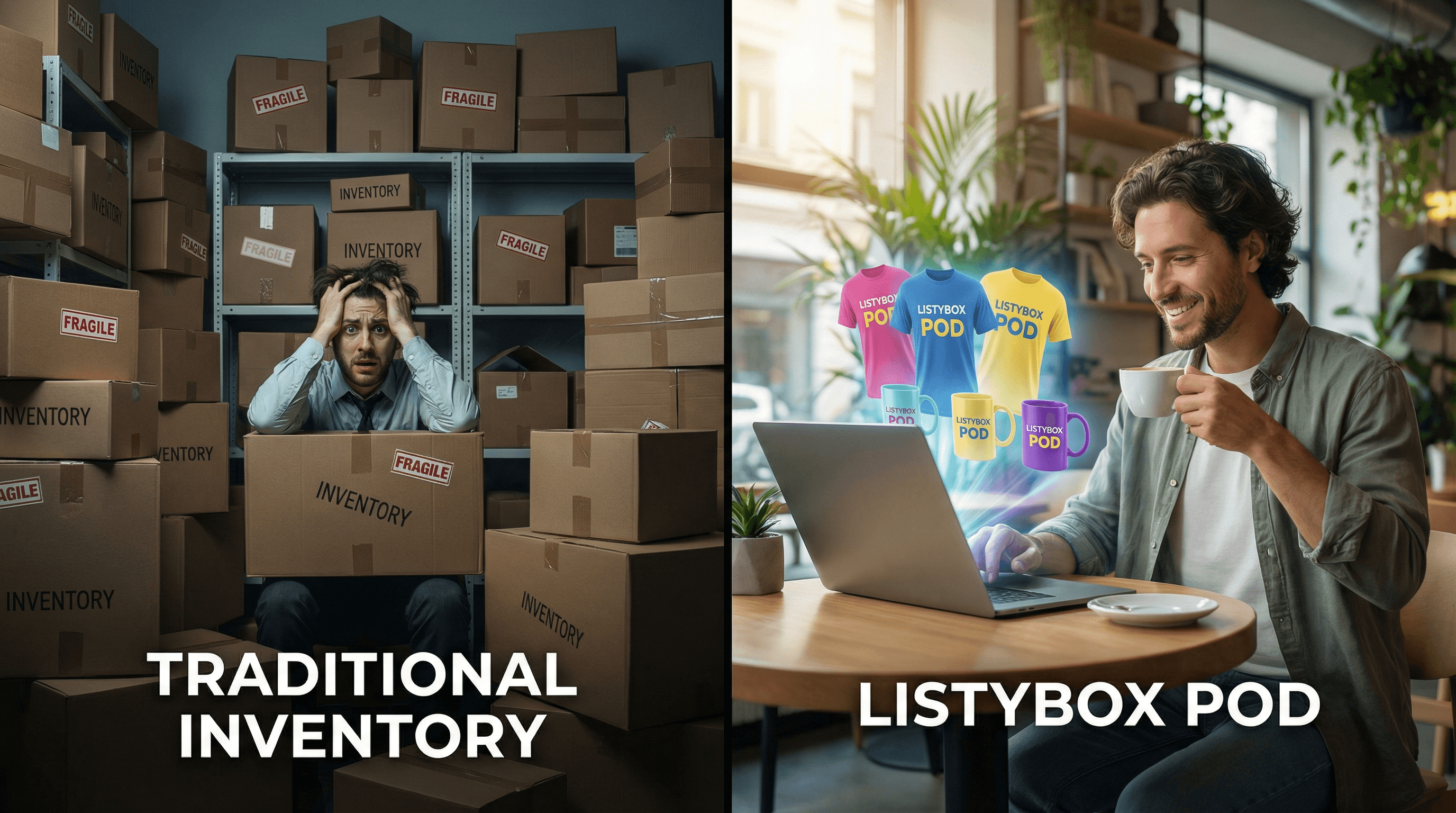
The question "what to sell in ecommerce" often paralyzes aspiring entrepreneurs. You have likely heard stories of people making fortunes overnight, but for every success story, there are countless others who lost their savings on a garage full of unsold inventory. The digital landscape has evolved, and the "buy low, sell high" model of the past is no longer the only—or the smartest—path to financial freedom.
Today, the battle isn't just about what you sell, but *how* you sell it. Choosing the wrong business model can trap you in a cycle of logistical nightmares and thin margins. Conversely, the right model allows you to focus purely on creativity and growth while technology handles the heavy lifting. Let's analyze the three major contenders: Inventory-Based Retail, Dropshipping, and Print on Demand (POD), to discover which one truly offers the path of least resistance and highest reward.
Inventory-Based Retail: Is Traditional Ecommerce Dead?
For decades, if you wanted to sell online, you had to become a warehouse manager. You would research a product, invest thousands of dollars to buy 500 units from a supplier, and hope people wanted to buy them.
This model carries massive risk. If your market research is slightly off, you are left with "dead stock"—cash tied up in physical goods that gather dust. You are also responsible for the physical labor: printing labels, packing boxes, and driving to the post office. The stress of managing stock levels and the fear of unsold inventory can quickly dampen the excitement of starting a business. Our internal data suggests that new sellers who start with inventory-based models spend 60% of their operational time on logistics rather than marketing or growth.
While not "dead," this model is incredibly heavy. It requires capital, space, and a high tolerance for risk. For a solo entrepreneur looking for agility, there are far superior options.
Dropshipping: The Low-Cost Trap?
In response to the heaviness of inventory, dropshipping exploded in popularity. The promise was seductive: list products from a supplier (usually in China) on your store, and when a customer buys, the supplier ships it directly to them. No inventory, no packing.
However, the reality of traditional dropshipping is often a nightmare of quality control. You are usually selling generic, low-quality items that hundreds of other stores are also selling. Worse, shipping times can take 2-4 weeks. In a world where customers expect Amazon Prime speeds, a 3-week wait is a deal-breaker.
The pain here is reputational. You have no control over the product quality or the unboxing experience. When a customer receives a broken plastic gadget three weeks late, they blame *you*, not the supplier. Dealing with endless refund requests and negative reviews is a fast way to burn out.
Print on Demand: The Sweet Spot for Modern Entrepreneurs?
Enter Print on Demand (POD). This model combines the best aspects of dropshipping (no inventory) with the quality and branding of a legitimate creative business. You create a design, place it on a high-quality product like a t-shirt, mug, or canvas, and list it for sale. The product does not physically exist until a customer buys it.
Once an order is placed, a production partner prints your unique design on the product and ships it directly to the customer—usually from facilities in the US or Europe, ensuring fast delivery. You never touch the product, but you own the brand.
Risk Profile
Inventory: High Risk. You pay upfront.
Dropshipping: Medium Risk. You pay later, but risk refunds and bans due to poor quality.
Print on Demand: Zero Risk. You pay only after the customer pays you. The product is custom-made.
Brand Control
Inventory: High. You control the packaging.
Dropshipping: Low. You are selling someone else's generic solution.
Print on Demand: High. Every product carries your unique intellectual property. You build an asset, not just a storefront.
Scalability
Inventory: Difficult. Scaling means buying more stock and hiring staff to pack boxes.
Dropshipping: Volatile. Winning products are quickly copied.
Print on Demand: Infinite. You can list 10,000 unique products without owning a single one. This scalability is turbocharged when you use automation tools like Listybox's Creation Wizard, which turns a few designs into a massive catalog in minutes.
How Do I Start Selling Without Buying Inventory?
Understanding the model is one thing; executing it is another. Let's look at a realistic scenario to see how automation changes the game.
The Scenario: Meet Sarah
1. The Persona: Meet Sarah, a graphic designer tired of trading her time for money in client work. She wants to build a passive income stream.
2. The Goal: Her plan is simple: launch an Etsy store selling tote bags and hoodies featuring her unique typography art.
3. The Manual Grind: Sarah starts the traditional way. she signs up for a basic POD provider. She uploads her first design, selects a hoodie, positions the artwork, writes a description, and publishes it. It takes her 25 minutes. She does the math: to list her 50 designs on 10 different products, it will take her over 200 hours of manual clicking. She is discouraged before she even begins.
4. The Hidden Trap: She pushes through and gets her first sale! But then she realizes she has to manually log into her provider's website, type in the customer’s name and address, and pay. She makes a typo in the street address. The package gets lost. The customer is angry. Sarah is stressed.
5. The Listybox Solution: Just as she considers quitting, Sarah discovers Listybox. She connects her Etsy store and uploads her 50 designs to My Artworks. Using the Bulk Listing Engine, she applies all 50 designs to hoodies, tote bags, and mugs simultaneously. Listybox generates SEO-optimized titles and tags for her. What would have taken 200 hours is done in an afternoon.
6. The Transformation: When the orders start rolling in, Sarah doesn't lift a finger. Zero-Touch Order Management automatically detects the Etsy order, routes it to the best manufacturer, and even updates the tracking number on Etsy when it ships. Sarah went from an overwhelmed data entry clerk to a true business owner focused on creating new art.
What Is the Safest Way to Scale an Ecommerce Business?
Scaling a business usually means "more problems." In the inventory world, it means a bigger warehouse. In the manual POD world, it means hiring virtual assistants to manage listings. But with the right infrastructure, scaling can be painless.
The key to scaling in 2026 is automation. You cannot compete if you are manually writing every product description or researching every keyword. Tools like the Magic Wand SEO tool analyze real-time market data to write titles and tags that actually rank on Etsy search. Instead of guessing what to sell, you are guided by data.
Furthermore, scaling requires protecting your profit. Many platforms charge a premium for "better prices." At Listybox, we believe your margin is yours. Our Lowest Price Guarantee ensures you get the production rates usually reserved for enterprise clients, automatically. This means as you scale, your profit margins remain healthy, giving you more cash to reinvest in your business.
Need Help Launching Your Store?
Does all of this feel overwhelming? You don't have to start from scratch. With Listybox Store Setup, our expert team sets up your Etsy store, lists your first 10 products from our premium catalog, and optimizes everything for SEO. This service is included FREE with annual Starter and Professional plans! It's the perfect way to bypass the technical setup and potential mistakes, ensuring you start your journey on the right foot.
The era of risking your life savings on inventory is over. The era of manual data entry is ending. The future belongs to those who leverage automation to build lean, scalable brands. Don't let technical hurdles stand between you and your financial independence.
Start your free trial - no credit card required and experience the power of selling smarter, not harder.
Never Miss an Update
Get actionable Etsy tips delivered to your inbox every week. No spam, unsubscribe anytime.