You work in four different places.
Trends live in one tool, design in another, listings in a third, production somewhere else again. You stitch the seams yourself, every single time.
The same work, on one line.
One panel from trend to order. The stitching between the steps is our job now.
You hand the work off four times.
You find the trend in eRank, Marmalead, EverBee or Alura, then carry it into Canva or Photoshop by hand.
The cost: context breaks and every idea starts from zero
You upload the design to Placeit or Kittl and position it again for each product. Tee separately, mug separately, canvas separately.
The cost: repositioning on every product
You write the title, 13 tags and the description from scratch, then switch to Vela or OneClickLister for bulk edits. Which tags actually worked, you learn after publishing.
The cost: tag blindness, and quality that changes listing by listing
When an order lands you go back into Printify, Printful or Gelato. You match the product, upload the file, follow the shipment.
The cost: a manual step on every order
All four handoffs are gone here.
Below is the line itself: the same four steps, without the carrying work you do between them.
Four tools, four accounts, four invoices. The carrying work between them is measured nowhere, because it belongs to no tool.
Four steps, one panel.
Trend Compass scans world news every hour and builds trending designs on its own. What comes out is already inside the line, so there is nothing to fetch and carry.
Pick from the artwork gallery, upload your own file, or edit it in Canva. It sits on every product in the catalog with the same care, so you do not reposition it per product.
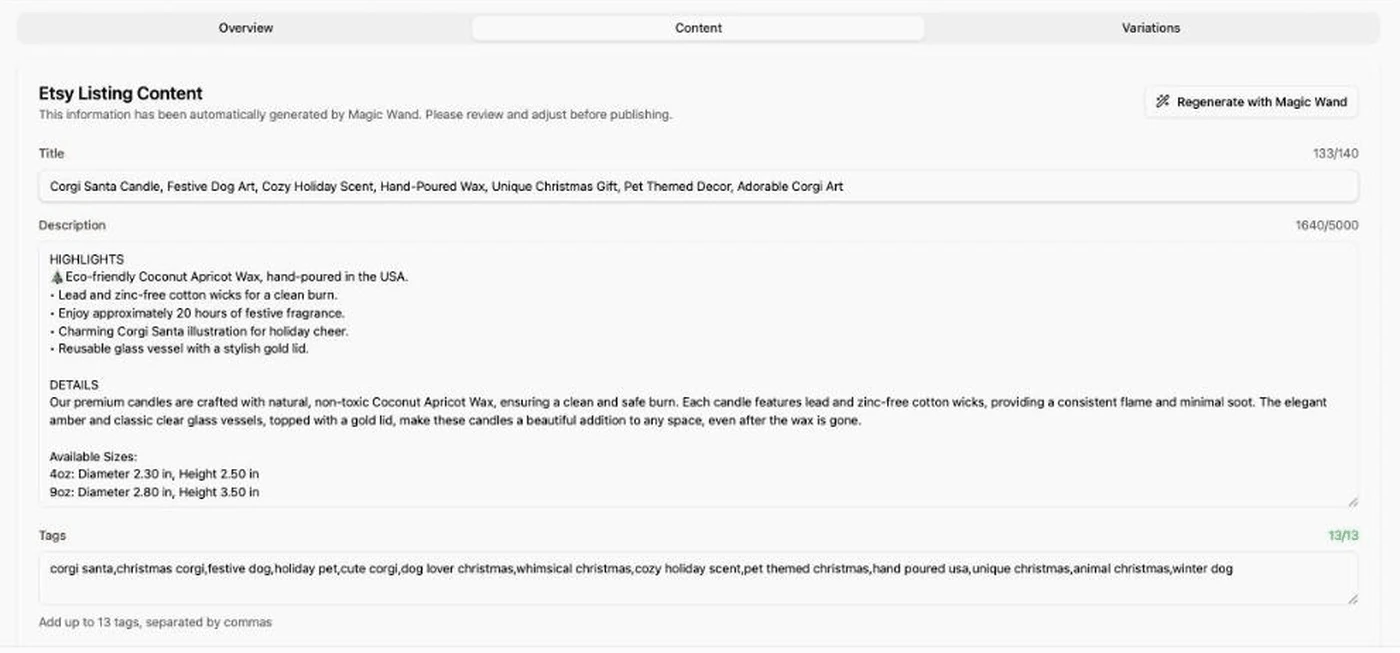
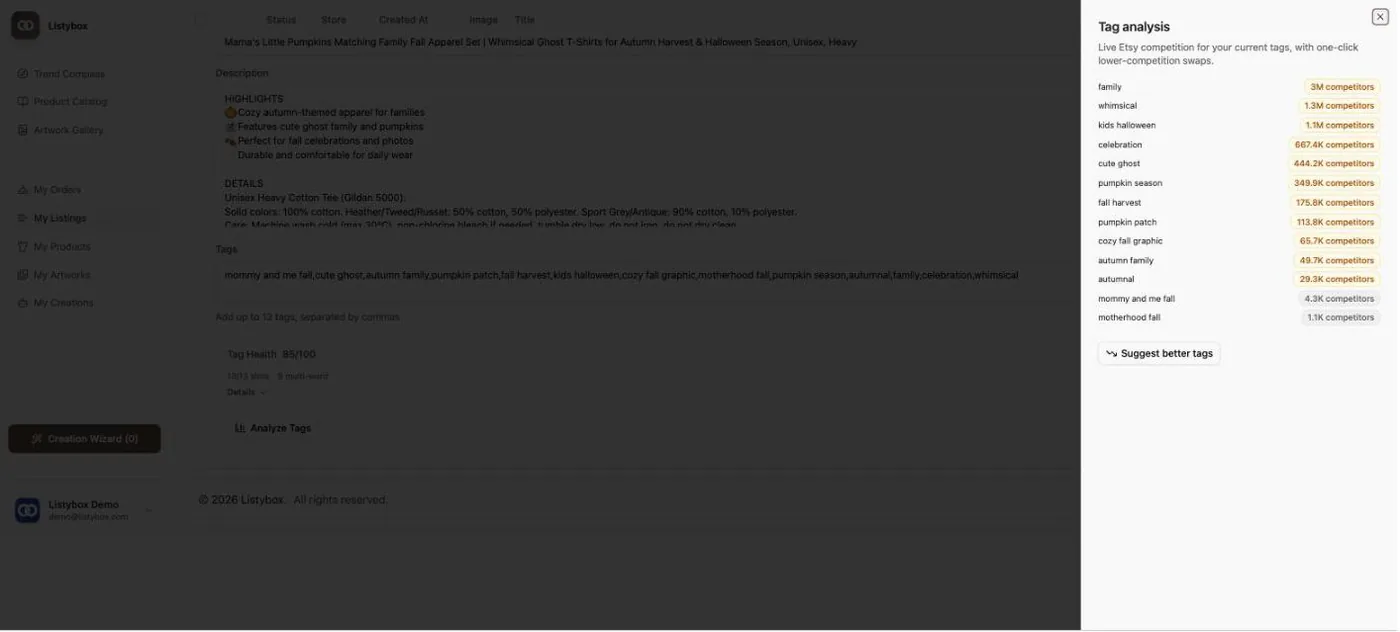
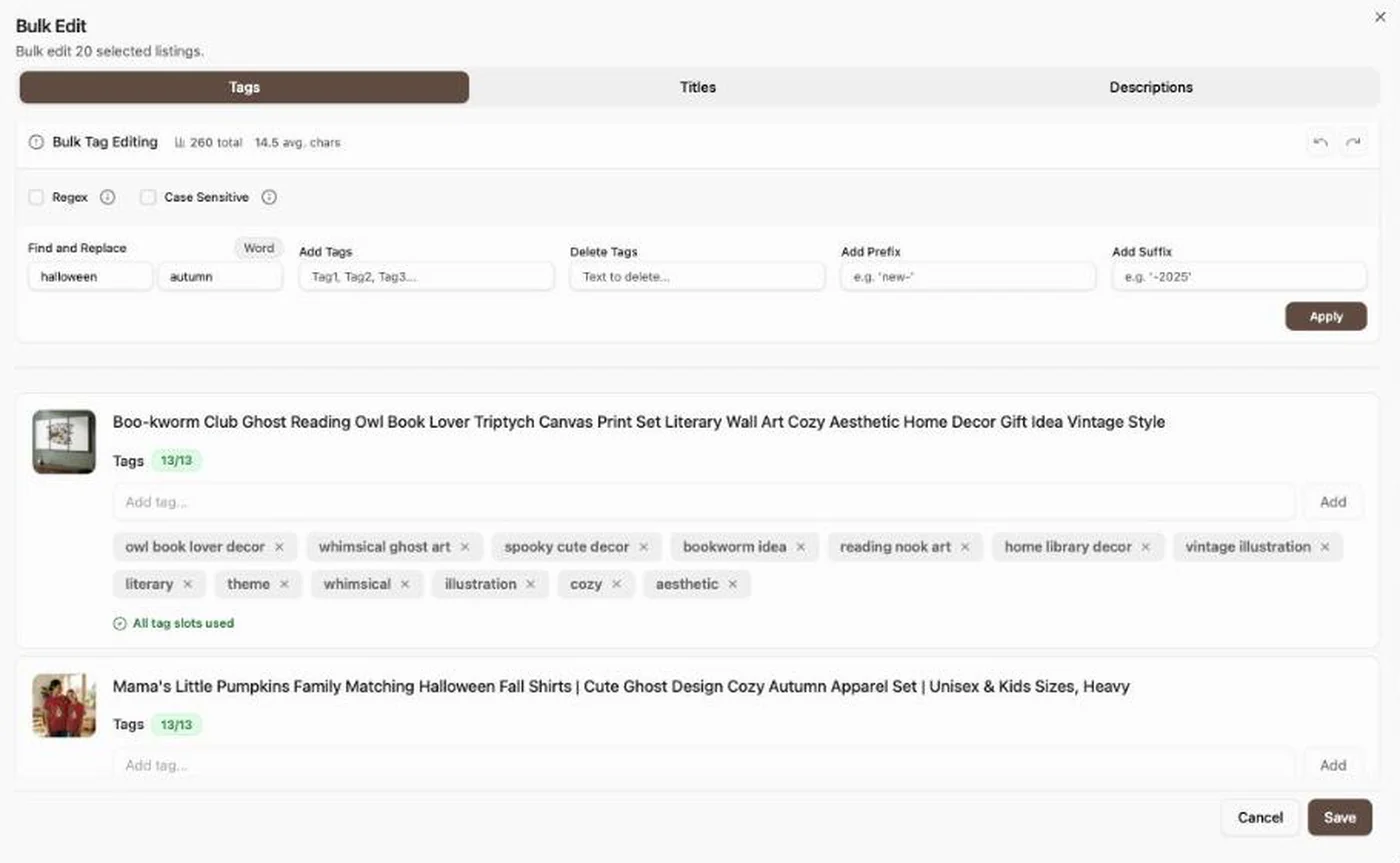
Magic Wand writes the title, 13 tags and the description from the product itself. Tag Health measures your tags against live Etsy competition, before you publish.
The listing goes to your connected Etsy shop. Orders flow back and stay in the same panel.
Four subscriptions, four logins, four invoices. The carrying work in between is measured nowhere.
One panel, one invoice. From trend to shipping, the work in between is off your plate.
What happened after the line was set up.
Monthly orders through shops connected to Listybox, counted from the moment they connected. In December 2025 it was 122 a month. In June 2026 it reached 1,398.
December 2025 - August 2026 · faded column: August is only 28 days in · measured 28 Aug 2026
Start freeThese are not marketing illustrations. They are the app's own screens.
measured 28 Aug 2026 · shops with live authorization, syncing
"One of the products I listed got 12 orders in a single week, which was a great feeling."
Caner B. · Listybox seller
Everyone who gets this far asks the same three things. All three are fair.
"I have my own product. Your catalog is no use to me."
You can upload your own product from the panel. The 130-product catalog is a starting point, not a requirement.
"I design everything myself."
Keep doing it. Connect your Canva account, the design opens there and comes back here. Placement on the product and background removal happen on this side.
"I don't have time to sit down with this now."
Set it up today and schedule the publish date. When the season arrives the listings go live on their own.
The fourth one cost the most: an order arrives and the work starts over.
When an order lands, production and shipping are ours.
Our partner print providers in the US print the products and ship them straight to your buyer. You do not need to hold stock or ship anything yourself. This is where the line closes.
Four handoffs gone. The line is what remains.
Connect your Etsy shop and build your first listing inside the line. There is a free plan.
Start freeListybox · One panel from design to shipping, for Etsy sellers