
The Complete Etsy Ads Guide for POD Sellers in 2026: Stop Wasting Your Budget
Spending money on Etsy Ads but getting zero sales? Paying for traffic will not fix a listing that fails to convert organically. Learn the exact 30-day testing strategy to find your winning products and scale your Print on Demand profits without burning your budget.
Bullet Points (TL;DR)
Start with the $1 official minimum daily budget and scale only when ROAS exceeds 3x.
Optimize your POD listings for conversions before scaling ad spend to avoid wasted clicks.
Most POD sellers achieve 2x-4x ROAS in 2026; track and adjust weekly.
Etsy Ads work on a CPC basis, so choose high-margin bestsellers to advertise first.
Patience and data are key: give campaigns 2-4 weeks to become profitable.
You log into your seller dashboard, excited to check your daily stats. You see 150 new clicks on your promoted items. Your heart skips a beat. But when you look at your revenue, it says zero. You just spent $25 on clicks, and you have absolutely nothing to show for it.
This is the painful reality for thousands of print-on-demand store owners. You watch your hard-earned profit drain away, funding clicks from window shoppers who never actually buy. It feels like you are simply handing your money back to the platform, hoping for a miracle that never comes.
Many sellers believe that turning on a paid campaign is a magic button for sales. They think that if they just get their t-shirt or mug onto the first page, buyers will naturally open their wallets. But in 2026, the marketplace is smarter, and the competition is fierce. Paying for placement is only half the battle. If your product does not convince the buyer to click "Add to Cart," you are just paying for expensive window displays.
This guide will show you exactly how to set up, test, and run your campaigns profitably. You will learn the strict 30-day testing method, how to calculate your true return on ad spend, and the exact moment you need to turn off a losing product. It is time to stop guessing and start treating your ad budget like a strict investment.
The Golden Rule: Ads Will Not Fix a Bad Listing
Before you even think about setting a daily budget, you must understand the most brutal truth of e-commerce marketing. Advertising is a magnifying glass. If you have a highly desirable product that people love, ads will magnify your sales. If you have a mediocre product that people ignore, ads will simply magnify your failure, and charge you for the privilege.
Traffic does not equal conversion. A click means a shopper was slightly interested in your main image. A sale means they trusted your brand, liked your price, and wanted your specific design. If your item gets 100 organic views but zero sales, paying to get 1,000 views will likely just result in zero sales and a depleted bank account.
Never run ads on a brand new shop that has zero organic sales history. You need proof that real humans actually want to buy your designs before you pay to promote them.
For a deep dive into turning those views into actual buyers, you should read our Etsy Conversion Rate Optimization Guide: Turn Views Into Sales.

The Pre-Launch Quality Check
If you want your budget to actually generate revenue, your listings must be perfect before you turn the campaign on. Buyers scroll past hundreds of options in seconds. Your main image is the only thing standing between a scroll and a click.
Are you using the same generic, flat-lay t-shirt mockup as 5,000 other sellers? If so, your click-through rate will be terrible, and your cost-per-click will rise. You need lifestyle imagery that makes your design look like a premium, established brand.
Instead of paying for expensive photo shoots or monthly subscriptions to generic mockup sites, you can use the ListyStyle mockup creator. It places your designs onto highly realistic, unique lifestyle models with a single click. Our internal data shows that sellers who upgrade from flat mockups to lifestyle images see their ad click-through rates jump by up to 40%.
Once they click, your SEO and product description must close the deal. The title needs to clearly state what the item is, and the tags must match the buyer's exact search intent. If you struggle with finding the right words, the Magic Wand SEO tool automatically writes high-converting, search-friendly titles and descriptions based on current market data.
The 30-Day Testing Phase: How to Launch Correctly
When you are ready to start, you must approach it scientifically. The biggest mistake new sellers make is turning on a campaign, watching it spend $15 over three days, panicking, and turning it off.
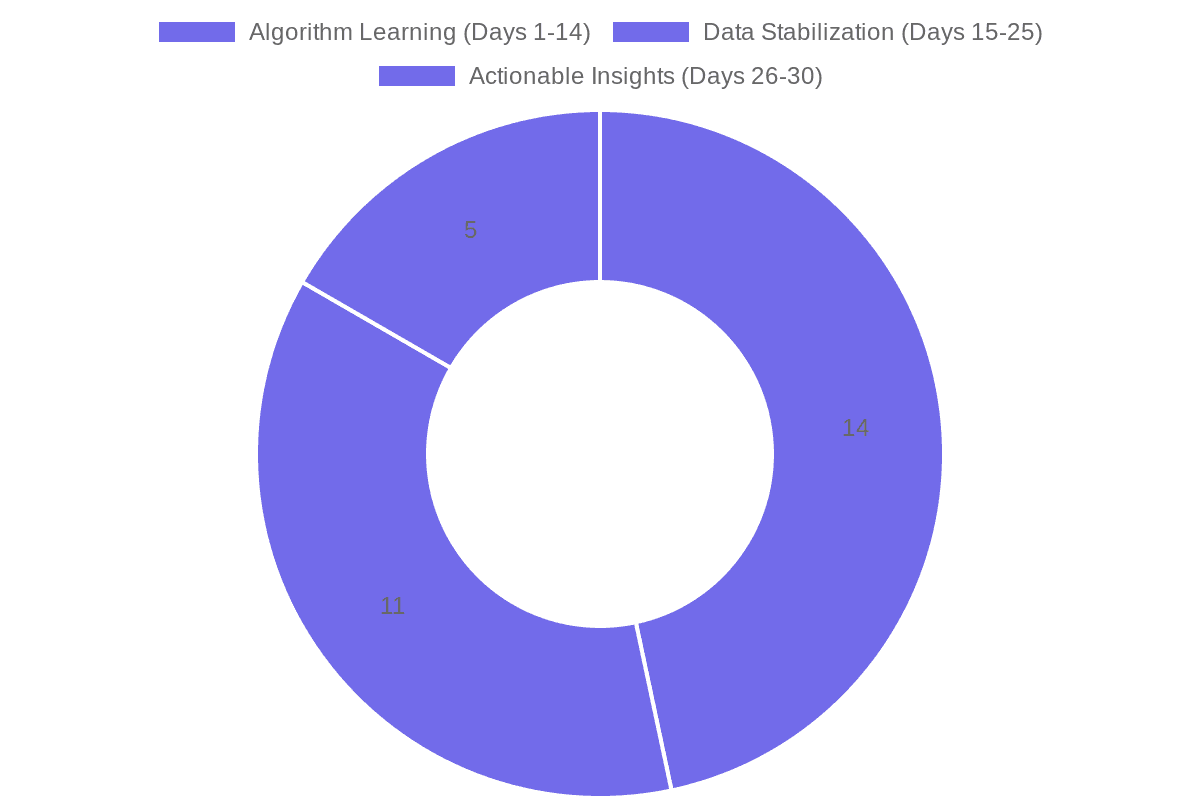
The platform's machine learning algorithm is not psychic. When you first launch a campaign, the system does not know who your ideal buyer is. It has to show your product to different types of shoppers, at different times of day, using different search terms, to see who actually clicks and buys.
This learning process takes time. Specifically, it takes about 30 days.

Setting Your Initial Budget
Do not start with a massive daily budget. The goal of the first 30 days is not to make a huge profit; the goal is to buy data. You are paying the platform to tell you which of your designs are actually winners.
Set a conservative daily budget that you are comfortable spending without seeing an immediate return. For most print-on-demand sellers, a budget of $3 to $5 per day is perfect for the testing phase. Over 30 days, this means you are committing $90 to $150 to gather vital market intelligence.
Turn On Every Active Listing
You might think you know which of your designs is the best. You might assume your funny cat mug will outsell your minimal typography shirt. You are usually wrong. The market decides what is good, not the designer.
During this initial 30-day phase, you must advertise every single active listing in your store. Yes, all of them.
Why? Because the algorithm will quickly figure out which items get clicks and which ones are ignored. It will naturally start spending more of your daily budget on the items that generate interest. If you only select five items to promote, you might accidentally leave your true best-seller hidden in the dark.
To understand more about how the system decides what to show buyers, review our detailed breakdown on How the Etsy Algorithm Works in 2026: The Complete Guide.
The Rule of Inaction
Once you set your $5 daily budget and turn on all your listings, you must do the hardest thing in e-commerce: nothing.
Do not check your stats every four hours. Do not turn off a listing just because it spent $2 and has not sold yet. Do not adjust your daily budget based on a slow Tuesday. You must let the campaign run untouched for a full 30 days.
If you change the budget or toggle listings on and off during this learning phase, you reset the algorithm. It has to start its learning process all over again, which means the money you already spent was wasted.
Calculating Your True ROAS for Print on Demand
While you wait for your 30-day test to complete, you need to understand your numbers. Print-on-demand is a fantastic business model because you hold no inventory, but the trade-off is tighter profit margins compared to sellers who make their own goods.
ROAS stands for Return on Ad Spend. It is the amount of revenue you generate for every dollar you spend on advertising. If you spend $10 and make $50 in sales, your ROAS is 5.0.
However, ROAS can be deceptive. A high ROAS does not always mean you are actually putting money in your pocket. You must calculate your true break-even point.

The Break-Even Formula
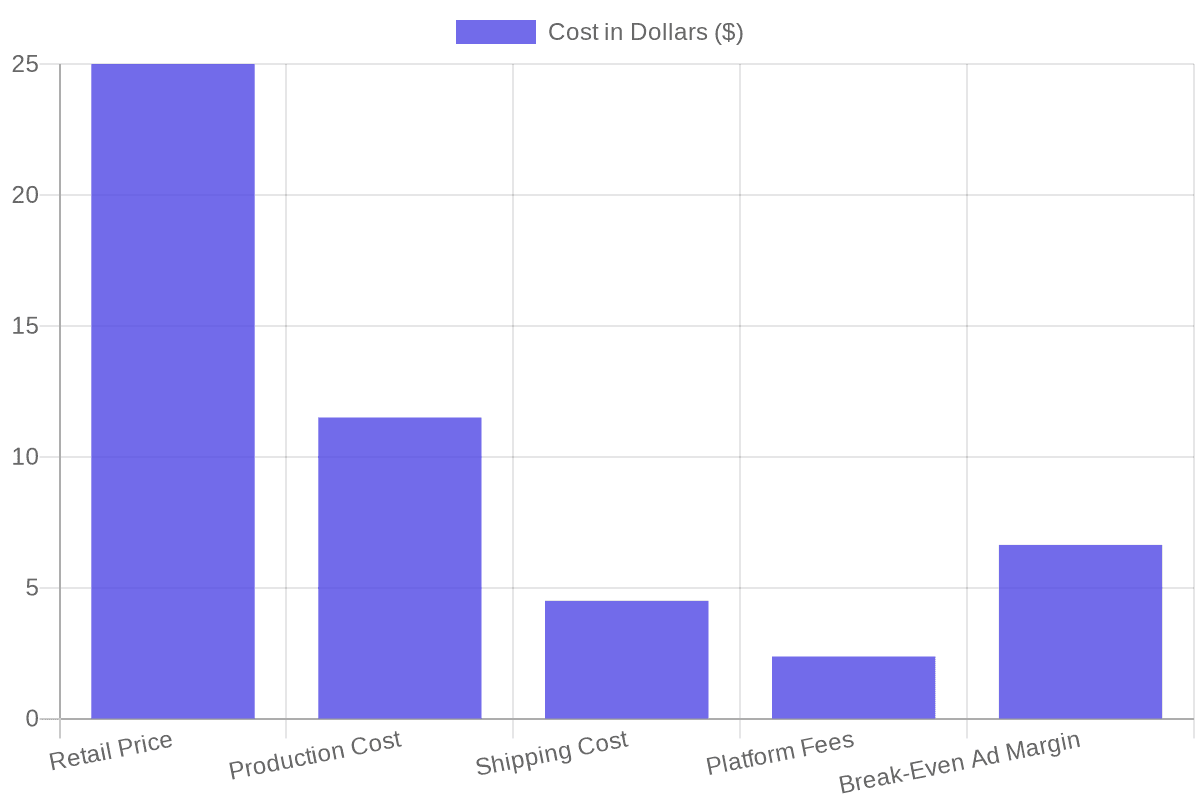
Let us break down a real-world example of a standard print-on-demand t-shirt sale in 2026:
Retail Price charged to customer: $25.00
Production Cost (shirt + printing): $11.50
Shipping Cost charged by printer: $4.50
Platform Transaction Fees (approx 9.5%): $2.37
Total Costs before Ads: $18.37
In this scenario, your raw profit margin before advertising is $6.63.
This $6.63 is your break-even point for ads. If you spend $6.63 on clicks to get one sale, you make exactly zero dollars in profit. If you spend $4.00 to get a sale, you make $2.63 in pure profit. If you spend $8.00 to get a sale, you actually lose $1.37 on that transaction.
Industry data suggests that a healthy ROAS goal for print-on-demand sellers should be between 3.5 and 4.5 to ensure actual take-home profit after all production costs.
If you want to dive deeper into pricing your items correctly to absorb these costs, check out our Etsy Pricing Strategy for POD Profit in 2026: The Formula That Actually Works.
Protecting Your Margins
Because your break-even point is so tight, lowering your base production cost is the most effective way to make your ads more profitable. If you can reduce the cost of that t-shirt from $11.50 to $9.50, you instantly give yourself $2.00 more breathing room in your ad budget.
This is why smart sellers rely on the Lowest Price Guarantee. By accessing the collective buying power of a massive community, you secure the absolute best production rates without paying for expensive monthly premium subscriptions. Lower base costs mean your ad campaigns reach profitability much faster.
According to the official Etsy Seller Handbook, understanding your exact profit margin per item is the single most important step before scaling any paid traffic source.
The Pruning Process: Analyzing Day 31
The 30 days have passed. Your algorithm has gathered enough data. Now it is time to put on your analyst hat and prune your garden. You are going to look at your dashboard and categorize every single listing into one of three buckets.
Bucket 1: The Money Burners (High Spend, No Sales)
These are the dangerous listings. The algorithm showed them to people, people clicked on them, but nobody bought them. You might see an item that has 40 clicks, has spent $12 of your budget, and has zero revenue.
Action: Turn these off immediately.
This data tells you that your main image is good enough to get attention, but something else is completely broken. Your price might be too high, your shipping times might be too long, or your description might be confusing. Do not keep paying for clicks while you figure it out. Stop the bleeding.
Bucket 2: The Invisible Items (Low Views, Low Clicks)
These items barely spent any of your budget. They might have 5 views and zero clicks over the whole month.
Action: Leave them on, but fix their SEO.
The algorithm could not find anyone who wanted to look at these items. This usually means your tags and titles are too competitive or completely irrelevant. You are not losing much money on them, so keep the ads running, but you must update their keywords.
If you want to learn how to update your keywords quickly, read our AI SEO automation guide to see how to align your tags with actual buyer search habits.
Bucket 3: The Winners (Profitable ROAS)
These are the golden geese. These items received clicks, generated sales, and the cost per acquisition was lower than your break-even point.
Action: Keep them running. These are the items that will build your business.
Once you have turned off the Money Burners, your daily budget will naturally redirect all its power toward these Winners. This is how you scale. You stop funding the losers and pour all the fuel onto the items that actually convert.
Fixing the Losers: Do Not Delete, Rework
When you turn off a Money Burner, you should not just delete the design from your hard drive. You spent time creating that artwork. The market data told you that the current presentation is not working, but the core idea might still have potential.
Instead of letting the design die, you need to rework it.
First, analyze the pricing. Look at the top five organic search results for that specific niche. Are they selling for $19 while you are asking for $26? If so, your clicks will never convert because buyers are finding cheaper alternatives.
Second, look at the product type. Maybe that funny quote does not work on a premium hoodie, but it would sell perfectly on an inexpensive ceramic mug or a tote bag.
You can use your existing artwork and quickly apply it to different, lower-cost products to test the market again without starting from scratch.
Advanced Strategies for 2026
Once you have mastered the basic 30-day testing and pruning cycle, you can start using advanced tactics to squeeze even more value out of your daily budget.
Consolidating Spend with Combo Listings
One of the biggest problems with advertising a large catalog is that your budget gets spread too thin. If you have the same design on a t-shirt, a sweatshirt, and a tank top, you are paying to advertise three separate listings. The algorithm has to learn about all three individually.
Smart sellers use Combo Listings to solve this. By combining multiple product types into a single, massive listing with variations, you focus all your ad spend into one place.
When a buyer clicks your ad, they land on a page where they can choose the t-shirt, the hoodie, or the mug all from the same drop-down menu. This pools your conversion data, making that single listing rank much higher organically while making your ad spend far more efficient.
Winning the Click with Video
The ad space is crowded. When a buyer searches for "custom dog shirt," they see a grid of static images. If you want to dramatically lower your cost-per-click, you need to stand out in that grid.
Listings with video naturally draw the human eye. The platform auto-plays videos in the search results, instantly capturing attention. Sellers who add motion to their listings see significantly higher engagement rates.
You do not need a camera crew to do this. You can easily generate professional, animated product showcases that stop the scroll and force the buyer to look at your design. Adding motion is the fastest way to make your promoted spots perform better than the static images surrounding them.
Does all of this feel overwhelming? You don't have to start from scratch. With Listybox Store Setup, our expert team sets up your Etsy store, lists your first 10 products, and optimizes everything for SEO. This service is included FREE with annual Starter and Professional plans!
Treat Your Ads Like a Business, Not a Casino
Running successful campaigns for your print-on-demand shop is not about luck. It is about discipline. It requires the patience to wait 30 days, the analytical mindset to understand break-even margins, and the ruthlessness to turn off products that bleed money.
Stop paying for traffic that does not convert. Fix your mockups, perfect your SEO, dial in your pricing, and then let the algorithm do its job. Follow this systematic approach, and you will turn your advertising budget from a daily expense into a predictable, profitable growth engine.
Start your free trial - no credit card required to access the intelligent automation system customized for Etsy sellers and build a store that actually converts.
Never Miss an Update
Get actionable Etsy tips delivered to your inbox every week. No spam, unsubscribe anytime.