
Etsy Pricing Strategy for POD Profit in 2026: The Formula That Actually Works
Most Etsy POD sellers set their prices by looking at what competitors charge and undercutting them by a dollar. This is the fastest route to burning out while making almost nothing. This guide breaks down the exact pricing formula that protects your margins, explains how to make buyers pay more without hesitation, and shows how Listybox's cross-platform cost comparison tools make the whole process automatic.

Bullet Points (TL;DR)
Use a profit-first pricing formula: Base Cost + Desired Profit + All Etsy Fees = Retail Price.
Increase perceived value through design, branding, and product presentation instead of lowering prices.
Regularly compare production costs across POD platforms to maintain margins as costs change.
Monitor and adjust prices every quarter based on sales data, seasonality, and fee updates.
Pricing is the decision most Etsy POD sellers get wrong before they even publish their first listing. They open a few competitor tabs, find the lowest price in their niche, subtract a dollar, and call it a strategy. Within three months, they are either making almost nothing per sale or they have quietly raised their prices out of desperation - and then wonder why sales dropped.
This guide is about doing it differently. You will learn the exact formula for building a price that protects your profit from day one, understand every Etsy fee that quietly eats into your margin, and see why the sellers consistently earning $5,000 to $15,000 per month are almost never the cheapest option in their category.
What Is the Correct Formula for Pricing POD Products on Etsy?
Most pricing advice for Etsy sellers starts with the market and works backwards. That approach is backwards for a reason: it anchors your business to someone else's cost structure, someone else's supplier relationships, and someone else's acceptable margin. You have no idea if the seller you are copying is profitable or just stubborn.
The correct approach starts with your actual costs and works forward.

The Core POD Pricing Formula
Here is the formula every serious POD seller should use:
Final Sale Price = (Production Cost + Etsy Fees + Shipping Cost + Target Profit Amount) / (1 - Total Cost Ratio)
Let's unpack each component so it is genuinely useful rather than just a line of algebra.
Production Cost is what your POD provider charges you to make and ship the item. This is your base cost and it varies significantly across providers - more on that in the platform comparison section below.
Etsy Fees are the non-negotiable costs of selling on the platform. As of 2026, Etsy charges:
A $0.20 listing fee per item (charged when you publish or renew a listing)
A 6.5% transaction fee on the total sale price, including shipping
A payment processing fee of approximately 3% plus $0.25 per transaction (varies slightly by country)
An optional 15% Offsite Ads fee if a sale comes through Etsy's external advertising (mandatory once you exceed $10,000 in annual sales)
For a detailed breakdown of how these fees stack up across different sale price points, the The Complete Etsy Fees Calculator Guide for 2026 is worth reading before you finalize any price.
Shipping Cost is either passed directly to the buyer or absorbed into your price. Etsy's algorithm gives a ranking boost to listings with free shipping on orders over $35. If you choose to offer free shipping, the full shipping cost must be included in your sale price or it comes straight out of your margin. Read The Etsy Free Shipping Strategy for 2026: Beat the Algorithm Update for the full picture on how to handle this without destroying your margins.
Target Profit Amount is the number most sellers forget to include as a deliberate input. This is not what is left over after costs - it is what you decide you need to earn per sale before you set the price. If you want to earn $8 on every mug sale, that $8 goes into the formula as an input, not as a hopeful outcome.
Total Cost Ratio represents all variable costs as a percentage of the sale price. For most POD sellers on Etsy, this lands between 35% and 50% depending on the product category and whether Offsite Ads fees apply.
A Real-World Pricing Example
Let's say you are selling a custom ceramic mug. Here are your numbers:
Production cost (including standard shipping to US): $8.50
Etsy listing fee (amortized across expected sales): $0.20
Etsy transaction fee (6.5% of sale price): calculated as a ratio
Payment processing (3% + $0.25): calculated as a ratio
Target profit per sale: $9.00
Combining transaction and payment processing fees, your total Etsy fee ratio is approximately 9.5% of the sale price. Add your production cost and target profit as fixed inputs:
Fixed costs = $8.50 + $0.20 + $0.25 + $9.00 = $17.95
Final Price = $17.95 / (1 - 0.095) = $17.95 / 0.905 = $19.83
Round up to $19.99 or $21.00 for psychological pricing, and you have a number built on your actual economics - not on what the seller two spots above you decided to charge last year.
Always calculate your Etsy fees as a percentage of the final sale price, not as a flat amount. Because the transaction fee is 6.5% of whatever you charge, working with ratios gives you a more accurate margin at every price point.
How Do Etsy Fees Affect My Print-on-Demand Profit Margin?
Etsy fees are the most misunderstood part of POD economics. New sellers often calculate their margin by subtracting only the production cost from the sale price. The result looks healthy. Then the first month's payment arrives and the number is nothing like what they expected.
The problem is that Etsy's fees are layered, and several of them are percentage-based, meaning they scale with your price. The higher you price, the more you pay in absolute fee terms - though your percentage margin stays stable if you have done the formula correctly.

Breaking Down the Full Fee Stack
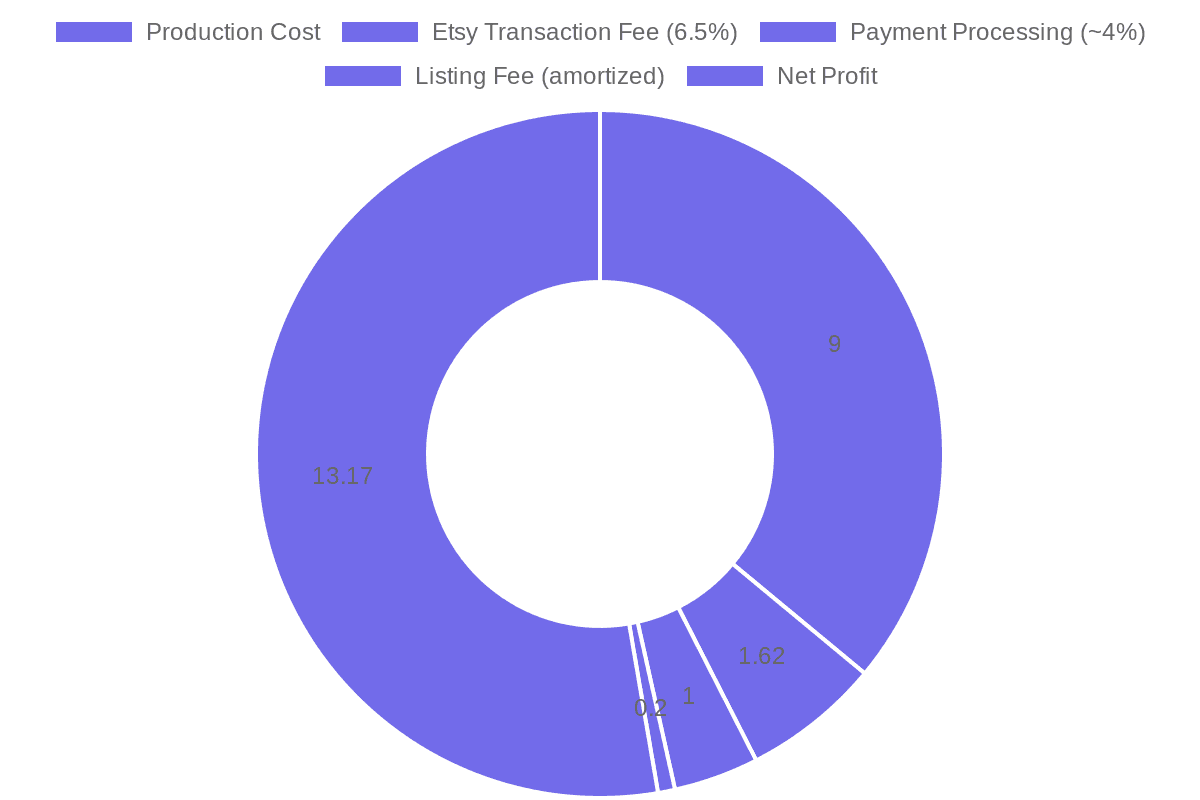
Here is what the full fee stack looks like on a $24.99 sale in 2026:
Listing fee: $0.20
Transaction fee (6.5%): $1.62
Payment processing (3% + $0.25): $1.00
Total Etsy fees: approximately $2.82
If your production cost on that item is $9.00, your gross profit before Etsy fees is $15.99. After fees, it drops to $13.17. That is a 17.6% fee load on your revenue - not the 6.5% that most sellers quote when they talk about Etsy's transaction fee.
The Offsite Ads fee adds another layer of complexity. Once your shop passes $10,000 in annual revenue, Etsy automatically enrolls you in Offsite Ads and charges 15% on any sale that originated from an external ad. You cannot opt out above that threshold. This means a sale that came through a Google Shopping ad costs you an additional 15% on top of the standard fee stack.
If you are approaching $10,000 in annual Etsy revenue, recalculate your prices now to account for the mandatory 15% Offsite Ads fee. Many sellers who cross this threshold find their margins collapse on their most popular products because they never priced in this cost.
For sellers running paid Etsy Ads on top of this, the math gets even tighter. The The Complete Etsy Ads Guide for POD Sellers in 2026: Stop Wasting Your Budget covers how to structure your ad spend so it does not cannibalize your margin.
Should I Compete on Price or Increase Perceived Value on Etsy?
This is the most important strategic question in Etsy POD, and the answer is almost always the same: competing on price is a race you cannot win and should not enter.
Here is why. The sellers with the lowest prices in any POD category on Etsy are almost never the most profitable. They are often running on margins of $1 to $3 per sale, relying entirely on volume, and one supplier price increase away from losing money on every order. They also attract the most price-sensitive buyers - the ones most likely to leave a negative review over minor issues and least likely to return.
The sellers earning real money on Etsy are charging 30% to 60% more than the category average. They do this not by having a better product in any technical sense, but by building higher perceived value around the same or similar underlying item.

What Perceived Value Actually Means in Practice
Perceived value is the gap between what something costs to make and what a buyer believes it is worth. On Etsy, this gap is created through four main levers:
1. Listing imagery and visual presentation
A mug photographed against a white studio background looks like a $12 product. The same mug shown in a warm kitchen scene, held by someone in a cozy sweater with morning light coming through a window, looks like a $22 product. The mug is identical. The perceived value is not.
This is not a minor effect. According to data from Etsy's own seller research, listings with lifestyle photography convert at significantly higher rates than those using standard mockups. Sellers using the ListyStyle mockup creator report click-through rate improvements of up to 5x compared to generic white-background mockups - and a higher CTR directly supports a higher price point because buyers arrive already engaged.
2. Premium and specific design positioning
A generic "dog mom" t-shirt competes with thousands of listings. A "Golden Retriever Mom - Est. 2019" t-shirt with a specific, high-quality illustration competes with dozens. Specificity signals craftsmanship and justifies a higher price. Buyers searching for something specific are also less price-sensitive because they have already decided they want something particular.
3. Bonus items and bundle value
Adding a perceived bonus to a listing - a matching digital download, a gift-ready packaging note, or a second coordinating item - increases the buyer's sense of value without necessarily increasing your cost by much. A $24.99 mug that comes with a printable gift card template feels worth more than a $22.99 mug that does not, even if the printable costs you nothing to include.
4. Listing copy and social proof
How you describe a product shapes how buyers value it. "Custom ceramic mug" and "Handcrafted-style ceramic mug, dishwasher safe, made to order with your personal message - the gift they will actually use" describe the same item. The second version builds perceived value through specificity and benefit language. Pair strong copy with genuine five-star reviews and you have a listing that commands a premium. For building that copy foundation, the Magic Wand SEO tool generates SEO-optimized titles, descriptions, and tags in one click, using Listybox's fine-tuned AI engine built specifically for Etsy.
In a 2025 Etsy marketplace analysis, listings with professional lifestyle imagery and benefit-focused descriptions commanded an average price 34% higher than comparable listings using standard mockups - with no statistically significant difference in conversion rate.
How Can Premium Visuals and Product Presentation Justify Higher Prices?
Visuals are not decoration on an Etsy listing. They are the primary sales mechanism. Etsy is a visual marketplace - buyers make a click decision in under two seconds based almost entirely on the thumbnail image. Everything else, including your title, your price, and your reviews, comes after that first visual impression.
This means your investment in visual quality has a direct and measurable return.
The Cost of Looking Like Everyone Else
The default mockup images provided by most POD platforms are functional but generic. They show the product clearly, but they do not tell a story. When a buyer searches for a custom hoodie on Etsy and sees fifty listings that all use the same flat-lay mockup from the same provider, the only differentiating factor visible at a glance is price. You have just created a price competition by default.
Sellers who break out of this trap with distinctive, high-quality lifestyle imagery immediately occupy a different visual tier. Their listings look like a brand, not a catalog entry. Buyers perceive them as more trustworthy, more premium, and worth paying more for.
The ListyStyle mockup creator addresses this directly by generating hundreds of unique, hyper-realistic lifestyle images for each product - images that place your design in real-world scenes relevant to your target buyer. A gardening-themed tote bag shown in an actual garden setting. A teacher appreciation mug shown on a school desk with morning coffee. These images do not just look better - they make the buyer imagine owning the product, which is the mental step that precedes a purchase decision.
Video Listings and the Algorithm Advantage
Etsy's algorithm in 2026 gives a measurable visibility boost to listings that include video content. Listings with video have been shown to hold buyer attention longer, which improves Etsy's quality score for that listing. The practical challenge for most POD sellers is that creating video content requires time, software, and at least basic editing skills.
The ListyStyle Video creator removes that barrier entirely. You select a listing, click to generate a video, and the system produces a professional product video ready to upload directly to Etsy. For sellers focused on maximizing listing visibility, this is one of the fastest improvements available. You can also read more about visual content strategy in our Etsy Conversion Rate Optimization Guide: Turn Views Into Sales.
How Do I Compare Production Costs Across POD Platforms to Protect My Margins?
Production cost is the single largest variable in your pricing formula, and it is the one most sellers set once and never revisit. This is a significant mistake.
POD platform pricing changes. Suppliers adjust their rates, new providers enter the market, and the difference between what you pay on one platform versus another for the same product category can be $2 to $5 per unit. On a product you price at $24.99, a $3 difference in production cost is the difference between a 28% margin and a 40% margin. At 200 sales per month, that is $600 in additional profit - from doing nothing except switching or renegotiating your supplier.
Platform Cost Comparison: What the Numbers Look Like
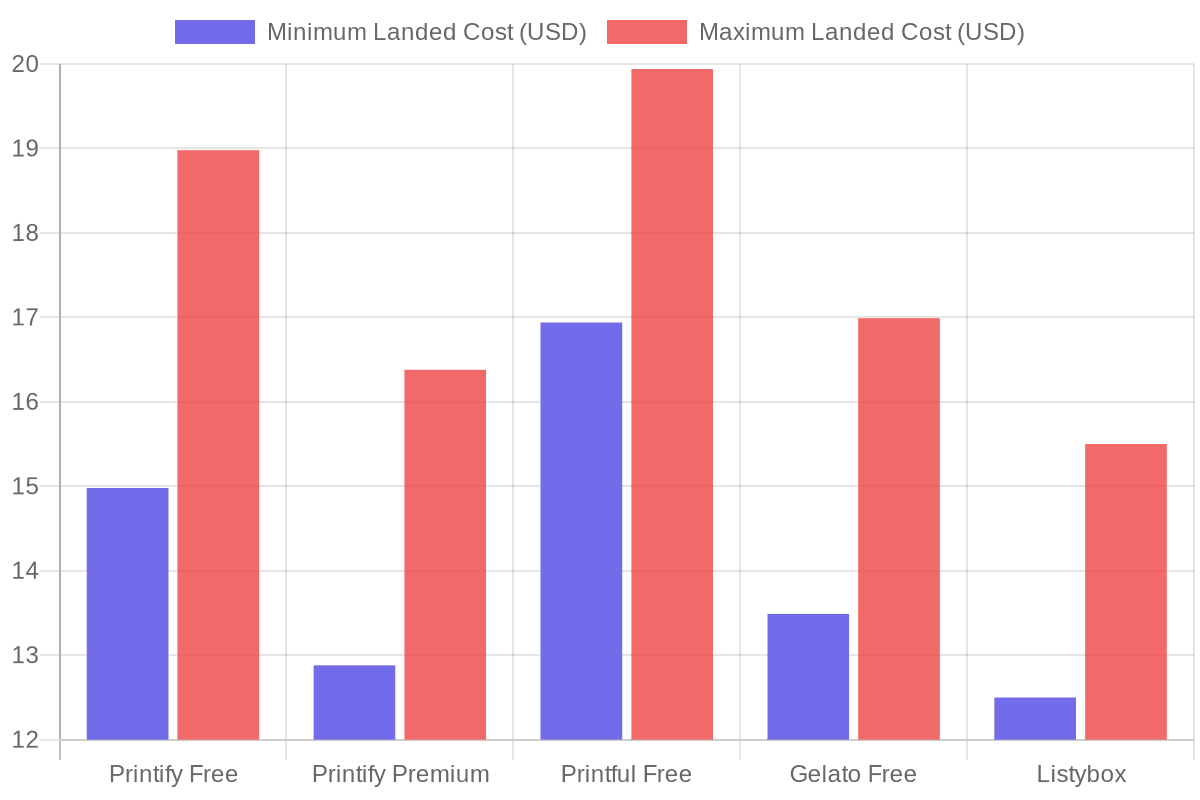
For context on how production costs vary across the major POD platforms in 2026, here is a realistic comparison for a standard unisex t-shirt (Bella+Canvas 3001 or equivalent):
Printify (free plan):
Base cost: approximately $10.49 - $12.99 depending on print provider
Standard shipping to US: $4.49 - $5.99
Total landed cost: $14.98 - $18.98
Printify Premium ($29.99/month):
Base cost: approximately $8.39 - $10.39 (20% discount)
Standard shipping to US: $4.49 - $5.99
Total landed cost: $12.88 - $16.38
Printful (free plan):
Base cost: approximately $12.95 - $14.95
Standard shipping to US: $3.99 - $4.99
Total landed cost: $16.94 - $19.94
Gelato (free plan):
Base cost: approximately $9.50 - $11.50 (varies by local production hub)
Standard shipping to US: $3.99 - $5.49
Total landed cost: $13.49 - $16.99
These numbers shift constantly, which is exactly why manual comparison is impractical at scale. You can see our product catalog to see current base costs across Listybox's integrated provider network.
Why the Lowest Base Cost Is Not Always the Right Choice
Cost comparison is not purely about the lowest number. Production quality, print consistency, shipping speed, and return rates all factor into your true cost per sale. A provider that is $1.50 cheaper per unit but generates a 4% defect rate will cost you more in the long run through refunds, replacements, and negative reviews.
The right comparison framework weighs:
Base production cost
Average shipping cost and speed to your primary customer geography
Historical defect and return rate
Customer service quality when issues arise
Platform reliability and uptime
For a broader look at how different e-commerce platforms compare on operational and cost dimensions, The E-commerce Seller Dashboard Showdown: Etsy, Amazon, Shopify, and Trendyol provides a useful reference point.
How Listybox Handles Cross-Platform Cost Comparison
This is where the operational reality of running a POD business on Etsy gets genuinely difficult. Manually checking production costs across four or five providers, updating your pricing formula, and adjusting live listings every time a supplier changes their rates is a part-time job in itself.
Listybox's Lowest Price Guarantee approaches this differently. Rather than requiring you to manually monitor and compare costs, Listybox uses the collective purchasing volume of its entire seller community to negotiate the best available production rates across providers - and those rates are automatically applied to every user's orders without any additional subscription fee.
In practical terms, this means sellers on Listybox often access production costs comparable to what Printify Premium users pay, without the $29.99 monthly fee. On a business doing 300 orders per month, that saved subscription cost alone adds up to $360 per year - before accounting for any per-unit savings on the production cost itself.
For sellers who want full control over their supplier relationships and custom production arrangements, the Custom Product Hub allows you to add your own products with your own cost structures, so Listybox's automation tools work with your existing supplier network rather than replacing it.
Start your free trial - no credit card required
Putting It All Together: A Pricing Audit in Five Steps
If you have been selling on Etsy for more than three months without doing a formal pricing audit, there is a reasonable chance you are leaving money on the table - or worse, actively losing it on some products. Here is a practical five-step process to audit and reset your prices correctly.
Step 1: Pull Your Actual Cost Data
For each product you sell, document the exact production cost including shipping to your primary customer geography. Do not use estimates - pull the actual numbers from your POD provider's pricing page or order history. If costs have changed since you first listed the product, you are probably working with outdated numbers.
Step 2: Calculate Your Real Etsy Fee Load
For each product, calculate the full fee stack as a percentage of your current sale price. Include listing fees amortized over expected sales volume, the 6.5% transaction fee, payment processing, and Offsite Ads if applicable. For most sellers, the total fee load sits between 15% and 22% of revenue.
Step 3: Apply the Pricing Formula
With accurate cost and fee data in hand, run each product through the formula: (Production Cost + Fees + Shipping + Target Profit) / (1 - Total Cost Ratio). If your current price is below the formula output, you are underpriced. If it is significantly above, check whether your conversion rate supports that premium or whether you need to build more perceived value to justify it.
Step 4: Assess Your Visual Presentation
For any listing where your formula says you should be charging more but your conversion rate does not support it, the gap is almost always in visual presentation or listing copy. This is where upgrading your mockups and product photography pays for itself immediately. The Etsy SEO guide also covers how listing quality signals affect your search ranking, which affects how many buyers see your price in the first place.
Step 5: Update and Monitor
Once you have reset your prices, use Bulk Listing Editing to apply changes across multiple listings at once rather than editing each one individually. Then set a quarterly reminder to repeat this audit, because production costs, Etsy fees, and market conditions all shift over time.
A quarterly pricing audit takes about two hours and is one of the highest-return activities you can do for your Etsy business. Most sellers who do this for the first time find at least two or three products where they have been underpricing by $3 to $6 per sale for months.
For sellers who are just getting started and want to skip the setup complexity entirely, Listybox's Store Setup service handles your store launch, initial product listings, and SEO optimization from day one - included free with annual Starter and Professional plans.
Never Miss an Update
Get actionable Etsy tips delivered to your inbox every week. No spam, unsubscribe anytime.