
Shopify Dropshipping in 2026: Why It Fails and Where Etsy POD Wins
Shopify dropshipping promises passive income with zero inventory, but 73% of new stores fail within a year due to ad costs, supplier issues, and customer service nightmares. Etsy print on demand offers a built-in audience and lower risk. With Listybox automation, you can skip the manual grind and build a profitable store faster.
Bullet Points (TL;DR)
Shopify dropshipping carries hidden costs that can eat 80–90% of your revenue before you see a profit.
Platform algorithms now penalize generic dropshipping stores, making organic traffic nearly impossible.
Etsy Print on Demand gives you immediate access to 96 million active buyers without paying for ads.
Listybox automates the most time-consuming tasks, from SEO-optimized listings to hands-off order fulfillment.
Switching from Shopify to Etsy POD with Listybox can reduce your monthly operational costs by up to 90%.
Liam, a 34-year-old software engineer, wanted a side hustle that could eventually replace his salary. He spent two weeks watching YouTube gurus promise passive income with Shopify dropshipping. The model sounded perfect: find a trending product, build a store in an afternoon, run some Facebook ads, and watch orders roll in while he slept.
He launched his store with $1,200 in startup capital. Nineteen days later, he'd made three sales for a total of $127. His ad account was suspended for no clear reason. His supplier shipped a broken unit to his only 5-star reviewer. And he'd spent $890 on ads. Liam isn't alone: a 2025 industry survey found that 73% of new Shopify dropshipping stores fail to break even in their first 12 months. The model isn't broken, but the playbook most beginners follow is dangerously outdated.

What Is Shopify Dropshipping and Why Does It Seem So Appealing?
Shopify dropshipping is an e-commerce model where you create an online store, list products from suppliers, and when a customer orders, the supplier ships the item directly to them. You never handle inventory. The appeal is obvious: no warehouse, no upfront stock investment, and the freedom to sell anything from yoga mats to phone cases.
Platforms like Shopify make setup feel effortless. With pre-built themes and apps, you can have a store live in under an hour. Video courses and TikTok success stories paint a picture of easy money: find a winning product, scale ads, and repeat. In reality, this simplicity hides a series of expensive pitfalls that crush most sellers before they ever see a profit.
The All-In Cost of Running a Shopify Store
The $29/month Basic plan is just the entry ticket. To make a store functional, you'll need apps for reviews, upsells, email capture, and more. On average, a serious dropshipping store spends an extra $50–$150 per month on essential apps alone. Domain registration, a professional theme, and payment processing fees add up quickly. Before running a single ad, your fixed monthly cost often exceeds $200.
The Hidden Costs of Shopify Dropshipping in 2026
📈 A 2025 survey of 800+ Shopify dropshippers revealed the average monthly operating cost (excluding ads) is $327. When you add ad spend, that number jumps to $1,400+ for stores attempting to scale.
The Advertising Money Pit
Facebook and TikTok ads are the primary customer acquisition channels for most dropshippers. But ad costs have risen sharply. The average cost-per-click on Facebook in 2026 is $1.12 for e-commerce, up 34% from 2024. Many products sell for under $30 with a gross margin of $15–$20. At a 2% conversion rate, a single sale requires 50 clicks, costing $56 in ads alone.
You lose money on every sale unless you nail retargeting, email sequences, and upsells. Newcomers rarely have these systems. They bleed cash, hoping the algorithm will eventually optimize their campaigns. Most run out of budget before that happens.
Supplier Nightmares and Quality Control
When you dropship, your brand's reputation rests on a supplier you've never met. Shipping times can stretch to 30+ days if products come from overseas. Packaging is inconsistent. Returns are a logistical maze. A single viral negative review about a late or defective item can kill a fledgling store's conversion rate overnight.
Liam's first 5-star review turned into a 1-star catastrophe when the mug arrived shattered. The supplier refused a refund, and Liam had to cover the loss himself while dealing with an angry customer. That's the hidden cost: time, stress, and the slow erosion of trust in your own business.
Customer Service Hell
When the supplier messes up, you take the blame. Dropshippers report spending 15–20 hours per week on customer service alone: tracking inquiries, refund requests, and chargeback disputes. Payment processors like Stripe and PayPal can freeze your funds if your chargeback rate exceeds 1%, leaving you unable to pay for ads or even refund customers. This death spiral kills thousands of stores each year.
The Brutal Realities: Why Most Shopify Dropshippers Fail
⚠️ 64% of Shopify dropshippers report that unpredictable ad account bans are their biggest operational risk. Facebook's automated review system can flag innocent stores with no human appeal, pausing all sales overnight.
Platform Bans and Policy Changes
Facebook, TikTok, and Google are not on your side. They have a financial incentive to keep you spending, but they also enforce strict policies that change without notice. A product that was approved last week can suddenly get flagged as "deceptive" or "low quality." Payment processors can hold funds for 180 days if they suspect high risk.
On the Shopify side, if your store attracts too many complaints, Shopify itself may suspend your account. That kills your business instantly because your domain, listings, and customer data are all on their platform.
The Saturated Market Problem
By the time a "winning product" appears on YouTube, thousands of copycat stores have already launched. The window for profit shrinks daily. To compete, you need to offer better branding, faster shipping, and a truly unique angle. Most beginners lack the design skills, copywriting knowledge, and marketing budget to stand out.
Here's the painful math: if you spend $1,400/month on ads and apps, you need to generate at least $2,000 in sales just to break even. With average order values around $35, that's 57 orders per month. To get those orders at a 2% conversion rate, you need 2,850 visitors. At $1.12 per click, you spend $3,192 on ads for $2,000 in revenue - a $1,192 loss. And that assumes no chargebacks, no returns, and no shipping disasters.
A Smarter Alternative: Etsy Print on Demand vs. Shopify Dropshipping
While Liam was burning cash on Shopify, his friend Maya was quietly building a six-figure side income on Etsy using print on demand (POD). She didn't pay for a single ad. Her products - custom mugs, t-shirts, and wall art - appeared in Etsy search results organically, tapping into a built-in audience of 96 million active buyers.
Etsy's model is fundamentally different: you pay $0.20 per listing, and Etsy takes a 6.5% transaction fee. There's no monthly subscription (unless you use Listybox, which starts with a free plan). More importantly, Etsy's search algorithm rewards shops that consistently add new, relevant products. You don't need to master Facebook ads; you need to understand Etsy SEO, a skill that Listybox automates for you.
To fully understand the differences, read our detailed comparison: Dropshipping vs Print on Demand: The 2026 E-commerce Showdown.
Comparing Startup Costs: Shopify vs. Etsy POD
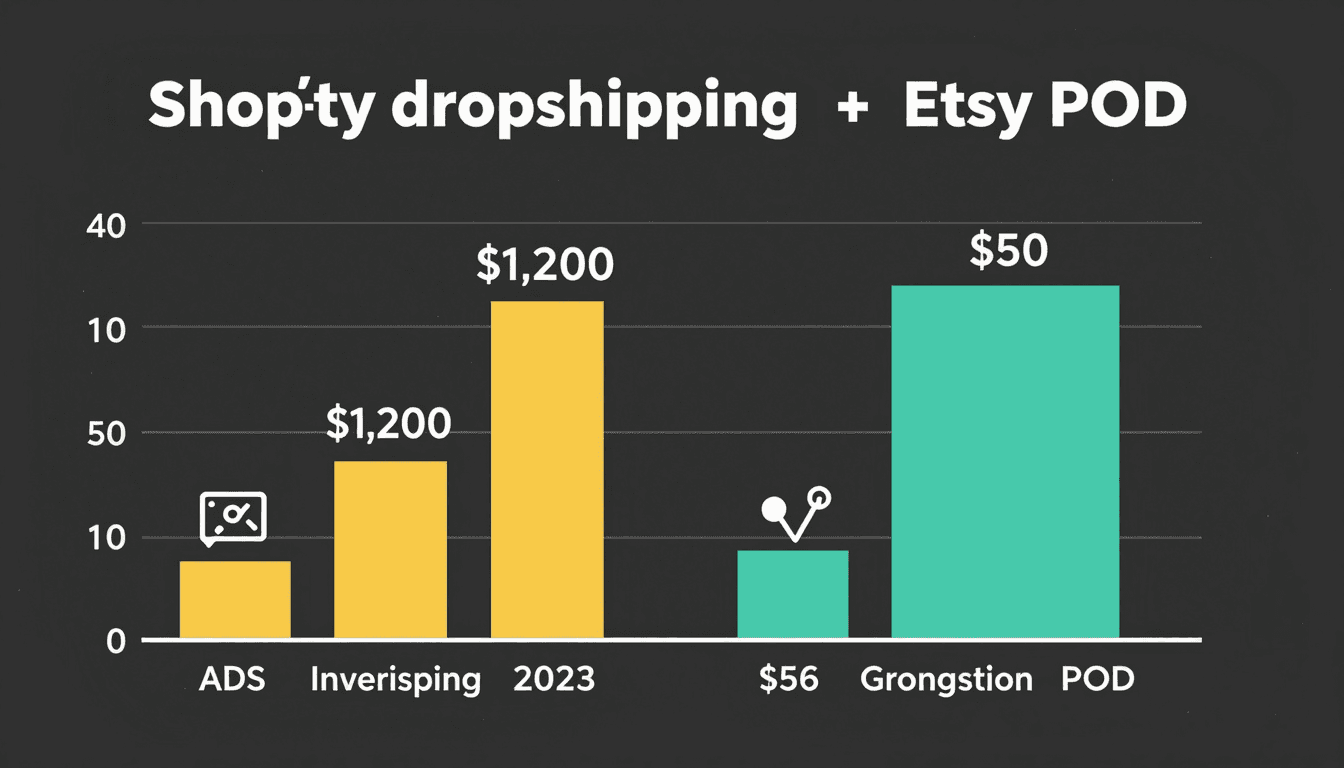
Shopify Dropshipping startup: Shopify plan ($29/mo), essential apps ($50–$150/mo), initial ad budget ($500–$1,000), sample products ($100–$200). Total first month: $679–$1,379.
Etsy POD with Listybox: Listybox free plan ($0), Etsy listing fees (10 listings x $0.20 = $2.00). You can start with zero ad spend. Total first month: under $30.
You don't need to master Facebook ads to get traffic. Etsy brings buyers to you. For a complete beginner's roadmap, check out our guide: How to Start Selling on Etsy: The 2026 Beginner's Guide.
How Listybox Turns Etsy POD Into a True Passive Income Machine
Liam decided to give Etsy a try but didn't want to repeat his Shopify mistakes. He signed up for Listybox's free plan and chose the Store Setup service. Within a week, his store was live with 10 SEO-optimized products, all without him touching a single listing.
💡 Instead of paying for ads, Listybox helps you rank organically on Etsy. A single optimized listing can generate sales for years without additional cost.
Store Setup: Skip the Learning Curve Entirely
If staring at an empty Etsy shop makes you anxious, the Listybox Store Setup service is your shortcut. Our team builds your store, lists your first 10 products, and optimizes them for Etsy SEO. It's included free with annual Starter and Professional plans. No guesswork, no wasted hours.
Magic Wand: SEO That Actually Converts
On Shopify, you have to figure out meta titles, descriptions, and keywords yourself, often paying for apps like Plug in SEO. Listybox's Magic Wand SEO tool analyzes the exact keywords your successful competitors rank for and generates optimized titles, tags, and descriptions in one click. One user reported her search traffic increased 340% within 30 days of switching from manual keyword research to Magic Wand.
Zero-Touch Fulfillment: True Passive Income
The biggest difference between Shopify dropshipping and Etsy POD with Listybox is what happens after a sale. On Shopify, you still need to manually forward orders to your supplier and track shipping. With Listybox, the entire process is automated. When a customer buys, the order is routed to your print provider, produced, and shipped without you lifting a finger. Zero-Touch Order Management means you focus on design and growth, not logistics.
Trend Compass: Never Chase a Dying Fad Again
Shopify dropshippers spend hours scrolling AliExpress and TikTok to spot the next trend, often arriving too late. Listybox's Trend Compass radar alerts you to rising design trends on Etsy while they're still unsaturated. It shows you what's gaining traction in real time, so you can launch products before the market floods. This data-driven approach replaces costly ad testing with informed, low-risk product creation.
For a deeper look at building a truly automated income stream, read Passive Income with Print on Demand: A Realistic Guide for Etsy Sellers.
Liam's Transformation: From Shopify Struggles to Etsy Profits
Six months after abandoning Shopify, Liam's Etsy store had 73 active listings, a 4.8-star average rating, and monthly revenues of $3,200. His profit margin after Etsy fees, production costs, and his Listybox subscription was 42%. He spent exactly $0 on ads. His customer service workload? About 15 minutes per week, thanks to automated fulfillment and transparent shipping policies.
That's the difference between a business that bleeds you dry and one that runs itself. You don't need to repeat Liam's costly Shopify experiment. The data is clear: for beginners seeking real passive income with low risk, Etsy print on demand powered by Listybox is the superior choice in 2026.
Never Miss an Update
Get actionable Etsy tips delivered to your inbox every week. No spam, unsubscribe anytime.