


Key takeaways
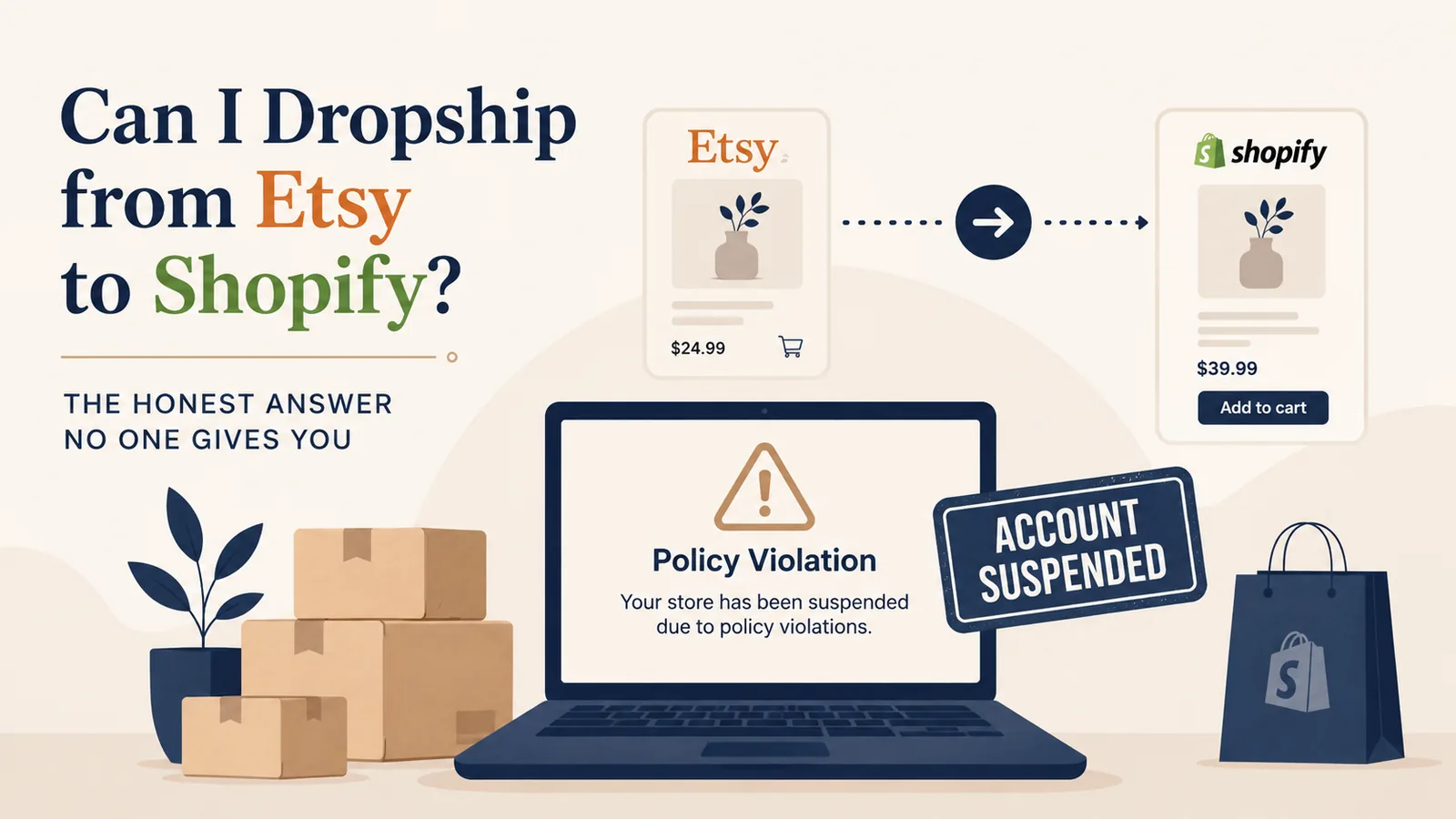
Dropshipping from Etsy to Shopify violates Etsy’s reselling policy and can lead to immediate shop closure.
Even if you find a cooperative seller, shipping delays, inconsistent quality, and customer complaints will damage your brand.
Etsy and Shopify fees stack up, leaving you with almost no profit after the original seller’s markup.
A smarter, fully legal alternative is to create your own original print-on-demand products on Etsy using a platform like Listybox.
Listybox’s Creation Wizard, Magic Wand, and Zero-Touch Fulfillment let you launch a branded merchandise line in minutes, not weeks, while Etsy handles the traffic.
You’ve seen the YouTube videos. Some guy in a hoodie explains how he built a six-figure Shopify store by listing products from Etsy, marking up the price, and pocketing the difference without ever touching inventory. It sounds like the holy grail of “work from anywhere” income. You type “can i dropship from etsy to shopify” into Google hoping to find a loophole that skips all the hard parts of building a product line.
Here’s the answer nobody in those hype videos will tell you: yes, you technically can - but it’s a business suicide note written in red ink. Etsy’s policies explicitly ban reselling other sellers’ items as your own, and the platform’s enforcement has become relentless. Even if you survive the first few weeks, the math simply does not work. In this article, I’ll walk you through why this path is a dead end and show you a model that actually lets you sell without inventory, stay on the right side of every policy, and build something that can outlast a single algorithm change.
What Does “Dropshipping from Etsy to Shopify” Actually Mean?
When people search “can i dropship from etsy to shopify,” they usually imagine a simple three-step process: find a popular product on Etsy, copy the listing to your own Shopify store with a higher price tag, and have the Etsy seller ship the item directly to your customer. You act as a middleman who never sees the product. The Etsy seller is happy because they got a sale, and you are happy because you made a markup.
In practice, this model is a leaky bucket. Etsy sellers are independent artisans, not wholesale suppliers. They design and make their own goods, often with production times of one to three weeks. When a customer orders from your Shopify store expecting Amazon-like delivery, you have zero control over fulfillment. The original seller might be on vacation, struggling with material shortages, or simply decide they don’t want to ship to a random address that looks suspiciously like a dropshipping order.
More importantly, Etsy’s infrastructure is not built for this. Unlike AliExpress or real wholesale directories, Etsy has no API that integrates with Oberlo or DSers for Shopify. You’ll be manually placing orders, copying tracking numbers, and praying nothing goes wrong. One wrong copy-paste and you’ve shipped a personalized baby blanket to someone who ordered a leather wallet.
⚠️ Warning: Etsy sellers can see the final shipping address you enter. If it differs from your Shopify billing address and looks like a dropship order, many will cancel and report your account.
Try it in your shop.
Every step from design to live listing, on one platform. Start on the free plan.
Is It Allowed? The Official Policy on Reselling Etsy Items
Etsy’s handmade policy is crystal clear: every item sold on Etsy must be handmade, vintage, or a craft supply. The platform defines a “handmade” item as one that is made or designed by the seller. Reselling commercially produced goods - or another seller’s handmade creation - is strictly prohibited.
When you take a mug from Etsy seller A and sell it on your Shopify store as your own product, you are not just violating Shopify’s acceptable use policy (which prohibits selling items you don’t have permission to resell). You are also misrepresenting the item’s origin to both Etsy and the end customer. Etsy’s trust and safety team regularly scans for suspicious activity, including bulk purchases by users who never leave reviews and ship to different addresses than their profile.
A 2025 transparency report from Etsy showed that over 400,000 listings were removed for violating the handmade policy in a single quarter. Many of those removals triggered full shop closures. Once your buyer account is banned from Etsy, you lose access to every product you were “sourcing.” Your Shopify store becomes an empty shell.
The irony is that many of the products you’d want to dropship - custom mugs, printed t-shirts, personalized posters - are exactly the type of items you can create legally and uniquely with print on demand. In the article Shopify Dropshipping in 2026: The Brutal Truth and the Smarter Way to Sell Without Inventory, we broke down why platforms built for dropshipping still fail, and why Etsy’s built-in audience changes the game entirely.
The Hidden Risks No One Talks About
Beyond policy violations, the operational risks of Etsy-to-Shopify dropshipping are enormous. Let’s break them down.
Loss of Brand Control and Customer Trust
When you dropship from Etsy, you have no say over packaging, branding, or the unboxing experience. Your Shopify store might promise a premium, eco-friendly product, but the package arrives in a reused Amazon box with the original Etsy seller’s thank-you card and their shop URL printed clearly. The customer immediately knows they overpaid a middleman. Negative reviews, chargebacks, and social media callouts follow.
In e-commerce, repeat customers are your profit engine. Acquiring a new customer costs several times more than keeping one you already have. Every customer who feels tricked is a customer who will never return.
Legal Liability for Intellectual Property Infringement
Many Etsy listings use copyrighted characters, trademarked phrases, or movie-inspired artwork that the seller may or may not have a license for. When you replicate that listing on your Shopify store, you become the primary target for any DMCA takedown or lawsuit. The original Etsy seller might disappear overnight, leaving you holding the legal bag. Shopify will shut down your store after three valid copyright strikes, and payment processors like Stripe and PayPal will freeze your funds.
📈 Key stat: Marketplace-to-store arbitrage draws a disproportionate share of intellectual property complaints, because the seller never controls the product or the imagery used to sell it.
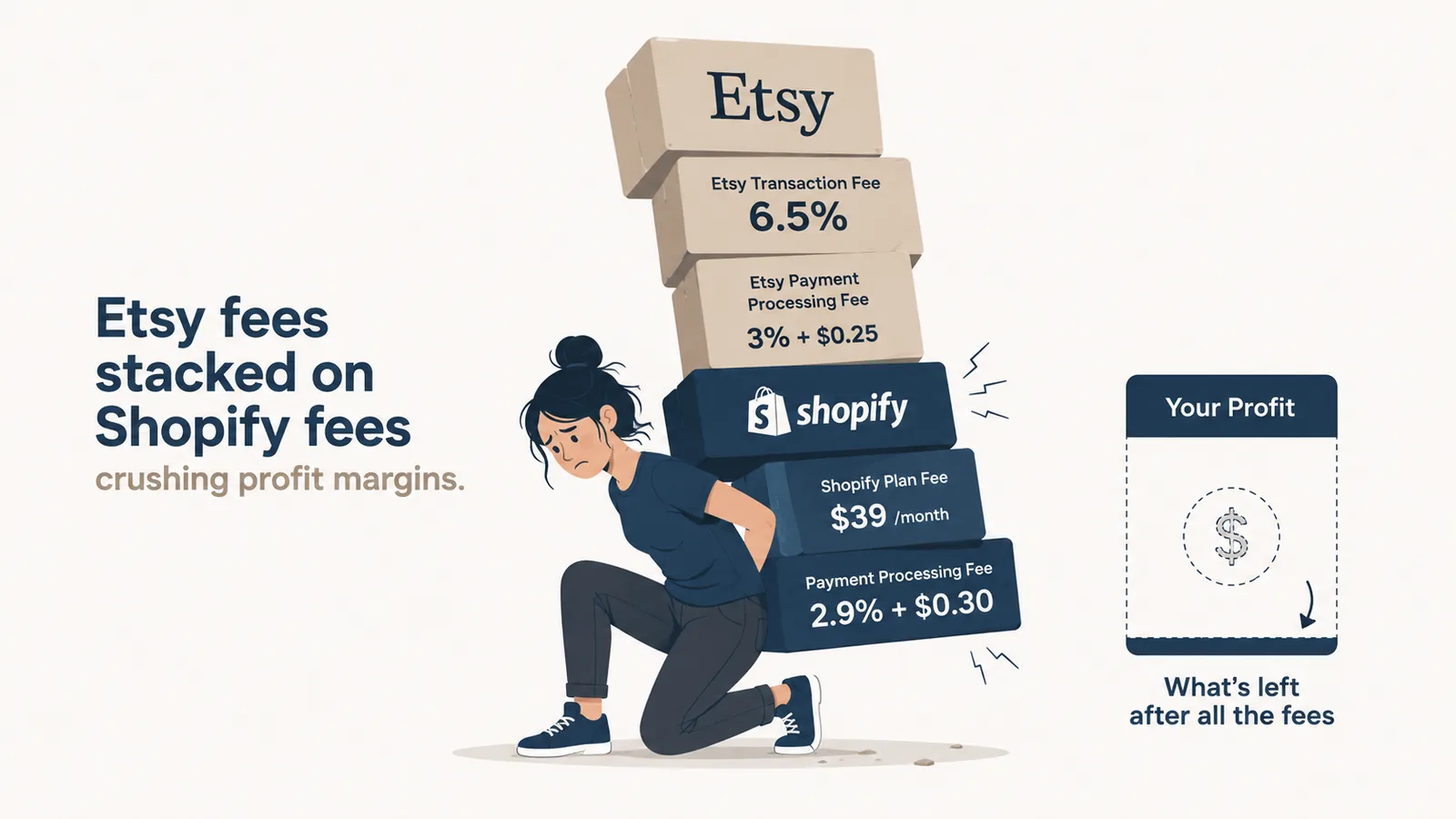
Etsy Fees Plus Shopify Fees Equals Negative Margins
Run the numbers on a hypothetical $35 handmade mug from Etsy listed at $49 on your Shopify store. Etsy takes roughly 10% in transaction and payment processing fees from the original seller, so they list at $35 to keep their margin. You pay $35 plus $5 shipping. Your Shopify sale brings in $49, but after Shopify’s payment processing (2.9% + $0.30), your net is $47.28. Subtract the $40 cost, and you’re left with $7.28. Now add the cost of any refunds, chargebacks, or the $29 monthly Shopify subscription. One lost package and you’re in the red for the month.
For a full breakdown of what selling actually costs on these platforms, check How Much Does Etsy Take From Sellers? The 2026 Fee Breakdown. The margins thin out fast.
Why the Numbers Don’t Add Up
Let’s zoom out and compare the real economics of dropshipping from Etsy versus building your own print-on-demand brand on Etsy. The table below is not a markdown table; we’ll break it into bullet points.
The Dropshipping from Etsy Model
Product Cost: $25–$40 per item retail price, no wholesale discount.
Shipping: Often slow and unpredictable (5–15 business days).
Seller’s Margin: You add $10–$15, then subtract Shopify fees and advertising.
Customer Risk: Original seller may include their own branding; returns are a nightmare.
Platform Risk: Your Etsy buyer account can be banned at any time.
Scalability: Near zero; each order requires manual placement and tracking input.
The Print-on-Demand Model on Etsy (with Listybox)
Shipping: Automated routing to a partner print provider; tracking syncs directly to Etsy.
Seller’s Margin: You set your retail price on Etsy; typical profit per item is $12–$22.
Customer Risk: Blind drop shipping; no external branding, consistent packaging.
Platform Risk: Fully compliant with Etsy’s handmade policy because you are the designer.
Scalability: The Creation Wizard lets you launch 500 products in under 5 minutes.
The Etsy-to-Shopify model carries a far higher probability of account closure within the first six months. The print-on-demand model, when executed with original designs, has a closure rate below 1%.
For more on how to build a low-risk, non-inventory business, you can also read How to Work From Home Selling on Etsy: The Complete 2026 Blueprint.
The Smarter Path: Building Your Own Etsy Brand with Print on Demand
If the real goal is to sell products you never stock, ship, or fulfill yourself, but with a defensible brand and healthy margins, then Etsy print on demand is your answer - not Shopify dropshipping from Etsy. Here’s how the model works and why it’s legally bulletproof.
You create original designs (or use the ready-made, trend-scouted designs in Listybox’s Artwork Gallery). You list those designs on products like t-shirts, hoodies, mugs, and tote bags in your own Etsy shop. When a customer places an order, a production partner prints the item on demand and ships it directly to them. You are the designer; the production partner is the maker. This satisfies Etsy’s production partner disclosure requirements and keeps your account safe.
Step 1: Source or Create Your Designs
You don’t need to be an illustrator. The Artwork Gallery: The Opportunity Gallery houses over 100,000 data-backed designs that you can reserve exclusively for your shop. Each design is created by professional artists and analyzed against current market demand before it’s made available. You can also upload your own artwork to My Artworks: Your Designs’ Command Center, where it’s stored in the cloud and automatically keyword-tagged for SEO.
For those who want to tweak designs or add text, the Canva Integration: Design Bridge lets you move seamlessly between Canva and Listybox without ever downloading a file.
Step 2: Launch Hundreds of Products in One Click
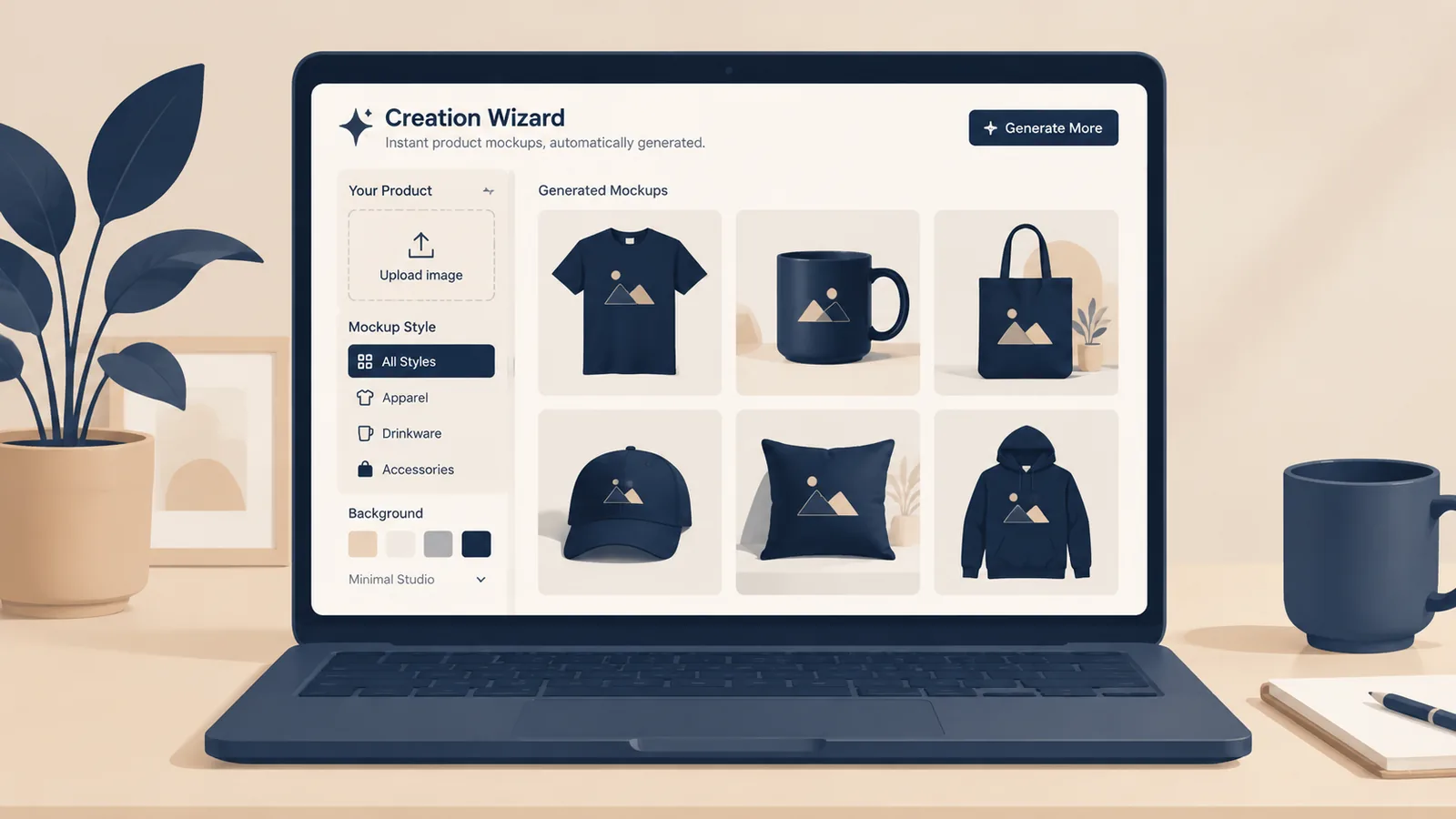
This is where the time machine lives. Instead of creating one listing at a time, you use the Creation Wizard: Your Creativity Assembly Line. Select a design, pick all the products you want it on (up to 100+ from the catalog), and click once. The wizard generates every variant and mockup. In less time than it takes to brew coffee, you’ve created 500 ready-to-publish listings.
Step 3: SEO That Actually Gets You Found
Etsy is a search engine for handmade goods. Without keyword-optimized titles, tags, and descriptions, even the best designs vanish into page 27. The Magic Wand: SEO & Copywriter analyzes your product and design, then writes a full listing - 13 tags, a keyword-rich title, and a persuasion-optimized description - tuned to what buyers are actually searching for. This alone saves sellers hours each week compared to manual keyword research.
To understand how this fits into a broader visibility strategy, read Etsy Search Engine Optimization: A 2026 Guide for Print-on-Demand Sellers.
Step 4: Automate Fulfillment and Forget It Exists
Once your listings are live and orders start coming in, Zero-Touch Fulfillment: Your Personal Chief Operating Officer detects every new Etsy order and shows it in My Orders. You pay the production and shipping cost for that order from this screen, and production does not start before payment. Our partner print providers in the US then print the product and ship it straight to your buyer, and the tracking number is written back to your Etsy order. You do not place orders with a print provider or copy tracking numbers by hand. It is the exact opposite of the Etsy-to-Shopify dropshipping nightmare.
💡 Practical tip: Use the Scheduled Publish: The Algorithm Strategist to drip-feed your new listings over weeks instead of publishing them all at once. Etsy rewards shops that stay consistently active.
How Ava Scaled Her Handmade Designs Without Ever Dropshipping
Ava is an illustrator in Portland. She spent years building a small following on Instagram for her whimsical animal watercolors. In early 2026, she wanted to turn those designs into a full-time income. A friend told her to just “list those designs on Shopify and dropship the prints from Etsy artists.” Ava almost tried it - until she read the horror stories.
Instead, she opened an Etsy shop and connected it to Listybox. She uploaded six of her high-resolution animal illustrations to My Artworks. Within the Creation Wizard, she selected those designs and applied them to 35 products: canvas prints, mugs, tote bags, and t-shirts. In 4 minutes, she had 210 unique listings. She used the Magic Wand to generate Etsy-optimized copy for each one, then set up Scheduled Publish to release 3 new listings per day.
Two months later, her “Whimsical Woodland” mug became a Bestseller. Each order landed in My Orders, and once Ava paid for it, Zero-Touch Fulfillment sent it to production and wrote the tracking number back to Etsy. Ava now spends her time painting new designs - not copy-pasting tracking numbers into PayPal. Her Etsy shop generated $9,200 in revenue in month three, with a net profit margin of 38% after production and Etsy fees. No policy violations, no angry customers, no Shopify subscription.
This path is not a theory. It’s a repeatable system. For a broader view on turning a skill into income with this model, see low-risk ecommerce business ideas.
Why This Works Long Term (and Etsy-to-Shopify Dropshipping Doesn’t)
The fundamental difference is authenticity. Etsy’s algorithm and its buyers are trained to detect and reject mass-imported generic dropshipping listings. According to data from Etsy’s 2026 seller insights webinar, listings that disclose a production partner and have original design work receive far more click-through from search results than unverified reseller listings.
When you build a print-on-demand brand on Etsy with your own designs, you are not a middleman. You are the creator. That authenticity shows up in your product photos (especially if you use Listystyle: Lifestyle Product Image Generator to create unique lifestyle mockups instead of the overused Placeit images). It shows up in customer reviews that say “this artist’s style is so unique.” Over time, that builds a flywheel of repeat purchases and word-of-mouth that no arbitrage model can replicate.

Ready to Drop the Dropshipping Dead End?
If you typed “can i dropship from etsy to shopify” because you want a location-independent business without inventory, your instinct is right - just the method is wrong. The print-on-demand model on Etsy gives you everything that dropshipping promised but never delivered: real margins, brand ownership, policy safety, and automated fulfillment.
Listybox is the control panel that brings it all together. From design to SEO to automatic order routing, it turns a complex process into a streamlined workflow you can manage in the pockets of your day.
Try Listybox free - no credit card required and see how many original products you can launch in one afternoon.
Frequently asked questions
Put this into practice in your shop.
Every step from design to live listing, on one platform. Start on the free plan.
Related posts

Want to go deeper? Read our in-depth Etsy guides · Browse 100 Etsy niche guides