


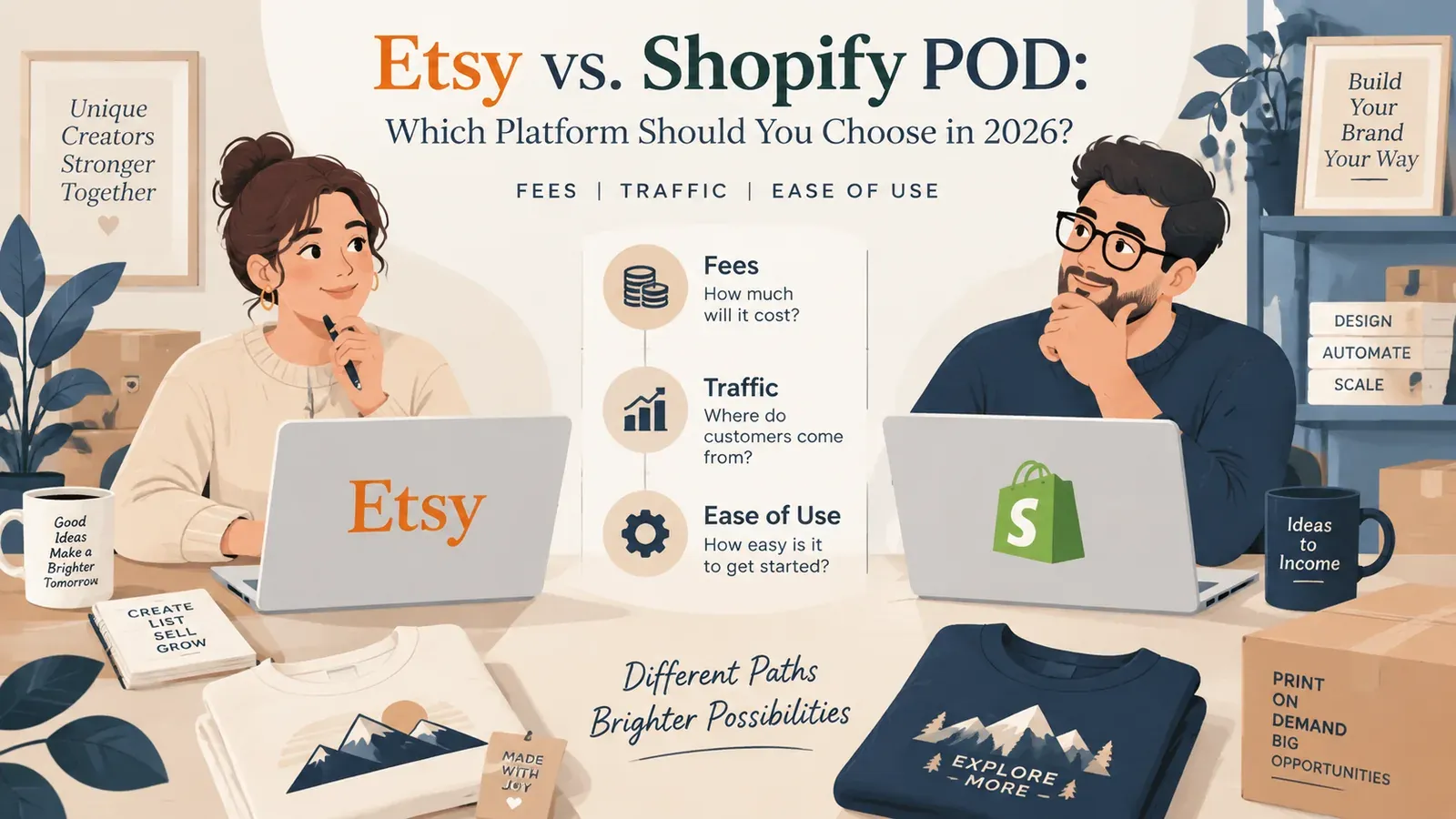
Key takeaways
Etsy is best for beginners with its built-in traffic and simple setup.
Shopify gives you full brand control and customer data ownership.
Selling on both platforms can diversify your income streams.
Understand fee structures to maximize your profit margins.
Focus on SEO for Etsy and ads/social media for Shopify traffic.
The dream of earning online often hits a fork in the road before you even list your first product: Etsy or Shopify?
It is the most common debate in the Print on Demand (POD) world. One offers you a stall in the world’s busiest artisan market; the other offers you the keys to your own private boutique. If you choose correctly, you can build a six-figure business in months. If you choose poorly, you could drain your savings on ads for a store nobody visits.
For POD sellers in 2026, the answer boils down to one critical factor: Traffic.
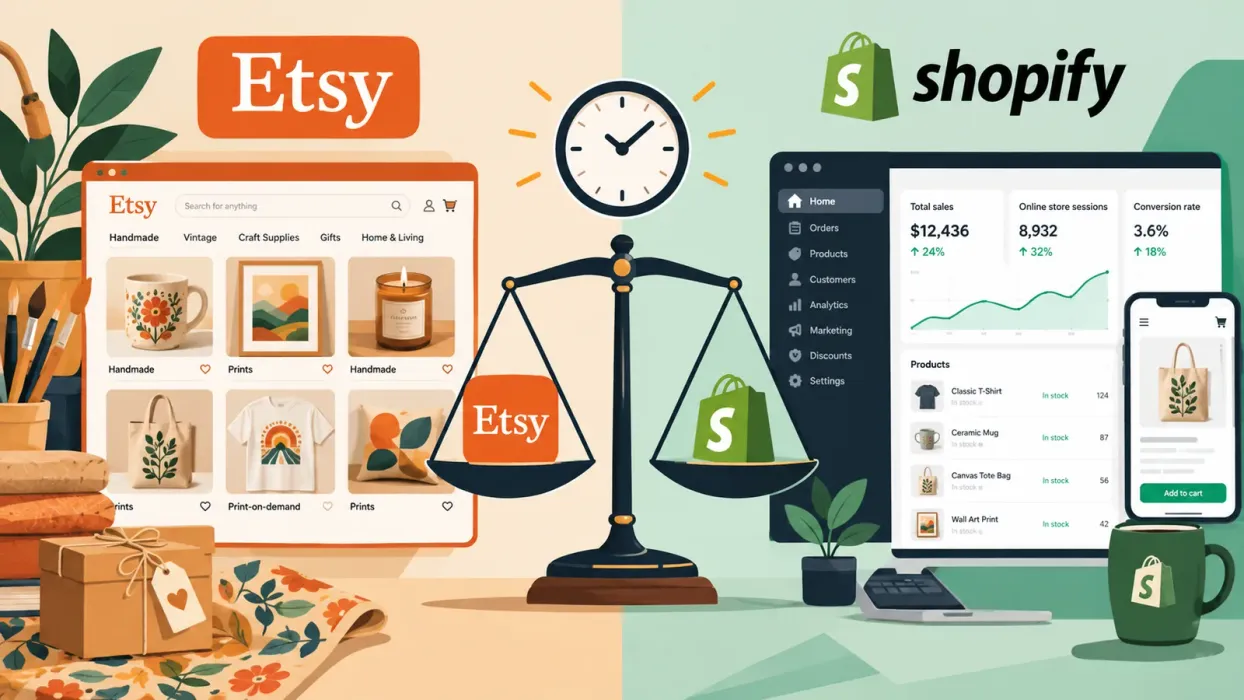
The Core Difference: “The Mall” vs. “The Desert”
To make the right choice, you must understand the fundamental nature of these two giants. It is not just about features; it is about how customers find you.
Etsy: The Busy Shopping Mall
Imagine Etsy as a massive shopping mall with 96 million active buyers walking through the doors every day. They are already there, wallets in hand, searching for “funny cat mugs” or “custom nurse hoodies.”
The Pro: You don’t need to find customers; they are already looking for you.
The Con: You are renting the land. You must follow their rules, and you are competing side-by-side with thousands of other stalls.
Shopify: The Private Island Shopify is not a marketplace; it is a platform to build your own standalone website. It is like building a beautiful luxury store in the middle of a desert.
The Pro: You own everything. The customer data, the branding, the rules. No competitor listings appear on your product pages.
The Con: Zero traffic. If you don’t run ads, post on social media, or work on SEO for months, nobody will ever find your store.
The Realistic Scenario: Meet Sarah Let’s look at a common scenario using our “Starting vs. Scaling” framework.
1. The Launch: Sarah is a talented illustrator. She wants to sell her art on t-shirts. She hears “Shopify is more professional,” so she spends weeks building a stunning Shopify site. It looks perfect.
2. The Silence: She launches and… crickets. No visitors. She realizes she needs to pay for Facebook ads. She spends $500 in her first month on ads but, because she is new to marketing, she only makes 2 sales. She is down $450 and feels defeated.
3. The Pivot (The Solution): Sarah pauses her Shopify store and moves to Etsy. She uses Listybox’s Creation Wizard to quickly upload her designs onto 50 different products.
4. The Result: Within 48 hours, she makes her first organic sale. She didn’t pay for ads; a customer simply found her via search. By using Listybox’s Magic Wand SEO tool, she wrote her titles and tags for her niche keywords. Now, she is generating cash flow first, which she can later use to build her brand.
Try your first design.
Try your design on a product and prepare its Etsy listing in Listybox.
Cost Breakdown: Fees vs. Marketing Budget
Many beginners are scared off by Etsy’s fees, but this is often a math error. Let’s compare the true cost of starting.
Etsy Costs
Listing Fee: $0.20 per item (lasts 4 months).
Transaction Fee: ~6.5% per sale.
Subscription: $0 (Standard Plan).
Marketing: $0 (Optional).
On Etsy, you only pay significant fees when you make a sale. It is a low-risk model.
Shopify Costs
Subscription: ~$29/month (Basic).
Apps: Most stores need 3-5 apps ($10-$50/month extra).
Marketing ( The Hidden Killer): To get the same 100 visitors Etsy gives you for free, you might need to spend $50-$100 in ads.
The Verdict: For starting out, Etsy is infinitely cheaper because it solves the “Customer Acquisition” problem for free.
The Workload: Marketing vs. Product
Your platform choice dictates your daily job description. This is where many creatives burn out.
The Shopify Grind: 80% Marketer, 20% Creative
If you choose Shopify, you are no longer just an artist. You are a Chief Marketing Officer. You must learn Facebook Ads Manager, email marketing flows, and social media content creation. If you stop marketing, your sales stop instantly.
The Etsy Grind: 80% Creative, 20% Optimizer
On Etsy, the algorithm breeds success if you are active. The “grind” here is listing volume and SEO. You need to constantly add new, high-quality products to keep your shop fresh in the algorithm’s eyes.
The Solution? Automation. This is where the manual work of Etsy usually breaks people - but it doesn’t have to.
Keyword Research: Instead of guessing, use Listybox’s Magic Wand to write SEO-optimized titles and tags instantly.
Consistent Activity: Use the Scheduled Publish feature to batch-create listings on Sunday and release them on the schedule you set.
Sellers who list consistently (at least one item per day) see a steadier increase in organic traffic than those who upload in sporadic bursts.
Can I Build a Brand on Etsy?
The biggest argument for Shopify is “branding.” Critics say Etsy stores all look the same. While true to an extent, you can stand out significantly with superior visuals.
Most Etsy sellers use generic mockups from the same 3 websites. To look like a premium brand on Etsy, you must have unique imagery. With Listystyle, you can generate hyper-realistic, professional lifestyle photos for your products in seconds.
Instead of a plain white t-shirt on a hanger, your product appears on a model in a coffee shop or a hiker on a mountain.
Conclusion: The “Walk, Then Run” Strategy
So, which platform wins?
For 99% of beginners, the answer is Etsy. You need validation. You need cash flow. You need to fail fast and cheaply if a design doesn’t work. Etsy provides the sandbox to do this with almost zero financial risk.
The Roadmap for 2026: 1. Start on Etsy: Use the traffic to find your best-selling niche. 2. Automate with Listybox: Use Creation Wizard to scale your winning designs across hundreds of products. 3. Scale to Shopify (Optional): Once you are making $5k/month on Etsy, you can launch a Shopify store for your dedicated fans, while keeping your Etsy store as your “acquisition engine.”
If the idea of setting up your first shop still feels daunting, we have a solution for that, too.
Start the Right Way
Does all of this feel overwhelming? You don’t have to start from scratch. With Listybox Store Setup, our team helps you set up your Etsy store. It is available inside a custom Enterprise+ offer, so plan a demo or write to [email protected].
Don’t let “analysis paralysis” stop you. The traffic is waiting.
Frequently asked questions
Put this into practice in your shop.
Every step from design to live listing, on one platform. Start on the free plan.
Related posts

Want to go deeper? Read our in-depth Etsy guides · Browse 100 Etsy niche guides