
How to Design a T-Shirt to Sell on Etsy: The Complete 2026 Guide for POD Sellers
Most Etsy sellers who try t-shirt design spend weeks creating products that never get a single view. The real problem is not the design itself - it is the gap between making something and making something people are actively searching for. This guide walks you through every step of the process, from picking a profitable niche to writing listings that rank, and shows you where smart automation can close that gap in minutes instead of months.
Bullet Points (TL;DR)
A t-shirt design only sells when it targets a specific, searchable audience - generic designs compete with millions of listings and almost always lose.
Niche research before designing is not optional. Spending 30 minutes validating demand saves weeks of wasted creative effort.
You do not need to be a professional designer. Tools like Canva, combined with a clear niche and strong typography, produce consistently strong results.
Your mockup is your first impression. Lifestyle images outperform flat product shots in click-through rate by a significant margin.
SEO-optimized listing titles, 13 relevant tags, and a keyword-rich description are what get your design in front of buyers - not just good artwork.
Scaling from one design to hundreds of listings does not have to mean hundreds of hours of manual work. Automation tools close that gap dramatically.
Consistency in publishing new products signals activity to the Etsy algorithm and compounds your visibility over time.
You have a design idea. Maybe it is funny, maybe it is niche, maybe it just feels right. So you build it, upload it to Etsy, and wait. Nothing happens. A week passes. Then a month. The listing sits at zero views while someone else's nearly identical design is racking up sales.
This is the most common experience for new print-on-demand sellers, and it is not a creativity problem. It is a process problem. Designing a t-shirt that sells on Etsy in 2026 is not just about making something that looks good. It requires the right niche, the right keywords, the right mockup, and the right publishing strategy - all working together. This guide breaks down every step of that process so you can stop guessing and start building a catalog that actually generates revenue.
What Makes a T-Shirt Design Actually Sell on Etsy?
Before opening any design software, it helps to understand what separates a best-seller from a dead listing. The answer almost always comes down to one word: specificity.
Etsy is not a general marketplace in the way Amazon is. Buyers on Etsy search with intent. They type things like "funny nurse retirement gift shirt" or "golden retriever mom tee" - not just "funny shirt." The more precisely your design matches a specific search phrase, the higher your chances of ranking and converting.

The Niche vs. Mass Market Problem
A t-shirt that says "Coffee Lover" competes with tens of thousands of listings. A t-shirt that says "Introverted But Willing to Discuss My Cat" targets a very specific personality type and has far fewer direct competitors. That specificity is what creates sales.
According to Etsy's own seller data, listings with a clearly defined target audience convert at rates 3 to 4 times higher than broad, generic products. The design does not need to be more complex - it just needs to speak directly to someone.
This is why the most successful POD sellers on Etsy build around niches, not aesthetics. A niche is a combination of an audience, an interest, and an emotion. "Teachers who love wine and hate Mondays" is a niche. "Funny shirts" is not.
Etsy listings targeting a defined sub-niche (audience + interest + emotion) convert at 3-4x the rate of broad, generic product listings, according to Etsy's internal seller benchmarks.
What Buyers Are Actually Looking For in 2026
Search behavior on Etsy has shifted meaningfully over the past two years. Buyers are increasingly looking for:
Personalization signals - designs that feel made for them, not mass-produced
Occasion-specific messaging - gifts for graduations, retirements, birthdays, and holidays
Community identity - designs that say "this is who I am" to a specific group (nurses, teachers, dog owners, gamers)
Humor with relatability - specific enough to feel personal, broad enough to gift
Understanding this shapes every design decision you make. For a deeper look at how buyer intent connects to search ranking, the Etsy Listing SEO Optimization Step by Step Guide: Rank Higher in 2026 is worth reading alongside this guide.
How Do You Research a Profitable T-Shirt Niche Before Designing?
Niche research is the step most beginners skip because it feels less exciting than designing. It is also the step that determines whether your work pays off. Spending 30 minutes validating demand before you design saves weeks of effort on products nobody is searching for.
Step 1: Start With Etsy's Own Search Bar
Etsy's autocomplete is a free, real-time keyword research tool. Type a broad term like "teacher shirt" and watch what Etsy suggests. Every suggestion is a phrase that real buyers are actively typing. Write down 10 to 15 of these phrases.
Then search each one and look at the top listings. Ask yourself:
How many total results exist for this phrase?
Are the top listings recent, or have they been sitting there for years?
What do the best-selling designs have in common - typography style, color palette, message tone?
Are there gaps? Sub-audiences that are not well served?
This process alone can generate a week's worth of design ideas grounded in real demand.
Step 2: Validate With External Tools
Tools like eRank, Marmalead, and Sale Samurai let you see estimated monthly search volume, competition levels, and click-through rates for specific keywords. A keyword with 2,000 monthly searches and low competition is a far better target than one with 50,000 searches dominated by established shops with thousands of reviews.
A general rule of thumb: look for keywords with at least 500 monthly searches and fewer than 5,000 competing listings. That combination gives you enough demand to generate traffic without being buried by competition.
Step 3: Cross-Reference With Trend Data
Some niches are evergreen (nurses, teachers, dog breeds) and some are seasonal or trend-driven (specific TV shows, viral phrases, current events). Both can be profitable, but they require different strategies.
For trend-driven niches, timing is everything. A design that goes live two weeks after a trend peaks earns nothing. A design that goes live at the start of a trend's rise can generate hundreds of sales in days. Monitoring platforms like Google Trends, Reddit, and TikTok for early signals is one way to stay ahead - though doing this manually is exhausting and inconsistent.
The best niche research combines Etsy's autocomplete (real buyer language) with a tool like eRank (volume + competition data). Use both together, not one or the other.
What Tools Do You Need to Design a T-Shirt Without Being a Professional Designer?
This is the question that stops most people before they even start. The good news is that the barrier to entry for t-shirt design has dropped dramatically. You do not need Photoshop skills or a graphic design degree. You need the right tools and an understanding of what makes a t-shirt design work visually.

The Core Design Principles for T-Shirts
Before touching any software, understand these fundamentals:
Typography is design. The majority of best-selling Etsy t-shirts are text-based or text-dominant. A well-chosen font, a strong phrase, and good spacing can outperform complex illustrations.
Less is more. Designs that try to say too much say nothing. One clear message, one visual focal point.
Color contrast matters. Your design needs to work on multiple shirt colors. A dark design on a light shirt and a light design on a dark shirt - always test both.
File format is non-negotiable. Print-on-demand providers require high-resolution PNG files with transparent backgrounds, typically at 300 DPI or higher. A design that looks fine on screen can print poorly if the file quality is wrong.
The Best Free and Low-Cost Design Tools in 2026
Canva remains the most accessible starting point for non-designers. Its t-shirt design templates, font library, and element collections let you build clean, professional designs without any technical skill. The free tier is functional, and the Pro tier ($13/month) unlocks a much larger asset library.
Adobe Express offers similar functionality with stronger font control and is worth testing if typography is central to your designs.
Kittl has become a popular choice specifically for t-shirt sellers because it offers vintage, retro, and hand-drawn style templates that work extremely well in the Etsy market.
Procreate (iPad only) is the tool of choice for illustrators who want full creative control. It has a steeper learning curve but produces original artwork that is impossible to replicate.
If you already use Canva and want to connect your designs directly to your Etsy workflow, the Canva integration inside Listybox lets you pull your Canva designs into your product creation pipeline with a single click - no downloading and re-uploading files.
Preparing Your File for Print
Once your design is done, preparation matters as much as the design itself:
Export at 300 DPI minimum, PNG format
Remove the background so the design sits naturally on the shirt color
Check that the design is at least 4500 x 5400 pixels for front-placement prints
Test the design on a mockup before listing - what looks good in isolation can look wrong scaled onto a garment
The background removal step trips up a lot of sellers. Doing it in a separate tool like Remove.bg breaks your workflow and costs money. The Background Remover tool inside Listybox handles this in one click directly within your design workflow, saving the file as a clean transparent version without touching the original.
How Do You Create Product Mockups and Listings That Convert?
Your design is done. Now comes the part that most sellers underestimate: presentation. On Etsy, your mockup image is your storefront. It is the first thing a buyer sees in search results, and it determines whether they click or scroll past.
Why Generic Mockups Kill Conversions
Every major POD platform - Printify, Printful, Gelato - provides free flat-lay mockup images. They are clean, accurate, and completely generic. The problem is that every other seller using those platforms is showing buyers the exact same type of image.
Lifestyle mockups - images that show the shirt being worn by a real person in a real setting - consistently outperform flat product shots. Internal data from Etsy sellers using lifestyle imagery shows click-through rates 4 to 6 times higher than the same product shown on a plain background. Buyers do not just want to see the design. They want to imagine themselves wearing it.
Traditionally, creating lifestyle mockups meant hiring a photographer, booking models, or paying for a Placeit subscription at $14.95 per month. For a seller with 200 products, that cost and time adds up fast.
The ListyStyle mockup creator generates hyper-realistic lifestyle images by placing your design into real-world scenes automatically. It analyzes your design and target audience and produces images that look like professional photography - without a photo shoot.
Writing an Etsy Listing That Ranks
A great mockup gets the click. A well-written listing closes the sale. Etsy's search algorithm reads your title, tags, and description to decide when and where to show your product. Getting this right is not optional - it is the difference between a listing that gets found and one that does not.
Title: Your title should lead with your primary keyword phrase, followed by secondary descriptors. A strong title for a nurse t-shirt might be: "Funny Nurse Shirt - RN Gift for Women - Nursing School Graduation Tee." Notice how it stacks multiple search phrases naturally.
Tags: You have 13 tags. Use all 13. Each tag should be a phrase, not a single word. "nurse retirement gift" is a tag. "nurse" is a wasted tag.
Description: Write for the buyer first, the algorithm second. Open with the emotional benefit ("This shirt is for every nurse who has kept her sense of humor through 12-hour shifts"), then include practical details (materials, sizing, care instructions), and weave in keyword phrases naturally throughout.
For sellers who want to go deeper on this, the Etsy SEO guide covers keyword strategy in detail.
Never copy-paste the same description across multiple listings. Etsy's algorithm penalizes duplicate content, and buyers can tell when a description was written for a different product. Each listing needs its own copy.
Pricing Your T-Shirt for Profit
Pricing is where many sellers make a critical mistake: they price to compete rather than price for profit. On Etsy, a shirt priced too low signals low quality. Buyers on Etsy expect to pay a premium for something that feels unique and personal.
A basic pricing formula for POD t-shirts:
Production cost (varies by provider, typically $9 to $14 for a standard unisex tee)
Etsy transaction fee (6.5% of sale price)
Etsy listing fee ($0.20 per listing)
Payment processing fee (3% + $0.25)
Your target profit margin (aim for at least 30 to 40%)
At a $14 production cost, a shirt priced at $28 to $32 typically hits the 30 to 40% margin range after fees. Pricing below $22 for a standard tee almost always means selling at a loss or near-zero profit once fees are counted.
For a full breakdown of how Etsy fees affect your margins, the Complete Etsy Fees Calculator Guide for 2026 is the most thorough resource available.
How Do You Scale a T-Shirt Design Business on Etsy Without Burning Out?
Here is the reality that most guides do not talk about: the hardest part of building a successful Etsy t-shirt shop is not the first sale. It is what comes after.
You find a niche that works. You make a design that sells. Now you need to do it again. And again. And again. Because a shop with 10 listings has a fraction of the visibility of a shop with 300 listings. Volume matters on Etsy - not just for revenue, but for algorithmic trust.
The Scaling Math Problem
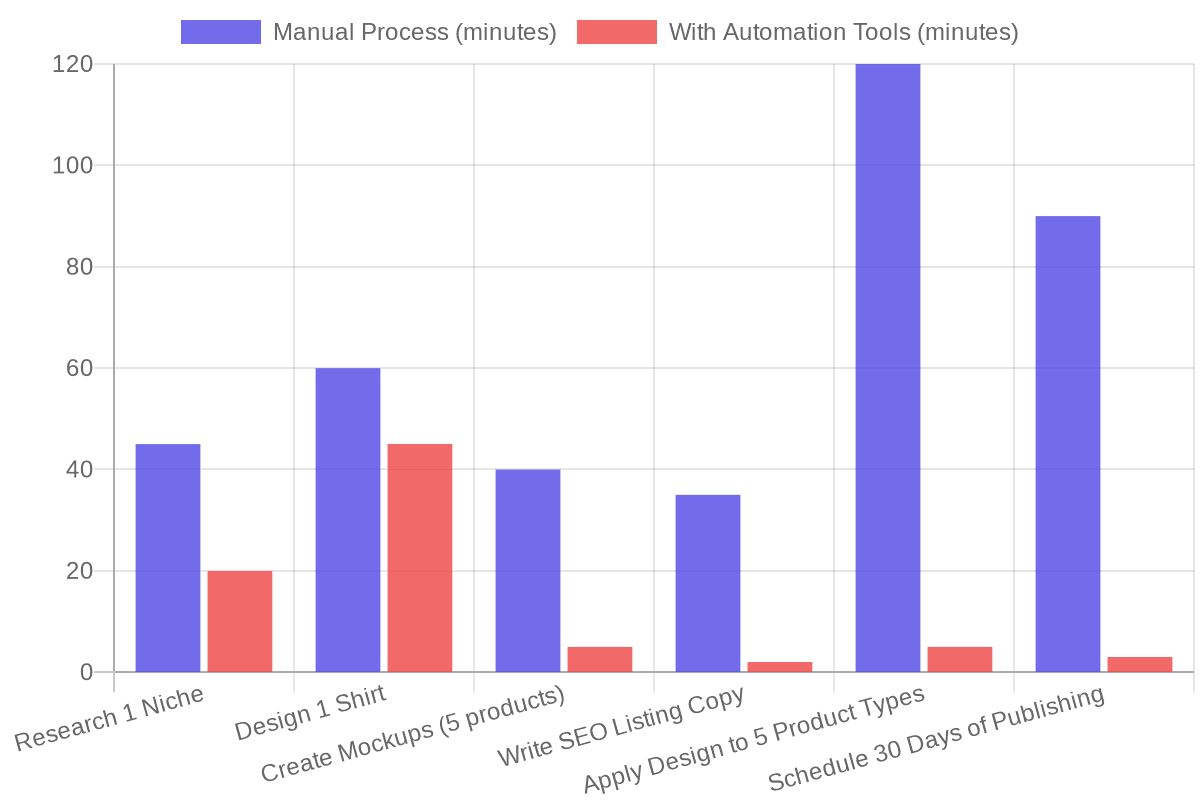
If creating one listing - design, mockup, title, tags, description - takes 90 minutes, then building a 200-listing shop takes 300 hours of work. That is 37 full working days. For someone running a shop alongside a job or family, that timeline stretches into years.
This is where the gap between sellers who grow and sellers who plateau becomes visible. The ones who grow are not working harder. They have found ways to do the repetitive parts faster.
From One Design to Hundreds of Products
One of the most powerful scaling moves available to POD sellers is applying a single winning design to multiple product types within a single workflow. A design that works on a t-shirt often works on a hoodie, a sweatshirt, a tank top, and a long-sleeve tee. That is five products from one design.
Manually applying a design to each product type, adjusting placement, generating mockups, and writing individual listings for each one takes hours. The Creation Wizard collapses that process. You select your design, select your product types, and it generates all the combinations - with mockups and variants ready - in minutes rather than hours.
Publishing Consistently Without Being Chained to Your Computer
Etsy's algorithm rewards shops that publish new listings regularly. A shop that adds one new product per day is treated as more active - and ranked higher - than a shop that uploads 30 products in one day and then goes quiet for a month.
The problem is obvious: publishing one listing per day manually means logging in every single day, forever. The Scheduled Publish feature solves this by letting you create a batch of listings in one session and then schedule them to go live automatically on a cadence you set - daily, every two days, or whatever interval fits your strategy. You do the work once. The algorithm sees consistent activity for weeks.
Shops that publish at least one new listing per day see an average of 34% more organic impressions per existing listing compared to shops that publish in irregular batches, based on Listybox seller data across 2025.
Keeping Your SEO Sharp Across a Large Catalog
As your catalog grows, keeping titles, tags, and descriptions optimized becomes its own full-time job. Trends shift. Keywords that worked six months ago may be losing traffic. A tag you used across 50 listings might need updating.
Doing this manually - opening each listing, editing the title, updating the tags, saving - is the kind of work that takes a full day and produces no new revenue. The Bulk Listing Editing feature lets you select multiple listings and apply changes across all of them at once. A seasonal keyword swap that would take four hours manually takes four minutes.
For sellers who want their SEO done at the point of creation rather than fixed retroactively, the Magic Wand SEO tool generates optimized titles, all 13 tags, and a full listing description from a single click, based on analysis of what is actually ranking and selling on Etsy right now. It is built specifically for Etsy - not a generic writing tool repurposed for e-commerce.
If you want to see the full picture of what is possible when these tools work together, you can explore all features on the Listybox features page.
Start your free trial - no credit card required
A Note on Order Fulfillment
Once sales start coming in, there is a new operational reality: every order needs to be processed, tracked, and confirmed. For a shop doing 5 orders a month, this is manageable. For a shop doing 50 orders a week, it becomes a part-time job.
POD is supposed to be a hands-off model - you design, the provider prints and ships, the customer receives. But in practice, there are tracking numbers to copy, orders to mark as shipped, and customers to notify. The Zero-Touch Order Management system handles all of this automatically: it routes orders to the right provider, captures tracking information, marks the order as shipped on Etsy, and notifies the customer - without you touching anything.
That is what passive income actually looks like in practice.
Does All of This Feel Overwhelming?
You do not have to build your store from scratch alone. With Listybox Store Setup, our expert team sets up your Etsy store, lists your first 10 products with SEO-optimized copy, and handles the branding setup so you start with a professional foundation. This service is included free with annual Starter and Professional plans.
Putting It All Together: The T-Shirt Design Process From Start to Sale
Here is the complete workflow in sequence, without shortcuts:
Phase 1: Research (Before You Design)
Identify 3 to 5 specific niches using Etsy autocomplete and a keyword tool
Validate demand: look for keywords with 500+ monthly searches and under 5,000 competing listings
Study the top 10 listings in your target niche - note what they do well and where the gaps are
Choose one niche to start. Do not try to cover everything at once.
Phase 2: Design
Write your message or concept first, then design around it
Use Canva, Kittl, or your preferred tool to build the design
Export as a high-resolution PNG with a transparent background
Test the design on mockups in multiple shirt colors before committing
Phase 3: Listing Creation
Generate lifestyle mockup images (not just flat product shots)
Write a keyword-rich title that leads with your primary search phrase
Fill all 13 tags with phrase-based keywords, not single words
Write a description that opens with the emotional benefit and includes natural keyword placement
Price for profit, not just competitiveness

Phase 4: Publishing and Scaling
Publish consistently - daily if possible, or use scheduled publishing to automate the cadence
Apply winning designs to multiple product types to multiply your catalog without multiplying your work
Monitor which listings get views and which convert - double down on what works
Update underperforming listings with better keywords before deleting them
For sellers who are just getting started and want a broader view of the POD business model, Print on Demand on Etsy: The 2026 Blueprint for Passive Income covers the full landscape.
The path from first design to consistent sales is not a straight line, but it is a learnable process. Every step described above can be done manually - and many successful sellers have done exactly that. The question is how much of your time you want to spend on the repetitive parts versus the creative and strategic parts. That answer is different for everyone, but the tools to shift that balance exist and work.
Never Miss an Update
Get actionable Etsy tips delivered to your inbox every week. No spam, unsubscribe anytime.