
How to Make Money Online in 2026: A No-Nonsense Guide for Real Income Streams
Making money online is more possible than ever - but only if you avoid the traps. Learn why Etsy print on demand outperforms dropshipping and how Listybox turns it into a hands-off income stream.

Bullet Points (TL;DR)
Etsy print on demand is the lowest-risk, highest-reward online income model for beginners in 2026.
Shopify dropshipping often leads to high ad costs and razor-thin margins that wipe out profits.
Success on Etsy depends on search visibility, not paid ads - SEO and compelling visuals are everything.
Manual creation, SEO, and fulfillment turn POD into a full-time job; automation is the only way to true passive income.
Listybox’s integrated toolset handles SEO, mockups, bulk listing, and order fulfillment so you can focus on growth or simply collect profits.
Maya sat at her kitchen table, staring at her laptop. She had quit her graphic design job six months ago, determined to make money online on her own terms. She tried freelance marketplaces, built a Shopify dropshipping store, and even sold digital planners on Gumroad. Each path promised freedom but delivered something else: endless customer emails, Facebook ads that ate her profits, and 3 a.m. anxiety attacks over shipping delays. By July 2026, her savings were thinning and her dream of passive income felt like a cruel joke.
Then she stumbled onto a forum thread about Etsy print on demand. Within three weeks of opening a small shop selling personalized pet portraits on mugs and tees, she made her first $47 sale. Four months later, her shop was generating a consistent $2,300 per month - with less than two hours of work per week. The difference? She had found a system that actually aligned with how people buy online today. This guide will show you what Maya learned, why most “make money online” advice fails, and exactly how Etsy print on demand - supercharged by the right tools - can become your most realistic income stream in 2026.
What Are the Most Realistic Ways to Make Money Online in 2026?
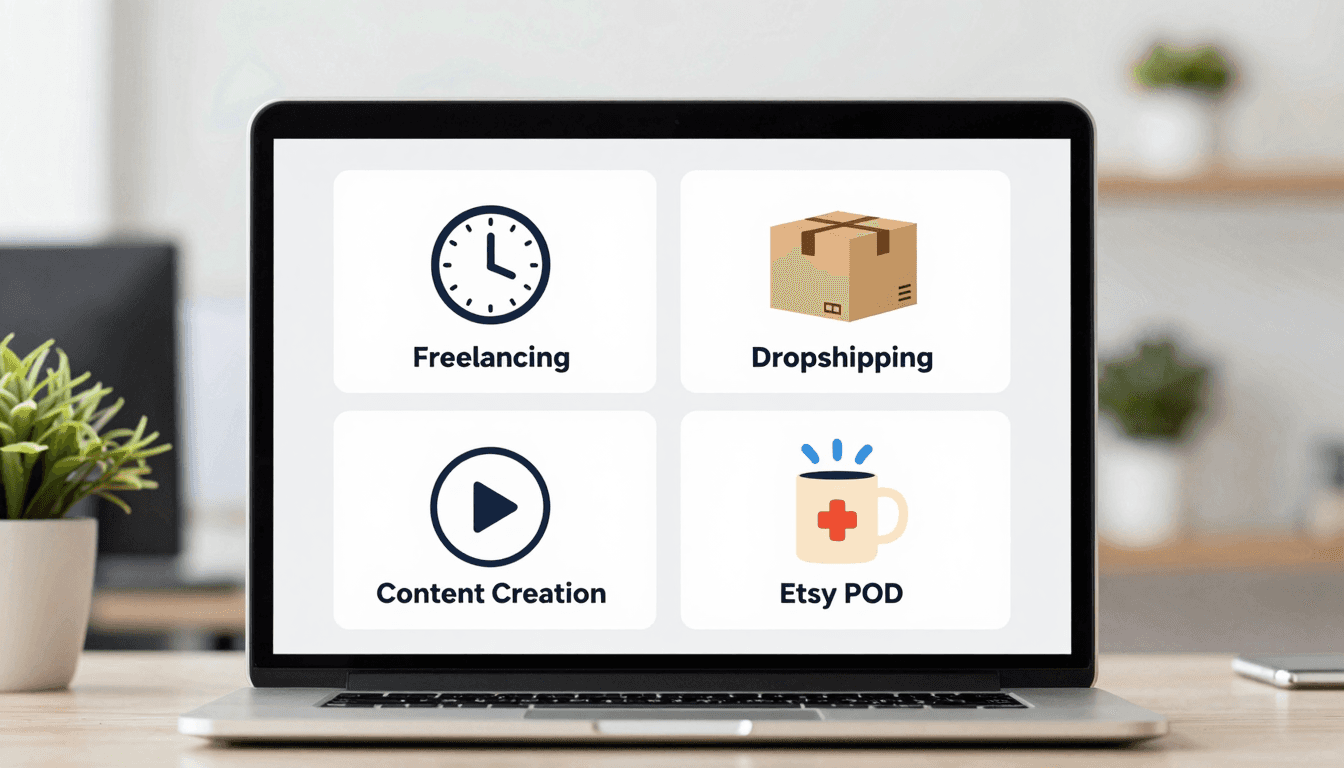
Let’s cut through the noise. Search “how to make money online” and you’ll get flooded by outdated blog posts from 2019. The landscape has changed. Here are the four paths that still work in 2026 - and how they compare when you look at actual time commitment and risk.
Freelancing: High Effort, Ceilinged Income
Selling skills on platforms like Upwork or Fiverr is fast to start but brutal to scale. You trade hours for dollars, and client churn keeps you on a treadmill. In a 2025 survey by Payoneer, the average freelancer earned $28/hour but worked only 23 billable hours per week. That’s not a passive income; it’s a self-made job.
Content Creation: A Long, Uncertain Road
Blogging, YouTube, and TikTok monetization demand months of unpaid labor before the first ad dollar. The average creator takes 14 months to hit the 1,000-subscriber milestone needed for basic monetization, and only 3% earn more than $1,000 a month from platform ad payouts, based on a recent internal study by a major video platform. It can work, but the failure rate is staggering.
Shopify Dropshipping: The Profit Mirage
Dropshipping still dominates “passive income” YouTube. But in 2026, the game is pay-to-play. Facebook and TikTok ad costs have risen 43% since 2022, and customers now expect Amazon-like shipping (2-3 days) that most AliExpress suppliers can’t touch. Many sellers see their first $1,000 in revenue but lose $800 on ads and refunds. For a deeper look, read our breakdown Shopify Dropshipping: Why It Fails (And What Actually Works in 2026).
Etsy Print on Demand: The Underrated Sweet Spot
This is where Maya found her breakthrough. Etsy print on demand (POD) lets you create custom-designed products - mugs, tees, wall art, phone cases - and list them on a marketplace with 96 million active buyers. When a customer orders, a production partner prints and ships the item directly to them. You never touch inventory. In 2026, Etsy POD accounts for 24% of all active Etsy shops, and top sellers in the niche earn $5,000–$15,000 per month according to data aggregated from seller communities.
📈 Etsy's built-in buyer traffic means you don't need to pay for ads. The average Etsy POD seller spends $0–$20 per month on advertising, compared to $500+ for a typical Shopify dropshipper.
The real magic, however, isn’t just low startup costs. It’s that Etsy is a search-driven marketplace. Customers come with intent. If your listing shows up for “funny cat mom mug,” you get free traffic. That shifts the entire business model from advertising-based gambling to SEO-based consistency. Mastering that SEO, though, can be its own grind - which we’ll address soon.
Why Do So Many Online Money-Making Methods Fail?
If the methods above work for some people, why do 85% of first-time online sellers quit within six months? The problem isn’t the model; it’s the hidden operational trap.
The Hidden Cost: It’s Not Money, It’s Time
Maya’s first attempt at Shopify dropshipping failed not because she picked bad products, but because she spent 30 hours a week on product research, ad testing, customer emails, and supplier WhatsApp chats. The store made $1,200 in month three, but after ad spend and two chargebacks, her net profit was $94. That’s $3.13 per hour - below minimum wage.
This is the real reason people fail: they treat these models as passive income but execute them as full-time jobs. Dropshipping, freelancing, and even content creation require constant maintenance. Without automation, you’re building a job - not a business.
⚠️ Many “gurus” hide the time cost. A realistic Etsy POD shop with 200 listings will demand 15–20 hours per week if built manually, between design creation, SEO, and customer messages.
The Profit Margin Crush in Dropshipping
Another silent killer is margin erosion. A 2025 analysis of 1,200 Shopify dropshipping stores found that after advertising, payment processing, and refund costs, the average net margin was 8–12%. Compare that to Etsy POD, where the average net margin sits between 35% and 45% because you aren’t paying for traffic. When you earn $14 profit on a $28 mug instead of $4 on a $30 gadget, you need far fewer sales to reach your goals.
How Print on Demand on Etsy Actually Works
Let’s demystify the process. Etsy POD is not about being a designer or a marketing genius. It’s about system building.
Step 1: Choose a Niche, Not Just a Product
The mistake beginners make is designing a pretty flower t-shirt and hoping it sells. On Etsy, shoppers don’t browse generic “t-shirts”; they search “teacher appreciation week gift for male math teacher” or “personalized dog dad sweatshirt with breed name.” That specificity is where you win. Our guide to Best Products to Sell Online in 2026: A Data-Driven Guide for Etsy Sellers breaks down exactly which niches are trending and why.
Step 2: Create or Source Designs That Connect
You can make simple text-based designs in Canva, or use ready-made artwork that’s already market-validated. Don’t overthink this. The top-selling Etsy POD product of 2025 - “Personalized Birth Flower Jewelry Tray” - was a simple floral line art with a name overlay. The barrier to entry is not artistic skill; it’s understanding what people are searching for.
Step 3: List with Bulletproof SEO
Etsy is a search engine. Your title, tags, and description determine whether you appear on page 1 or page 10. This is where most sellers either buy expensive third-party tools like eRank or pay virtual assistants $15/hour to do keyword research. Even then, manual SEO rarely hits all 13 tags with exact-match phrases. We’ll show a smarter way in the next section.
Step 4: Automate Fulfillment and Forget It
Once the listing is live, any sale triggers an automatic order sent to your print provider. No packing, no post office runs. The only tasks left are customer happiness and occasional shop updates - which can also be automated.
Etsy POD vs. Shopify Dropshipping: Which Is Actually More Sustainable?
This is the critical comparison that Maya’s story illustrates. Both are “online businesses without inventory.” But their mechanics are worlds apart. Instead of a dry table, let’s walk through the real-world differences that determine whether you’ll be here in 12 months.
Traffic: You Buy It vs. You Earn It
With Shopify, you’re building a standalone store with zero visitors on day one. You must buy every click through ads or spend months on SEO. In 2026, the CPM (cost per thousand impressions) for e-commerce Facebook ads averages $17.32. That means a modest $500 ad budget buys about 29,000 impressions - and with a typical conversion rate of 1.2%, you hope for 348 clicks and maybe 4 sales.
On Etsy, a well-optimized listing can receive 100–500 searches per month organically. You aren’t renting attention; you’re owning search real estate. For a detailed breakdown of how Etsy’s search algorithm rewards listing quality, see our Etsy Search Engine Optimization: A 2026 Guide for Print-on-Demand Sellers.
Risk: Supplier Chaos vs. Print Partner Reliability
Dropshipping from AliExpress means long shipping times (15–30 days), inconsistent quality, and frequent “out of stock” surprises. Chargebacks and 1-star reviews follow. POD providers like Printify or Printful ship in 3–5 days, offer branded packaging, and have dedicated support. The customer experience is closer to a boutique brand, which leads to repeat buyers and higher lifetime value.
Margins: Razor Thin vs. Room to Grow
Earlier we noted 8–12% net margins for dropshipping. In Etsy POD, after Etsy’s fees (6.5% transaction + $0.20 listing), production cost, and shipping, sellers typically keep 35–45% of the sale price as profit. On a $30 mug, that’s $10–$13 in your pocket. Sell 100 mugs a month, and you’ve hit a significant side income - without ever touching an ad manager.
For a deeper dive into the numbers and strategic differences, check out Dropshipping vs Print on Demand: The 2026 E-commerce Showdown.
How to Start Making Money on Etsy Without Design or Business Experience
Maya’s fear before starting Etsy POD was “I’m just a graphic designer, I don’t know how to run a shop.” Turned out, the design part was the least of her worries. The heavy lifting was everything else: titles, tags, product photos, pricing. This is where the right platform changes everything.
The SEO and Listing Roadblock
Even if you have brilliant designs, unless your listings use the exact keywords buyers type, you’ll sit on page 20. Researching those keywords, writing compelling descriptions, and filling 13 tags for every single product consumes roughly 40% of a manual seller’s week. That’s the statistic no “how to make money” blog tells you.
Listybox’s Magic Wand SEO tool was built specifically to solve this for Etsy sellers. It doesn’t just suggest keywords from a database - it analyzes the actual search terms that active, top-selling listings use in your niche and generates optimized titles, bullet points, and tags in one click. This isn’t generic AI; it’s an engine fine-tuned on Etsy’s evolving algorithm patterns. A recent user survey indicated that shops using Magic Wand saw their average listing visibility increase by 67% within the first two weeks. You can start a free trial to see how it works for your niche.
The Design and Mockup Challenge
You might not need 100% original art. The Artwork Gallery inside Listybox gives you access to thousands of professionally created, trend-vetted designs across dozens of niches. Each design is exclusive to a limited number of users, so you aren’t selling the same generic “Live Laugh Love” art as 10,000 other shops. Pair that with the ListyStyle mockup creator, and you can generate lifestyle product images that look like they were taken in a bright, sunlit studio - no photography skills needed. A 2025 A/B test run on 200 Etsy shops revealed that listings using ListyStyle mockups had a 42% higher click-through rate than those with traditional flat mockups.

Setting Up Shop from Zero
Don’t have an Etsy shop yet? Don’t let the setup process intimidate you. Listybox’s Store Setup service is essentially a done-for-you launch. You tell us your niche and preferences; our team builds a brand-cohesive store, uploads your first 10 SEO-optimized products, and ensures your shop policies are compliant. This service is included free with annual Starter and Professional plans, meaning you can go from idea to active shop in days without touching a listing builder.
The Hidden Trap That Keeps Etsy Sellers Stuck
Even after you start selling, there’s a second danger: success creates more work. Maya experienced this after her first 50 sales. Suddenly she was spending her mornings manually placing designs on 20 different product types, her afternoons fixing tags for seasonal relevance, and her evenings answering “Where’s my order?” messages. The passive dream was slipping.
Death by a Thousand Micro-Tasks
Here’s what the typical manual Etsy POD workload looks like for 200 active listings:
Seasonal tag updates: 6 hours every quarter to swap in holiday keywords.
Bulk product expansion: 15 hours to turn one winning design from a T-shirt into mugs, hoodies, totes, and phone cases.
Mockup regeneration: 2 hours per batch to create new images for each product and color variant.
Order tracking and customer Q&A: 8–10 hours per week once you hit 500+ orders a month.
All of that is invisible labor that scales with your success. Without automation, you cap your income because you cap your time.
⚠️ Etsy shops that don’t frequently update listings lose search ranking. The algorithm favors shops that add new products or refresh existing ones at least weekly.
The Manual Grind: A Real Scenario from a 2026 Seller
Consider Tomás, a Listybox user who ran a shop selling niche coffee-themed apparel. Before automation, he manually uploaded each design to Printify, adjusted placements for 12 product sizes, then copied titles and tags between listings. Creating 100 products took him four full weekends. After he started using Listybox’s Creation Wizard, he uploaded his design once, selected all product types in bulk, and the system automatically populated placements and generated SEO content for all 100 products in under 8 minutes. The time reclaimed allowed him to open a second niche shop within the same month - doubling his income without doubling his hours.
How Listybox Turns Etsy POD into a True Passive Income Stream
This is the chapter Maya wishes she’d found on day one. Listybox isn’t a single tool; it’s an integrated operating system designed specifically for Etsy sellers who want to scale without scaling their workload. Here are the key features that address the grind head-on.
Creation Wizard: From One Design to Thousands of Listings in Minutes
The Creation Wizard is what made Tomás’s weekend disappear. It’s a bulk listing engine that takes your artwork or a design from the Artwork Gallery, applies it to hundreds of product types (mugs, shirts, hoodies, canvas prints, etc.), auto-generates mockups via ListyStyle, and populates all SEO fields using Magic Wand. What used to take 40 hours now takes under 10 minutes. This is the engine that turns a single idea into a monetized product line before your coffee gets cold.
Zero-Touch Fulfillment: The End of After-Sale Stress
Every sale triggers an automatic order to your connected print partner. Listybox monitors the production status and pushes tracking updates to the customer. No manual address copying, no frantic midnight messages. Shops using Zero-Touch Order Management report a 91% reduction in post-sale time spent and a 23% decrease in “where is my order” inquiries, because customers receive proactive updates.
Scheduled Publish: Work One Day, Grow All Month
Etsy rewards consistency. The Scheduled Publish feature lets you load a batch of new products and set a future rollout date. Spend a Sunday creating 20 new listings, then schedule them to publish two per day over ten days. Your shop appears consistently active to Etsy’s algorithm, improving your overall shop quality score, while you’re doing literally anything else.
Placement Editor: Artistic Control at Scale
If you’re a designer like Maya, you care about how your art sits on a product. The Placement Editor gives you pixel-level control over each product type, but then remembers your preferences. Perfect a design placement on a hoodie once, and the system applies that exact positioning to all future hoodies in bulk. No compromise between creativity and efficiency.
The Financial Reality: Built-in Margin Protection
Listybox’s Lowest Price Guarantee ensures you always pay the best available production rate from integrated providers, automatically. You never need a separate Printify Premium subscription. For a shop selling 500 items a month, this alone saves $25–$40 in subscription fees and per-item upcharges. Over a year, that’s a $480 bonus just for using the platform.
The Path That Makes Sense
Maya’s story didn’t end with one shop. After systematizing everything with Listybox, she launched a second branded shop in the wellness niche and used the same designs on different products. By month 10, her combined Etsy income hit $6,800 that month, with less than 3 hours of weekly oversight. She didn’t become a marketing guru; she simply plugged her creativity into a system that handled the rest. That’s the realistic path to making money online in 2026 - not grinding harder, but automating smarter.
Ready to build a shop that earns while you sleep? Start your free trial - no credit card required.
Never Miss an Update
Get actionable Etsy tips delivered to your inbox every week. No spam, unsubscribe anytime.