



Key takeaways
Redbubble is a marketplace where you upload designs; Etsy is a platform where you build a distinct, branded shop.
Redbubble sets your profit margin as a percentage on top of their base price; on Etsy, you control your full retail price and strategy.
With Redbubble, you remain anonymous to the customer, making repeat business nearly impossible. Etsy lets you own the customer relationship.
Etsy’s listing process requires more upfront work, but tools exist to turn hours of manual SEO optimization into a task you complete in minutes.
For a scalable, long-term business asset you can eventually sell, Etsy offers a clear path that Redbubble’s artist marketplace model does not.
Ethan stared at his laptop screen, two tabs open. One showed a clean, simple upload button on Redbubble. The other displayed the slightly more intimidating dashboard of a brand-new Etsy shop. He had a folder full of designs he was proud of - funny dog-mom quotes, abstract geometric patterns, and a few niche hiking-themed illustrations. His goal was simple: build a side income stream that could eventually replace his monthly car payment.
He uploaded his first design to Redbubble in under five minutes. It felt like a victory. But two weeks and a handful of generic sales later, he realized he had no idea who his customers were. He was just a faceless designer in a sea of millions, earning pocket change per shirt. That’s when he started to wonder if the “easy” path was actually the dead end. The real question wasn’t which platform was simpler at the start; it was which one would let him build something he actually owned.
What are the core differences between Redbubble and Etsy for print on demand?
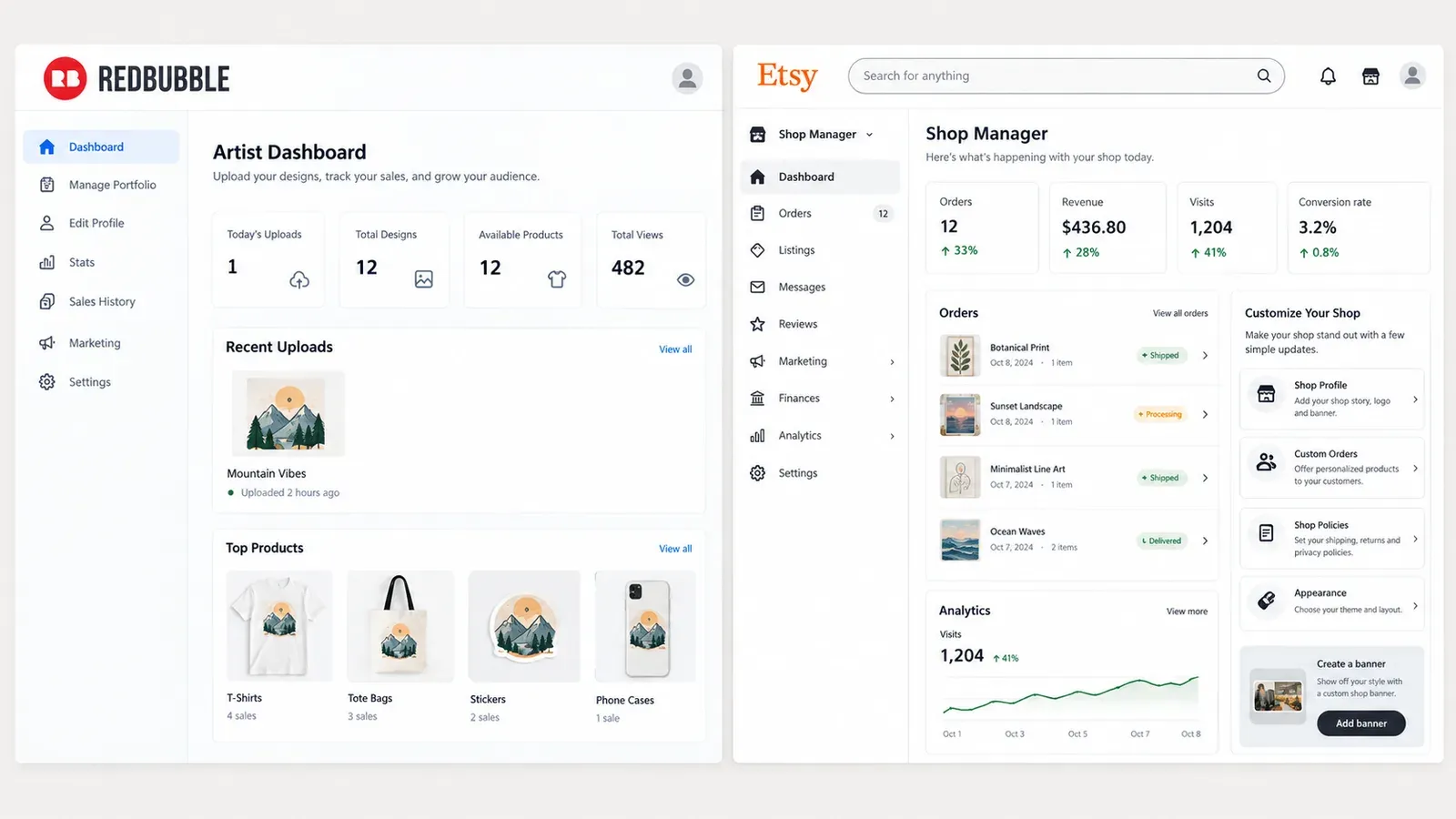
At a glance, Redbubble and Etsy seem to serve the same purpose: connecting creators with customers who want unique products. The reality is fundamentally different. Redbubble is a curated product marketplace. You are an artist uploading designs to their product catalog. Etsy is a shop-hosting platform. You are a business owner building a brand.
This distinction changes everything. On Redbubble, you never get a customer’s email address. You can’t send a thank-you note with your branding. You can’t build an email list for a future product launch. The customer buys from Redbubble, not from you. On Etsy, while the transaction happens on the platform, the relationship is yours to nurture. You can customize your shop’s banner, write a compelling “About” section, and direct shoppers to your social media. You are building a recognizable asset.
💡 Think of Redbubble as a massive department store that stocks your product anonymously. Etsy is more like renting your own boutique inside a busy shopping district. The foot traffic is great in both places, but only one lets you hang your own sign above the door.
The product creation workflow highlights this split. Redbubble forces your design onto their pre-selected products. You have limited control over placement and mockup quality. With Etsy, you choose your production partner. For a deeper look at how this choice impacts your business model, see our guide on Dropshipping vs Print on Demand: Why Choice Matters for Your Etsy Success. You select the specific t-shirt brand, the mug style, or the canvas type. You can order samples, check quality, and build a reputation for a specific product feel. This control is the foundation of a premium brand that can charge higher prices than a generic marketplace listing ever could.
The hidden cost of anonymity
The biggest trap with a pure marketplace like Redbubble is the illusion of progress. You see sales coming in. The dopamine hit is real. But you aren’t building a customer base; you are just renting access to Redbubble’s. If their algorithm changes, your sales can vanish overnight. If a competitor undercuts the standard margin, you have no brand loyalty to fall back on.
Etsy also has an algorithm, and it also changes. The difference is that on Etsy, your SEO, your branding, and your customer service can create a moat. A repeat customer can find your shop name in their purchase history. They can favorite your shop. You can use Etsy’s built-in tools to offer them a coupon for their next visit. You are not just a line item on a packing slip; you are a small business they chose to support.
How do the fee structures of Redbubble and Etsy compare for sellers?
Fee structures are where the platforms diverge most sharply, and where a simple comparison can be dangerously misleading. Redbubble’s model seems simpler on the surface, but it masks a critical loss of control.
On Redbubble, you never pay an upfront listing fee. You upload a design, and Redbubble sets a “base price” for each product. You then add your markup on top. The customer pays the total. Redbubble handles production, shipping, and customer service, and you get your markup as a royalty. You never see the customer’s payment, and you never set the final retail price. You are always a cost-plus seller.
Etsy’s model is a true retail model. You set the final price the customer pays. You pay a listing fee and a transaction fee when you make a sale. The platform is transparent about these costs, and they are well-documented.
Etsy charges a $0.20 USD fee for listing an item for sale. Taxes may also apply.
This upfront cost, however small, is actually a strategic filter. It discourages the mass uploading of thousands of low-effort, spammy designs that clutter Redbubble. It forces you to be intentional. You also pay a transaction fee on the sale, but because you control the final price, you can build these costs into your profit margin calculation. For a complete breakdown of how to price your products correctly, read our in-depth Etsy Fees Explained: The Complete 2026 Guide with Profit Margin Calculations.
⚠️ Don’t fall for the “no upfront fees” trap. Redbubble’s zero listing fee model comes at the steep price of you never owning the customer relationship. A small, predictable listing fee on Etsy is an investment in a business asset you control.
The margin control myth
But what happens when a high-quality, heavyweight hoodie costs more to produce? The platform that seems to take more in fees often leaves more net profit in your pocket because it allows for brand-driven pricing.
Which platform offers better product variety and customization?
Redbubble boasts a massive catalog of products, from standard apparel to stickers, phone cases, and wall tapestries. The variety is impressive, but the customization is surface-level. You upload a design, and their system automatically maps it onto dozens of products. You can adjust the scaling and placement, but you are stuck with their product quality and their mockup photos - the same mockups every other artist uses.
Etsy’s print on demand ecosystem is different. You aren’t locked into one production partner’s catalog. You can connect your shop to multiple providers, each specializing in different products. You might use one provider for organic cotton tees and another for all-over-print hoodies. This flexibility allows you to curate a product line that fits your brand perfectly.

Creating unique product combinations
The real power on Etsy comes from creating offerings that don’t exist in a one-size-fits-all marketplace. You can bundle products. You can offer a design on a t-shirt, a matching mug, and a framed print in a single listing with variations. This is exceptionally difficult to do cleanly on Redbubble. With a tool like the Combo Listing: The Bestseller Formula feature, you can combine multiple product types into one Etsy listing. When a customer selects “Canvas” from the variation dropdown, the product images automatically update to show the design on a canvas. This creates a seamless shopping experience that dramatically increases the average order value - a tactic simply not available on Redbubble’s rigid platform.
The mockup advantage
Redbubble provides generic mockups. Every artist selling a “funny cat dad” shirt uses the same photo of a smiling man holding a baby. On Etsy, you can generate unique, hyper-realistic lifestyle images that show your design in a specific, styled scene. Using a feature like Listystyle: AI Lifestyle Product Image Generator, you can place your hiking club design onto a shirt worn by a model standing on a mountain trail at golden hour. This isn’t just a product photo; it’s a story that a generic marketplace mockup can never tell. This visual differentiation is what stops a shopper from reverse-image searching your product to find a cheaper version.
How does the listing and SEO process differ on Redbubble vs Etsy?
Uploading a design to Redbubble is fast. You drag a file, add a title and a few tags, and hit publish. The platform’s internal search algorithm does the rest. The problem is that “the rest” is a black box. Your title and tags are competing with millions of other designs, many of which are spam or trademark-infringing content that hasn’t been caught yet. You have very little control over where you rank.
Etsy’s listing process is a more robust SEO exercise. You craft a title, write a description, and fill out 13 tag fields. This process can feel tedious if you are doing it manually, copying and pasting keywords from a spreadsheet for dozens of listings. But this effort is exactly what gives you an edge. Etsy’s search engine is trying to match buyer intent with seller listings. The more accurate and thorough your SEO, the better your chance of being found by a high-intent buyer.
For a complete walkthrough of how to master this, don’t miss our guide on Etsy Search Engine Optimization: A 2026 Guide for Print-on-Demand Sellers. The manual grind of SEO is a real pain point, but it’s a solvable one.
Turning hours of SEO into minutes
The manual SEO process for a single listing - researching keywords, writing a compelling title, crafting a description, and filling all 13 tags - can take a seller 15 to 20 minutes. Multiply that by 50 or 100 listings, and the math becomes a demoralizing block of hours. This is where the right tool changes the workflow entirely.
The Magic Wand: AI SEO & Copywriter feature analyzes your specific product and design combination. Instead of you staring at a blank tag field, it generates a full set of 13 SEO-optimized tags, a keyword-rich title, and a sales-focused description in one go. You stay in control, reviewing and editing the suggestions to match your brand voice, but the heavy lifting is done. A task that previously consumed a full afternoon can be wrapped up in minutes, freeing you to focus on creating new designs or planning your next marketing move.
The scheduling strategy
Redbubble has no concept of a “shop owner” who strategizes. You upload, and it’s live. On Etsy, a consistent uploading cadence can positively impact your shop’s visibility. Instead of dumping 50 listings live at once, you want to drip-feed them. The Scheduled Publish: The Algorithm Strategist feature lets you create a batch of listings and then set a schedule, such as publishing one listing every six hours. This keeps your shop active in Etsy’s algorithm without you needing to be glued to your computer.
Which platform is better for building a long-term, scalable print on demand brand?
If your goal is a true business asset, the choice is clear. A Redbubble store is not a sellable asset in the traditional sense. You cannot transfer your “artist profile” and its revenue stream to a new owner in a clean, verifiable way. It’s a personal income stream tied to your account.
An Etsy shop, however, is a transferable business. It has a verifiable revenue history, a customer list, and a brand identity. Shops are bought and sold every day through reputable online marketplaces. This makes every hour you invest in your Etsy SEO, your branding, and your customer service an investment in an asset with a potential future exit value.
💡 Build with the end in mind. Even if you never plan to sell, treating your Etsy shop like a valuable asset forces you to make better decisions about branding, customer experience, and product quality.
The fulfillment automation factor
One of Redbubble’s genuine advantages is the completely hands-off fulfillment. You never touch an order. For a long time, Etsy POD sellers had to manually push orders to their production partner, a daily administrative task that becomes a bottleneck as you scale. That bottleneck is now removable.
With Zero-Touch Fulfillment: Your Personal Chief Operating Officer, your Etsy orders appear in My Orders in Listybox. You pay the production and shipping cost for each order from this screen, and production does not start before payment. After payment, the order goes to production and the tracking number is written back to your Etsy order.

The path Ethan chose - and the one that leads to a real business - is the one that requires more upfront intention. The “easy” upload button on Redbubble is a shortcut to becoming a commodity. The slightly steeper learning curve of Etsy is the path to building a brand with a loyal customer base, premium pricing power, and a real exit value. You don’t have to grind through that learning curve alone. The tools to turn hours of manual work into a streamlined, minutes-long process are available. The choice isn’t just about fees; it’s about whether you want to be a nameless designer in a crowd or the owner of a brand that customers seek out by name.
Start free - no credit card required
Listybox
Create listings 10x faster with Listybox.
Frequently asked questions
Put this into practice in your shop.
Every step from design to live listing, on one platform. Start on the free plan.
Related posts

Want to go deeper? Read our in-depth Etsy guides · Browse 100 Etsy niche guides