


Key takeaways
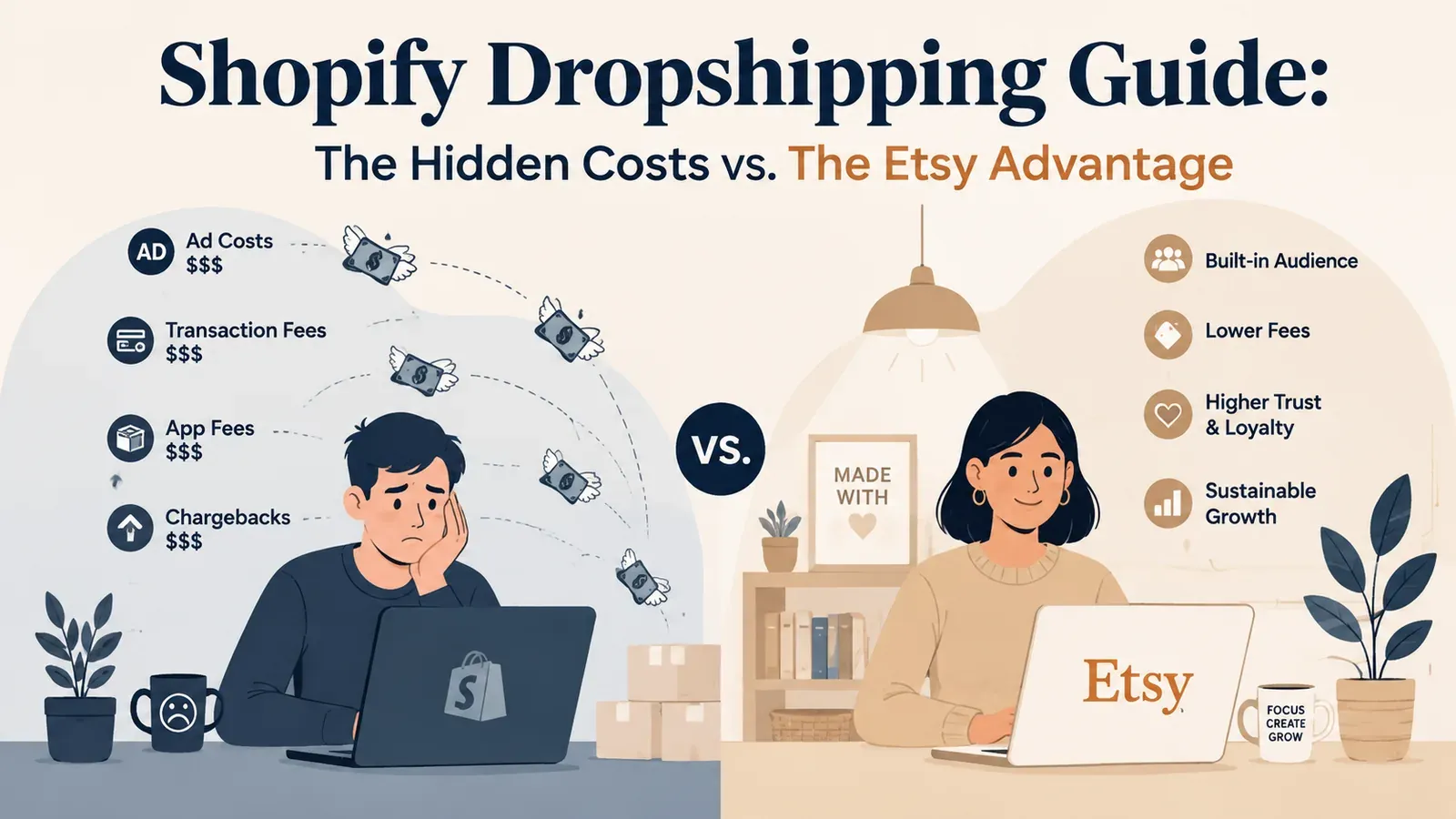
Avoid Ad Spend Traps: Shopify requires expensive marketing to get traffic, while Etsy brings 96 million active buyers to you for free.
Lower Financial Risk: Start on Etsy with just $0.20 listing fees instead of Shopify’s recurring monthly subscriptions and app costs.
Automate Your Workflow: Use Listybox to handle fulfillment, tracking, and product creation automatically.
Master SEO Instantly: Stop guessing keywords and use intelligent tools.
Scale Without Burnout: Transition from manual data entry to a system that automates listing creation and order routing.
The allure of dropshipping is powerful. You see the screenshots of six-figure months and the promise of “laptop lifestyle” freedom. Naturally, the first platform that comes to mind is Shopify. It is the giant of e-commerce, and for good reason. However, for a beginner in 2026, creating a Shopify dropshipping store can be like setting up a lemonade stand in the middle of a vast, empty desert. You might have the best lemonade in the world, but if no one walks by, you are just standing in the heat losing money.
This guide acts as a reality check. We will dissect the true costs of the Shopify model versus the marketplace power of Etsy. More importantly, we will show you how smart entrepreneurs are bypassing the “traffic trap” entirely by leveraging automation to build sustainable Print on Demand businesses.
The Hidden Math: Shopify Costs vs. Etsy Economy
When you watch a YouTube tutorial on “How to Start Shopify Dropshipping,” they often glaze over the operational costs. They mention the basic subscription, but that is just the tip of the iceberg. To run a competitive store, you need a stack of paid apps for reviews, upsells, and email marketing. And then, there is the monster in the room: traffic.
The Cost of Visibility
Shopify: You are building a standalone website. No one knows it exists. To get customers, you must pay for them. The average beginner spends over $600 on Facebook or TikTok ads before generating a consistent profit. If you stop paying, the traffic stops instantly.
Etsy: You are renting a booth in the world’s busiest artisan market. Etsy has over 90 million active buyers searching for products right now. You do not need to pay for ads to get found; you just need good keywords. You can master this organic reach with our Etsy SEO guide.
Monthly Burn Rate
Shopify: Even if you make zero sales, you are paying for the platform ($29+), apps ($50+), and domain ($14/year). The pressure is on from day one.
Etsy: There is no monthly subscription for a standard account. You pay $0.20 to list an item for four months. If it doesn’t sell, you lost twenty cents, not hundreds of dollars. This low-risk environment is why we recommend beginners start Listybox now to integrate directly with Etsy’s ecosystem.
Try it in your shop.
Every step from design to live listing, on one platform. Start on the free plan.
Is Shopify Dropshipping Still Profitable in 2026?
Technically, yes. But the barrier to entry has skyrocketed. The “Golden Era” of slapping a cheap AliExpress product on a basic Shopify theme and running $5 ads is over. Customers are savvy. They demand fast shipping, unique branding, and high trust.
Dropshipping generic products from China often leads to 3-4 week shipping times. In, 2026 consumers expect Amazon-level speed. This delay causes chargebacks, angry emails, and banned payment gateways.
The Print on Demand Advantage
Instead of selling generic gadgets, selling unique designs on high-quality products (Print on Demand) builds a defensible brand. When you combine this with Etsy’s trust factor, you bypass the skepticism consumers have towards random Shopify stores. You can verify the quality of products you can sell by browsing our product catalog.
Scenario: The Tale of Two Sellers
To truly understand the difference, let’s look at a realistic scenario involving a new entrepreneur.
Meet Sarah, a graphic designer who wants to monetize her art.
Her Goal: Create a passive income stream to replace her freelance grind.
Sarah starts with the “Guru Method.” She opens a Shopify store, buys a $180 theme, installs three “essential” apps for $60/month, and spends two weeks designing her site. She launches with excitement and runs Facebook ads.
The Hidden Trap: Three days later, Sarah has spent $150 on ads and made one sale for $25. She is minus $125. Then, she realizes she has to manually copy the customer’s address to her supplier. She makes a typo. The package gets lost. The customer charges back. Sarah is stressed, out of money, and exhausted.
The Listybox Solution: Sarah decides to pivot. She pauses her Shopify store and opens an Etsy shop. She connects it to Listybox. Instead of fighting for traffic, she uses the Magic Wand SEO tool to optimize her listings for keywords people are actually searching for.
The Transformation: She gets her first organic sale. No ad spend. When the order comes in, it appears in My Orders. Sarah pays for production and shipping there, and after payment Zero-Touch Order Management sends it to a US print partner. She starts using the Creation Wizard to turn her one design into 50 different products in minutes, filling her store with high-quality listings. Sarah has a thriving brand with healthy profit margins, while her Shopify store would still be draining her bank account.
How to Win on Etsy Without the Manual Grind
The only downside to Etsy is the volume of work required to list products frequently to please the algorithm. This is where the old way of doing things fails. Manually uploading mockups and writing descriptions for hundreds of products is impossible for one person.
Here is how smart sellers automate the process:
1. Automated Listing Creation Don’t waste weekends uploading files. With Listybox, you can upload your art once and apply it to t-shirts, mugs, and hoodies simultaneously.
2. Professional Visuals instantly
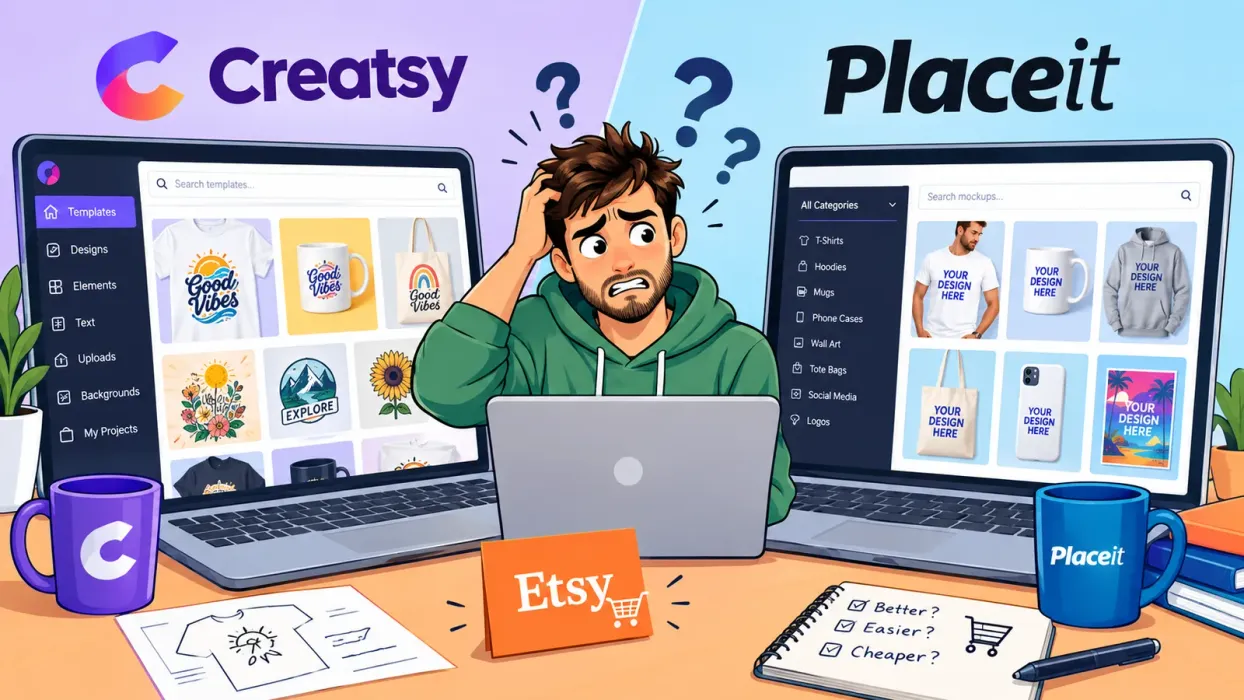
On Shopify, you often need to pay for a separate subscription like Placeit to get good mockups. Listybox includes the Listystyle mockup creator, which generates hyper-realistic lifestyle photos using AI. This increases your click-through rate significantly.
Can’t I Just Use Shopify Later?
Absolutely. In fact, that is the best strategy. Start on Etsy. Use the free traffic to validate your designs and build a customer base. Use the profit from Etsy to fund your expansion into Shopify later.
By starting on Etsy with Listybox, you are building a business on “Safe Mode.” You validate your product-market fit without risking your savings. Once you have a winning design that has sold 100 times on Etsy, then you can confidently spend money to advertise that specific design on a Shopify store.
Need Help Getting Started?
Does all of this feel overwhelming? You don’t have to start from scratch. With Listybox Store Setup, our team helps you set up your Etsy store. It is available inside a custom Enterprise+ offer, so plan a demo or write to [email protected].
Stop bleeding cash on ads for an empty Shopify store. Join the platform where the buyers are, and let automation handle the heavy lifting.
Frequently asked questions
Put this into practice in your shop.
Every step from design to live listing, on one platform. Start on the free plan.
Related posts

Want to go deeper? Read our in-depth Etsy guides · Browse 100 Etsy niche guides