

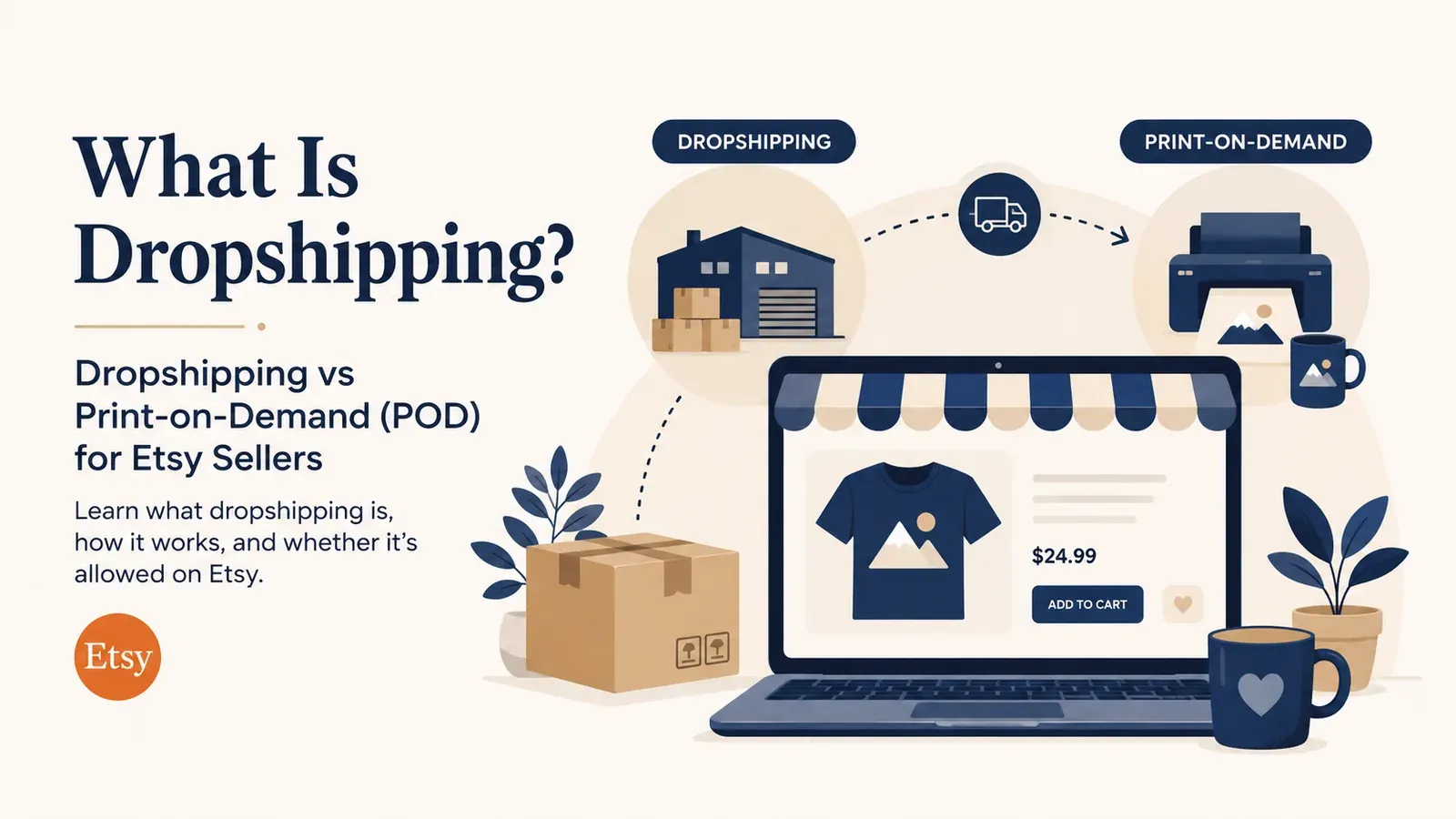
What Is Dropshipping? Dropshipping vs Print-on-Demand (POD) for Etsy Sellers

Key takeaways
Dropshipping is a fulfillment method, not a brand: You sell someone else’s inventory and hope the supplier performs.
Etsy + dropshipping can be a risky mix: Without transparent production partners and consistent quality, shops can get hit with poor reviews or policy issues.
POD is the “Etsy-native” alternative: You sell your own designs on made-to-order products, with far more control and differentiation.
Profitability is mostly about speed and conversion: Better SEO, better visuals, and consistent publishing can beat “cheap” products every time.
Listybox turns POD into a scalable system: Create, optimize, publish, and fulfill with intelligent automation customized for Etsy - so you spend time on strategy, not busywork.
Dropshipping gets pitched as “sell online without inventory.” And that’s technically true.
But if you’re an Etsy seller (or thinking about becoming one), the real question isn’t “Can I avoid stock?” It’s “Can I build a business I control, that customers trust, and that I can scale without burning out?”
This guide explains what dropshipping is, why it often becomes stressful on Etsy, and how Print-on-Demand (POD) gives you a cleaner path to a real brand - especially when you run it through Listybox’s intelligent automation system customized for Etsy.
What is dropshipping and how does it work?
Dropshipping is a retail fulfillment method where you list a product for sale, but you don’t keep the inventory. When a customer buys, you forward the order details to a supplier, and the supplier ships the product to the customer.
The basic dropshipping flow (in plain English)
You find a supplier (often via a marketplace or a private wholesaler).
You list the supplier’s product in your shop with your own pricing.
A customer buys from you.
You buy the product from the supplier using the customer’s shipping address.
The supplier ships it.
You handle customer service, refunds, and complaints.
Where dropshipping quietly gets painful
The “no inventory” promise is real, but it trades inventory problems for control problems.
A typical first-time seller spends hours each week just coordinating supplier messages, tracking updates, and customer replies once they start getting consistent sales.
Common friction points:
You don’t control shipping speed: If a supplier is slow, customers blame you.
You don’t control packaging or inserts: Branding is usually generic.
You don’t control quality consistency: Product photos rarely match what arrives.
You’re the “shock absorber”: Every mistake becomes your support ticket.
If your goal is a long-term Etsy shop (with repeat buyers and strong reviews), these are not small issues. They directly impact conversion rates, review velocity, and your shop’s search performance.
Try your first design.
Try your design on a product and prepare its Etsy listing in Listybox.
Is dropshipping allowed on Etsy in 2026?
Etsy is not Amazon. The platform is built around items that are handmade, designed by the seller, vintage, or craft supplies.
That’s why “dropshipping” on Etsy is not a simple yes/no. It depends on what you’re selling and whether you’re transparent about how it’s made.
The common compliance trap
Many sellers try to list mass-produced products from generic suppliers as “handmade” because that’s where the traffic is.
That’s where things break:
Customers receive a clearly mass-produced item and feel misled.
Reviews mention “AliExpress,” “Temu,” or “Amazon packaging.”
Etsy flags the listing or the shop.
We’ve seen shops lose weeks of momentum from a single review streak that signals “this isn’t handmade.”
Why POD fits Etsy’s model better (when done correctly)
Print-on-demand is often an Etsy-aligned workflow because you (the seller) are the designer, and a production partner manufactures your design on a blank product.
The difference is transparency and ownership:
You are selling your original design and brand.
The production partner is disclosed.
The product is made-to-order.
Once you commit to POD, the next bottleneck becomes execution: creating listings, writing SEO, uploading mockups, publishing consistently, and handling fulfillment without mistakes.
That’s exactly where Listybox becomes the unfair advantage - because it’s built specifically for Etsy sellers.
If you want to see the full ecosystem, you can explore all features.
What is the difference between dropshipping and print on demand (POD)?
Both models avoid holding inventory, but they create completely different businesses.
Brand control
Dropshipping: You’re mostly reselling. The product is usually identical to dozens of other listings.
POD: You’re building a design-based brand. Even if others sell the same blank, your design and positioning are yours.
A practical shift: POD lets you charge for identity, not just “cheap.”
Quality and customer experience
Dropshipping: Product photos and real-life quality can mismatch, and packaging is rarely brand-friendly.
POD: You can standardize product types and suppliers, and you can build consistent visuals with tools like the Listystyle mockup creator.
Policy and account risk
Dropshipping: Higher risk if you’re selling mass-produced goods without proper disclosure.
POD: Lower risk when you disclose production partners and sell your own original designs.
Operational complexity (the part people ignore)
Dropshipping: You manage supplier reliability, product variations, and shipping exceptions.
POD: You manage designs, listings, and publishing cadence - then fulfillment should be predictable.
This is where Etsy sellers either scale fast or stall.
If you build POD manually, listing creation becomes your new “inventory.” You can have 50 great designs, but if it takes you 45 minutes per listing to write SEO, upload images, and publish, you’ll move too slowly to win.
With Listybox, the workflow flips. You can generate product-ready listings at scale using:
Creation Wizard to turn multiple designs into multiple products in minutes
Magic Wand SEO tool to create Etsy-ready titles, tags, and descriptions
start Listybox now - no credit card required.
Which is more profitable for Etsy sellers: dropshipping or POD?
Profitability isn’t just “sale price minus product cost.” On Etsy, your profit is shaped by review quality, conversion rate, refunds, and how fast you can iterate.
Here’s a realistic scenario.
Meet Jordan, a new seller who wants to build a side income while working a full-time job.
His goal is simple: launch 30 products, get to 2–3 sales per day, and scale without needing a warehouse.
He starts with dropshipping because it looks faster. After listing 20 generic products, he realizes every listing is a copywriting project: rewriting descriptions, answering “When will it arrive?” messages, and chasing suppliers for tracking updates. Two weeks in, he’s spending 90 minutes per day on support with only a few low-margin sales.
Then the hidden trap hits: one supplier ships late, a buyer opens a case, and Jordan refunds to protect his shop rating. Now he’s not only losing the profit - he’s paying for the mistake with time, stress, and a visible review trail.
He pivots to POD using Listybox. He pulls designs from Artwork Gallery, applies them to best-selling product types from see our product catalog, and uses the Magic Wand to ship SEO in one click. With Zero-Touch Order Management, each order lands in My Orders; once he pays for production and shipping there, it goes to production and the tracking number is written back to his Etsy order.
Now the transformation: Jordan stops buying “random products to test.” He starts building a repeatable system.
The profitability levers POD wins on (especially on Etsy)
Higher pricing power: Better branding and unique visuals let you charge more.
Lower refund chaos: Fewer “product not as described” disputes.
Faster iteration: You can launch more tests per month and keep winners.
If you want to tighten your Etsy visibility engine next, read our Etsy SEO guide.
How do you start a POD store on Etsy step by step?
Starting POD is not hard. Starting POD without drowning in tasks is the hard part.
Here’s a clean, Etsy-first path that minimizes the manual grind.
Step 1: Pick a niche you can actually stay consistent in
Choose something where you can create 20–50 variations without feeling stuck.
If you’re unsure what’s trending, this is exactly what the Trend Compass trend finder is built for. It monitors trend signals and helps you move while demand is rising - not after the niche is saturated.
Step 2: Build a design library you can scale
You can use your own designs, or start with high-quality ready-to-use artwork.
Use My Artworks upload to organize and reuse your designs at scale.
Use Artwork Gallery to avoid the “blank canvas” problem and launch faster.
Step 3: Turn designs into listings fast (without sacrificing control)
Manually applying one design to multiple products is where most beginners stall.
With Creation Wizard, you can combine multiple designs and products in one workflow and generate ready-to-publish creations in minutes.
When you need consistent placement across variants, use the Placement Editor to fine-tune once and apply the same look across many products.
Step 4: Get found with Etsy SEO (titles, tags, descriptions)
Most sellers either:
Overthink SEO for hours in external tools, or
Publish quickly with weak keywords and stay invisible
The Magic Wand SEO tool uses Listybox’s fine-tuned engine built specifically for Etsy to generate keyword-rich titles, 13 tags, and conversion-focused descriptions based on your exact product and design.
Sellers get a large part of their week back once they stop writing every listing from scratch.
If you want a deeper breakdown of automated optimization, read the AI SEO automation guide.
Frequently asked questions
Put this into practice in your shop.
Every step from design to live listing, on one platform. Start on the free plan.
Related posts

Want to go deeper? Read our in-depth Etsy guides · Browse 100 Etsy niche guides